


New production expected online in December 2017 from the Suncor Fort Hills project in the oil sands region of northern Alberta could increase pipeline congestion from western Canada to the U.S. Gulf Coast market where the oil is in demand. That’s because existing capacity across the Canadian border is running close to full and the only possible capacity addition across before 2019 is Enbridge’s 300-Mb/d Alberta Clipper expansion at the border — assuming it gets a long-sought U.S. Presidential Permit later this year. As a result of this continuing near-term pipeline squeeze, producers are again turning to rail transport to bypass pipeline congestion and ensure their crude gets to market. On June 2 (2017), USD Group announced a new route option for Canadian producers following its purchase of a rail terminal in Stroud, OK, that is connected by pipeline to the Midwest crude trading and storage hub at Cushing, OK; USD will offer direct rail service from its Hardisty, AB, terminal to Cushing. Today we review the economics of this rail transport route for oil sands producers. (This blog is based on a recent note published by Morningstar Commodities and Energy Research.)
Interim Solution
As we have documented extensively in the RBN blogosphere, since the beginning of the Shale Era, rail has provided an interim solution for producers looking to ship crude oil over long distances to market where no pipelines existed or where existing pipes were already full (see The Year of The Tank Car). New pipelines take time to plan, justify, permit and build (at least three years, sometimes much longer) so rail offers a flexible alternative that can be up and running in a matter of months. The downside of moving crude by rail is that it is more expensive than pipelines on a per-barrel basis. The upside is that building a crude loading terminal connected to a Class One railroad allows midstream companies to offer producers access to destinations throughout the U.S. (or Canada, for that matter). Unloading terminals are located either at specific refineries or, more often, at terminals with pipeline or barge connections offering access to many refineries. According to data from the Energy Information Administration (EIA), U.S. domestic crude-by-rail (CBR) volumes grew from just over 100 Mb/d in January 2011 to a peak of 944 Mb/d in October 2014 (see I’ve Been Working on the Railroad). Sadly for rail terminal operators, as new pipeline capacity has been built out, U.S. rail use declined to 285 Mb/d as of March 2017 (see Slow Train Coming).
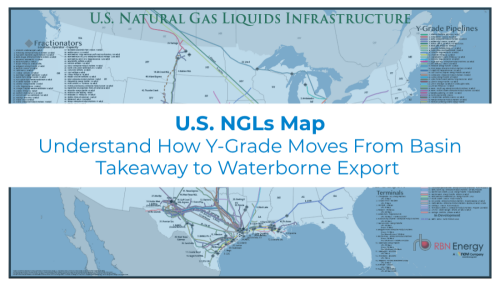
Visualize the infrastructure behind U.S. NGL movement.
The U.S. NGLs Map provides a comprehensive view of the transport, processing, and export networks moving NGLs across the U.S.
Stroud Terminal

About the song
Rolling Stones Classic “Get Off Of My Cloud” was recorded in September 1965 and topped the charts in the UK and the U.S. during November of that year.







Comments
It is hard to argue crude by rail is growing due to pipeline restrictions and that differentials show that they are less than the cost of pipeline to Cushing (you call them Cushing premiums). Yet this is what you are saying in this piece. If rail is growing it can't be because of pipeline capacity restrictions, the fact the differentials are so low indicates that committed shippers must be selling take or pay capacity at a discount meaning there must be pipeline capacity available and then why would any company ship by rail? What other reasons could it be? Perhaps the growth is in undiluted bitumen which is more competitive by rail with pipeline diluted bitumen or volume that does not have access to pipelines or is not moving to the gulf coast. Perhaps take or pay commitments on rail facilities and cars are driving some of the volume? But I'd suggest your piece needs to include these questions since the logic you present doesn't seem to hold together with the data you present.
Also you seem to mis-represent the Line 67 issue, the line is operating at its exanded capacity throughout its 1000 mile length except for a short section across the border where it jumps into an already upgraded section of Line 3 and then back after the border into 67. Since the full line 3 replacement has not been completed this section of line 3 has spare so line 67 is still operating full. The issue comes to a head when Line 3 is fully replaced and then the capacity across the border is needed on 3, then the border restricion on 67 will have an effect.