Permian natural gas production increased by about 10% in the winter of 2017-18, from about 7.1 Bcf/d to 7.8 Bcf/d, but all spring it’s remained relatively flat, never averaging more than an even 8 Bcf/d. There’s good reason for that. While at first glance it might seem as if there’s enough pipeline takeaway capacity out of the Permian to accommodate considerably more production growth, the big pipes from the Waha Hub to Mexico are transporting far less than they’re capable of because of delays in developing new pipes and gas-fired power plants on the Mexican side of the border. And pipes from the Permian to California are running less than full, in part because of that state’s hard tilt to renewable power. That’s left the Permian with a takeaway conundrum that may not be fully solvable — at least for a time — until new, greenfield pipeline capacity from West Texas to the Gulf Coast comes online in 15 to 18 months. Today, we discuss the options that producers, gas processors and midstream companies may need to consider if things get really tight.

The NATGAS Appalachia weekly report provides the data and insights to monitor the northeast natural gas market’s twists and turns and identify the risks and opportunities along the way, including tracking supply-demand trends, outbound capacity and their impact on takeaway pipeline utilization, and regional prices.
Permian takeaway constraints have been a frequent theme of RBN blogs over the past year. We’ve covered the crude oil side of the issue in No Time and All Dressed Up With No Place to Go (among others); delved into natural gas takeaway concerns in Blame It on Texas, Omaha, Help on the Way, and Witchy Waha (to name just a few); and talked about the middle-term need for more NGL pipes out of the Permian in Cowboys and NGLs. Figure 1 is the simplest way to explain what’s happening with gas. The blue area shows Permian gas production net of local demand (for power generation etc.) — in other words, the volume of gas that needs to be transported out of the Permian in takeaway pipelines. The area to the left of June 2018 (dashed yellow line) shows historical gas takeaway needs up to today (currently about 7.4 Bcf/d, up about 2.3 Bcf/d since January 2017) and the area to the right is forecasted gas takeaway needs through 2020 under RBN’s Mid-Curve Scenario, which is based upon crude and gas price trends similar to the current forward curves. However, the forecast trajectory assumes unfettered access to takeaway capacity. In this scenario, we estimate that gas takeaway needs would approach 9.4 Bcf/d by the end of 2019 and 10.4 Bcf/d by the end of 2020, an increase of 3 Bcf/d from today. The catch is that the amount of gas that can reach destination markets outside the Permian is limited by the play’s effective takeaway capacity (orange line).
About the song
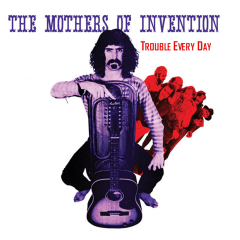
“Trouble Every Day” was a single off of The Mothers of Invention’s 1966 debut album, Freak Out. The song was written by band member Frank Zappa while he was living in Echo Park, a suburb of Los Angeles, and watching coverage of the 1965 L.A. riots on television. Long before there was a music genre known as rap, Zappa recorded this song, a talking rap against oppression, set to a blues background provided by The Mothers of Invention.
Considered ahead of his time, Zappa's music always provoked, both lyrically and musically. When MGM/Verve producer Tom Wilson signed The Mothers of Invention to his label, it was "Trouble Every Day" that grabbed his attention, leading him to believe he had signed a white blues band. Freak Out –– the first double rock album ever released (a few days before Bob Dylan’s Blonde on Blonde dropped) –– was recorded at the Sunset-Highland studios of T.T.G. in Hollywood in March 1966. The personnel on the “Trouble Every Day” track were: Frank Zappa (lead guitar and vocals), Ray Collins (lead vocals and tambourine), Roy Estrada (bass and vocals), Jimmy Carl Black (drums and vocals) and Elliot Ingber (guitar). The Freak Out double LP reached #130 on the Billboard Top 200 album charts. It received a Grammy Hall of Fame Award in 1999, and in 2003 Rolling Stone Magazine listed it in its "500 Greatest Albums of All Time."
Frank Zappa was an American musician, composer, activist and filmmaker. He passed away in 1993.