Unlike most natural gas producing jurisdictions in North America facing a pullback in drilling and capital spending, producers in Western Canada appear to be doing the opposite and lining up for a year of rising production, higher average prices and additional pipeline capacity from producing basins. In short, 2020 should be a year in which supplies in the region mount a comeback after the dismal down year for supplies — and prices — that characterized 2019. A good part of that supply and pipeline capacity growth optimism has to do with a major pipeline expansion out of the Montney Basin in northeastern British Columbia that just recently entered service. Dubbed the North Montney Mainline and operated by Canada’s largest gas pipeline company, TC Energy, this vital piece of new pipeline egress from one of the most prolific unconventional gas basins in North America is setting up Western Canadian gas supplies for recovery in 2020 and beyond. Today, we continue our series with a look at what this may portend for gas supplies this year.
It has been much discussed in the RBN blog space that 2019 was a very bad year for Western Canadian natural gas producers. Regional pipeline constraints, record low gas prices in some months, declining access to capital, lower spending and ever-stiff competition from U.S. gas supplies led to the unavoidable outcome of a supply pullback — the first time that happened in half a dozen years. Our recent Don’t Stop blog series provided numerous reasons for Canadian gas producers to be more optimistic about 2020, and Part 1 of this series described a critically important infrastructure project: the North Montney Mainline (NMM), which TC Energy brought into service at the end of January. The area of the Montney gas play served by the NMM has only been tapped to a limited degree in the past few years by smaller competing pipelines, but now has a major boost in egress capacity, with up to 2 Bcf/d on the NMM once the new pipe is fully operational later this year. We further described in Part 1 some of the supply impacts from the recent start-up of the NMM and how this has begun to set the stage for higher supplies in 2020.

The RBN Crude Oil Analytic Suite gives you access to four weekly reports covering crude oil markets, including: Crude Billboard, Crude Permian, Crude TradeView, and Crude Voyager.
In this second and concluding part of our discussion on the NMM, we take a closer look at some additional pipe flow and capacity data that sheds some light on the potential for additional supply going forward for the remainder of this year. As in Part 1, the Figure 1 map shows the newly completed Aitken Creek section of the NMM (blue line), the almost-finished Kahta section (dashed black-and-white line) and the NMM’s relation to an important pipeline delivery corridor on the NGTL system referred to as Upstream James River (USJR; black rectangle in inset map).
About the song
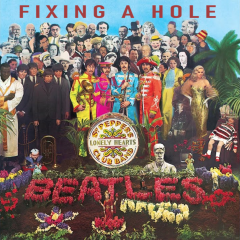
"Fixing a Hole" was written by Paul McCartney and credited to Lennon-McCartney. The song appeared as the fifth cut on side one of The Beatles’ eighth studio album, Sgt. Pepper's Lonely Hearts Club Band. It was recorded at Regent Sound and EMI Studios in London in February 1967, with George Martin producing. McCartney has said that the song is about "the hole in your make-up that stops your mind from going where it will." Personnel on the record were: Paul McCartney (lead vocals, bass, harpsichord), John Lennon (backing vocals, bass), George Harrison (backing vocals, guitar, lead guitar, maracas), Ringo Starr (drums) and George Martin (harpsichord).
Sgt. Pepper's Lonely Hearts Club Band was recorded between December 1966 and April 1967 at EMI Studios and Regent Sound in London. Released in May 1967, the album went to #1 on the Billboard Top 200 Albums chart, where it stayed for 15 weeks. It has been certified 11x Platinum by the Recording Industry Association of America. Many consider Sgt. Pepper's Lonely Hearts Club Band to be the most important rock and roll album ever recorded.
The Beatles were an English rock band formed in Liverpool, England, in 1960. With the lineup of John Lennon, Paul McCartney, George Harrison and Ringo Starr, the band released 23 studio albums, five live albums, 53 compilation albums, 21 EPs and 63 singles. With record sales of over 600 million units worldwide, The Beatles are the best-selling music act of all time. They have received one Academy Award, one Billboard Music Award, four Brit Awards, nine Grammy Awards, one Grammy Lifetime Achievement Award, 15 Grammy Hall of Fame Awards, 14 Ivor Novello Awards, one MTV Video Music Award and three World Music Awards. They are members of the Rock and Roll Hall of Fame, the UK Music Hall of Fame and the Vocal Group Hall of Fame.
The Beatles officially broke up in 1970, with all four members going on to pursue successful solo careers. John Lennon died in December 1980 and George Harrison in November 2001. Paul McCartney and Ringo Starr still record and tour as solo artists. Ringo Starr and his All Starr Band start a new tour in May 2020, and Paul McCartney will embark on a new European tour, also in May 2020.