


Tallgrass Energy’s Rockies Express Pipeline earlier this month (on January 6, 2017) brought into service the last 350 MMcf/d of its 800-MMcf/d Zone 3 Capacity Enhancement Project, boosting the line’s east-to-west takeaway capacity out of Ohio to 2.6 Bcf/d, up 45% from 1.8 Bcf/d previously. The new, fully-subscribed capacity, designed to serve Marcellus/Utica producers, filled up almost instantaneously. But unlike previous capacity additions, Northeast production did not increase. Instead the gas came from other pipelines. This development provides an early indication of what the new capacity will mean for producers, flows and prices. In today’s blog, we delve into pipeline flow data to understand the early impacts of the new takeaway capacity.
Since it first began bi-directional flow in its Zone 3 segment in 2014, REX has been an integral piece of the broader revolution to reverse traditional north and eastbound flow patterns to instead move gas out of the supply-rich, capacity-constrained Marcellus/Utica production region, one that we’ve been following closely in the RBN blogosphere (see Get Back to Where You Once Belonged and End of Displacement). Just about all the long-haul pipes that traditionally have flowed gas into the Northeast have at least partially reversed flows in recent years to allow Marcellus/Utica producers to target growing demand markets along the Gulf Coast and in Mexico. REX’s Zone 3 expansion has been the most significant of those, in terms of sheer volume, but also because its 15-plus interconnects with major long-haul pipelines (in Zone 3 alone) essentially make it a massive header system with access to just about every other U.S. market.
The NATGAS Appalachia weekly report provides the data and insights to monitor the northeast natural gas market’s twists and turns and identify the risks and opportunities along the way, including tracking supply-demand trends, outbound capacity and their impact on takeaway pipeline utilization, and regional prices.
The completion of this latest expansion—the Zone 3 Capacity Enhancement Project (Z3CE)—marks the last of a series of planned REX expansions. Prior to Z3CE, the last big capacity increase on REX came in August 2015 with the Zone 3 East-to-West (E2W) expansion, which tripled westbound throughput on REX to a design capacity of 1.8 Bcf/d from Clarington, OH (red box in Figure 1). Westbound flows into Zone 3 at the time already were up to right around 1.0 Bcf/d before E2W began service, and they didn’t grow much from there initially even as the new capacity came online. That’s because flows depend on more than just the mainline throughput capacity; there’s also receipt capacity (i.e. the ability to receive supply through third-party receipt points), the availability of supply to get on the pipe, and of course access and availability of demand markets downstream, among other factors.
About the song
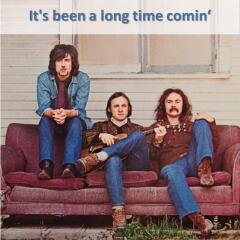
“Long Time Gone” by Crosby, Stills & Nash is known for the chorus refrain of “It's been a long time comin,' it's goin' to be a long time gone.” The song was written by David Crosby. It appears as the fourth song on side two of Crosby, Stills & Nash's debut album of the same name. Personnel on the record were: David Crosby (lead vocals, rhythm guitar), Stephen Stills (lead guitar, bass, keyboards, percussion, backing vocals), Graham Nash (backing vocals), and Dallas Taylor (drums).
The Crosby, Stills & Nash LP was recorded in February and March 1969 at Wally Heider's Studio III in Hollywood, CA. Produced by Crosby, Stills, and Nash, the album was released in May 1969 and went to #6 on the Billboard 200 Albums chart. It has been certified 3x Platinum by the Recording Industry Association of America. Two singles were released from the LP. An interesting side note is the story of the cover photo, shot by Henry Diltz. The group was placed seated on a dilapidated couch on the porch of an old house, before the band had decided on the name, Crosby, Stills, and Nash. The problem was they were seated on the couch in the left-to-right order of Nash, Stills, and Crosby. The group went back to re-shoot the photo, but the house had been demolished, so they used the original photo for the cover.
Crosby, Stills & Nash was a folk-rock supergroup formed in Los Angeles in 1968 by David Crosby (The Byrds), Stephen Stills (Buffalo Springfield), and Graham Nash (The Hollies). When joined by Neil Young (Buffalo Springfield) as a fourth member, they were called Crosby, Stills, Nash & Young. The group played its second public gig at the Woodstock Festival in New York in August 1969. Crosby, Stills, Nash & Young released eight studio albums, five live albums, six compilation albums, and 19 singles and was inducted into the Rock and Roll Hall of Fame in 1997. The group has been inactive since last playing together in 2015. All four members have gone on to successful solo careers, and still record and perform live.





Comments
Those words (more or less) intitally came from Sam cooke's 1964 song "A Change Is Gonna Come." See: https://www.google.com/?gws_rd=ssl#q=sam+cooke+song+long+time+coming+by++lyrics
A Change Is Gonna ComeSam CookeI was born by the river in a little tentOh and just like the river I've been running ev'r since
It's been a long time, a long time coming
But I know a change gonna come, oh yes it will