Earlier this month, Tallgrass Energy’s Rockies Express Pipeline (REX) achieved full in-service of its 800-MMcf/d Zone 3 Capacity Enhancement Project, boosting the line’s east-to-west takeaway capacity out of Ohio to 2.6 Bcf/d, up 45% from 1.8 Bcf/d previously. Flows since then provide early indications of how Marcellus/Utica producers and downstream markets are responding to this added ability to move gas west. In today’s blog, we continue our look at how the expansion has impacted flows, this time with a focus on the delivery side.
In Part 1 of It’s Been a Long Time Comin’, we looked at the early impacts of the 800-MMcf/d Zone 3 Capacity Enhancement expansion project (Z3CE) on REX flows and on Northeast natural gas production as a whole. REX has been in the business of building out new pipeline capacity for a while now, a decade ago to move gas from Rockies east to Ohio and the Northeast, and in more recent years (since 2014) to move Marcellus/Utica gas west to markets in the Midwest and Gulf Coast. With this latest expansion, REX increased westbound capacity from Clarington, OH, by 800 MMcf/d, starting with 200 MMcf/d on December 13, 2016, followed by another 250 MMcf/d three days later and the final 350 MMcf/d increment on January 6, 2017. In total, REX has added 2.6 Bcf/d of westbound takeaway capacity, including the latest expansion. But, as we noted in Part 1, this latest in-service was a little different.
The NATGAS Appalachia weekly report provides the data and insights to monitor the northeast natural gas market’s twists and turns and identify the risks and opportunities along the way, including tracking supply-demand trends, outbound capacity and their impact on takeaway pipeline utilization, and regional prices.
This time, gas flows climbed instantly to fill the new Z3CE capacity with each phase of the start-up. This is in contrast to the last big expansion—the 1.2-Bcf/d East-to-West expansion (E2W) in August 2015 (see Waiting for a REX Like You)—when flows increased gradually over several months. What changed between then and now is that significant third-party interconnect capacity (i.e., receipt point capacity) was added to bring gas supply onto REX, so by the time Z3CE began service there was more than enough receipt capacity to fill the pipe.
But, as we noted in Part 1, there is another big difference between the latest versus past expansions—even as REX flows increased. All indications are that overall Marcellus/Utica production has grown little. In the past, each westbound expansion of REX was like a lifeline for capacity-strapped producers looking to get their trapped gas out of the oversupplied Northeast. As such, producers met the incremental takeaway capacity with new production, if not immediately then within a few months’ time as third-party infrastructure became available and made it possible to do so.
About the song
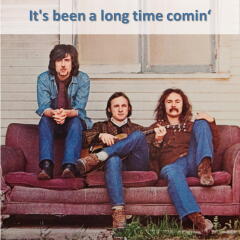
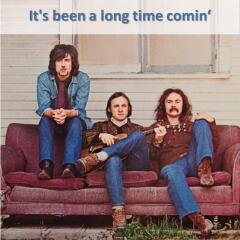
“Long Time Gone” by Crosby, Stills & Nash is known for the chorus refrain of “It's been a long time comin,' it's goin' to be a long time gone.” The song was written by David Crosby. It appears as the fourth song on side two of Crosby, Stills & Nash's debut album of the same name. Personnel on the record were: David Crosby (lead vocals, rhythm guitar), Stephen Stills (lead guitar, bass, keyboards, percussion, backing vocals), Graham Nash (backing vocals), and Dallas Taylor (drums).
The Crosby, Stills & Nash LP was recorded in February and March 1969 at Wally Heider's Studio III in Hollywood, CA. Produced by Crosby, Stills, and Nash, the album was released in May 1969 and went to #6 on the Billboard 200 Albums chart. It has been certified 3x Platinum by the Recording Industry Association of America. Two singles were released from the LP. An interesting side note is the story of the cover photo, shot by Henry Diltz. The group was placed seated on a dilapidated couch on the porch of an old house, before the band had decided on the name, Crosby, Stills, and Nash. The problem was they were seated on the couch in the left-to-right order of Nash, Stills, and Crosby. The group went back to re-shoot the photo, but the house had been demolished, so they used the original photo for the cover.
Crosby, Stills & Nash was a folk-rock supergroup formed in Los Angeles in 1968 by David Crosby (The Byrds), Stephen Stills (Buffalo Springfield), and Graham Nash (The Hollies). When joined by Neil Young (Buffalo Springfield) as a fourth member, they were called Crosby, Stills, Nash & Young. The group played its second public gig at the Woodstock Festival in New York in August 1969. Crosby, Stills, Nash & Young released eight studio albums, five live albums, six compilation albums, and 19 singles and was inducted into the Rock and Roll Hall of Fame in 1997. The group has been inactive since last playing together in 2015. All four members have gone on to successful solo careers, and still record and perform live.