The leaves have already fallen off New England’s trees, the first snow has come and gone, and the six-state region is preparing for another long, cold winter — this time with no Tom Brady and little hope that their beloved Patriots will make it to the playoffs. There is at least some good news, though: record volumes of propane have been railed or shipped into New England and put in storage, which should help to ensure that the many homes and businesses that depend on the fuel for space heating will stay warm. Today, we discuss propane supply and demand in the northeastern corner of the U.S., including a look at SEA-3 Newington — New England’s largest propane storage and distribution center, which rails in the fuel from the Marcellus/Utica and Canada and imports and exports propane by ship.
New England may be a leading producer of lobsters, cranberries, and maple syrup, but it doesn’t produce a barrel of crude oil, a gallon of NGLs, or a cubic foot of natural gas — unless you count the methane generated by the region’s grass-fed, organic-as-they-can-be dairy cows. Heck, it doesn’t even have a refinery. So, to fuel its cars and trucks, power its gas- or oil-fired power plants, and heat its indoor spaces, New England needs to bring in every molecule of dinosaur-based hydrocarbons from somewhere else. The region’s natural gas needs are met primarily by pipeline and, to a much lesser degree, by imported LNG — a topic we’ve covered in a number of blogs, most recently in I’m Movin’ On. Refined products like gasoline, diesel, and heating oil? They come in through a combination of tanker, rail, and truck, plus a couple of intra-regional pipelines that transport refined products inland from the ports of New Haven, CT, and Portland, ME. (See Move It On Over for more on that.)

Then there’s propane, which along with heating oil is a leading fuel for residential and commercial space heating, especially in rural areas far beyond the reach of urban/suburban natural gas distribution utilities. Our research and estimates suggest that New England consumes about 700 million gallons (MMgal) of propane a year, with the vast majority of that volume consumed during the colder months (October through March — and April in the northern parts of the region). New Hampshirites are the leading consumers of propane in New England (about 180 MMgal/year), followed by Maine (~160 MMgal/year) and (in a near-tie) Connecticut, Massachusetts, and Vermont (~110 MMgal/year each). Rhode Island brings up the rear, with annual demand of about 30 MMgal.
About the song
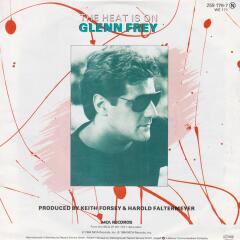
“The Heat Is On” was written by Keith Forsey and Harold Faltermeyer for the 1984 film Beverly Hills Cop. Glenn Frey played lead guitar and sang the vocals on the recording, which became a #2 hit on Billboard's Hot 100 in March 1985. Writer Keith Forsey is an English drummer, songwriter and producer who produced Billy Idol’s first solo album, which sold half a million copies. Harold Faltermeyer, Forsey’s writing partner on “The Heat Is On,” is a German session musician, songwriter and producer.
Frey was born and raised in Detroit, where he met his mentor Bob Seger, who encouraged him to seriously pursue songwriting. Frey sings backup harmonies on Seger’s early regional hit “Ramblin’ Gamblin’ Man.” Frey moved to L.A. in 1969 and joined with J.D. Souther to form the duo Longbranch Pennywhistle. They released one album. In 1970, while hanging out at the bar at The Troubadour in West Hollywood, Frey met drummer Don Henley. When they got word that Linda Ronstadt was looking for a band for an upcoming tour, Henley and Frey got the job, along with Randy Meisner and Bernie Leadon. The original lineup of The Eagles was formed as they toured behind Ronstadt.
Frey wrote — or co-wrote with Henley — many of The Eagles’ hits. After The Eagles broke up for the first time in 1980, Frey had eight hit singles as a solo artist. Consolidating his solo recordings with those of The Eagles, he had 24 Top 40 singles. The Eagles have won six Grammys and five American Music Awards, and were inducted into the Rock & Roll Hall of Fame in 1998. The Eagles reunited in 1994.
In addition to his musical achievements, Frey was active as an actor in television and movies. He received an honorary Doctorate of Music from Berklee College of Music in 2012. He passed away in 2016.