


New England’s aggressive effort to decarbonize is a tangled web. Over the past several years, the six-state region has replaced oil- and coal-fired power plants with natural gas-fired ones but most proposals to build new gas pipeline capacity have been rejected. It’s also made ambitious plans to add renewables — especially solar and offshore wind — to its power generation mix but many of the largest, most impactful projects have been delayed or canceled. And now there’s a big push to electrify space heating and transportation, which will significantly increase power demand, especially during the winter months, when New England’s electric grid is already skating on thin ice. In today’s RBN blog, we examine the region’s looming power supply challenges and how its energy transition plans may affect natural gas, LNG, heating oil and propane markets.

To truly understand Cushing — what it does and how it works — you need to know the hub’s assets and how they fit together. RBN’s Cushing Crude Oil Playbook provides the first one-stop, comprehensive guide to the hub’s assets.
As we said in The Tipping Point, the northeastern corner of the Lower 48 relied for a half-century on a traditional mix of oil, coal and gas plants — plus several nuclear units and some imported hydroelectric power from Quebec — to keep the lights on. More recently, though, enviro-conscious New Englanders have been cleaning house, shutting down many of their oil and coal facilities (and some nukes) and replacing them with new gas-fired combined-cycle plants and peaking units. They’ve also been making big plans to add renewables and have had some success in adding solar capacity and, to a lesser extent, onshore wind projects.
As shown in the two pie charts in Figure 1, the ramp-up in the region’s reliance on gas for power generation (yellow pie slices) has been dramatic — from only 12% of the electricity generated in 2000 to a hefty 46% last year. Over the same period, the share of New England’s power produced by oil plants (orange slices) and coal plants (gray slices) has plummeted to only 1% and 0.3%, respectively, from 18% and 14% at the turn of the century (coal’s share is too small to show in right graph), according to ISO New England (ISO-NE), which oversees the regional power grid. Notably, not much else has changed — nuclear’s piece of the pie (medium-blue slices) is down by 2 percentage points (to 23%), in-region hydroelectric power (light-blue slices) is up 1 percentage point (to 6%) and imports and renewables (dark-blue and green slices, respectively) are both flat at 14% and 11%.
About the song
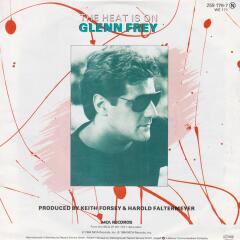
“The Heat Is On” was written by Keith Forsey and Harold Faltermeyer for the 1984 film Beverly Hills Cop. Glenn Frey played lead guitar and sang the vocals on the recording, which became a #2 hit on Billboard's Hot 100 in March 1985. Writer Keith Forsey is an English drummer, songwriter and producer who produced Billy Idol’s first solo album, which sold half a million copies. Harold Faltermeyer, Forsey’s writing partner on “The Heat Is On,” is a German session musician, songwriter and producer.
Frey was born and raised in Detroit, where he met his mentor Bob Seger, who encouraged him to seriously pursue songwriting. Frey sings backup harmonies on Seger’s early regional hit “Ramblin’ Gamblin’ Man.” Frey moved to L.A. in 1969 and joined with J.D. Souther to form the duo Longbranch Pennywhistle. They released one album. In 1970, while hanging out at the bar at The Troubadour in West Hollywood, Frey met drummer Don Henley. When they got word that Linda Ronstadt was looking for a band for an upcoming tour, Henley and Frey got the job, along with Randy Meisner and Bernie Leadon. The original lineup of The Eagles was formed as they toured behind Ronstadt.
Frey wrote — or co-wrote with Henley — many of The Eagles’ hits. After The Eagles broke up for the first time in 1980, Frey had eight hit singles as a solo artist. Consolidating his solo recordings with those of The Eagles, he had 24 Top 40 singles. The Eagles have won six Grammys and five American Music Awards, and were inducted into the Rock & Roll Hall of Fame in 1998. The Eagles reunited in 1994.
In addition to his musical achievements, Frey was active as an actor in television and movies. He received an honorary Doctorate of Music from Berklee College of Music in 2012. He passed away in 2016.




Comments
Really enjoyed reading this. Some good information here. Thank you