The Fiscal Responsibility Act (FRA) revived Mountain Valley Pipeline’s (MVP) prospects of being completed this year, but the outlook for new, large-scale natural gas takeaway projects in the Northeast beyond MVP hasn’t changed. What has changed, however, is how Appalachian natural gas-focused producers respond to pipeline constraints and lower prices. Gone are the days of drilling with abandon, crushing supply prices and assuming the necessary pipeline capacity will eventually get built. Instead, producers have demonstrated a willingness to slow drilling activity, delay completions and choke back producing wells in the short-term to manage their inventory during periods of lower gas prices. In today’s RBN blog, we lay out our view of what that shift in producer behavior will mean for Northeast supply, demand and pricing trends in the long-term.
Before we get into the details of today’s blog, we need to let you know it is based on our latest Backstage Pass Fundamentals Webcast. The webcast discusses our latest analysis of Appalachia fundamentals.
In the last decade, Appalachian natural gas production rocketed up to more than 35 Bcf/d, often straining infrastructure and pummeling local price basis. The situation became particularly dire by the middle of the last decade as Northeast supply surpassed intra-regional demand (see One Step Closer). At that point, producers became constrained by their ability to access markets outside the Northeast region. As regional supply growth outpaced takeaway capacity additions, production growth “slowed” to an average of 2.5 Bcf/d each year in the 2015-17 timeframe, compared with close to 4 Bcf/d in gains in 2013, and again in 2014.
A spate of pipeline capacity expansions from 2017-19 helped alleviate the constraints. For the first time in years, there was a little space in egress out of the basin, and Appalachian prices strengthened relative to Henry Hub. But by late 2019, the region was once again marching toward midstream constraints and weaker prices — this time with a dwindling number of pipeline projects on the horizon. The pandemic and the resulting lockdowns abruptly interrupted that march, however. As domestic and export demand evaporated and uncertainty loomed, gas prices tanked, rig counts fell and producers did something they hadn’t done on a large scale before in the Shale Era — they demonstrably choked back producing wells (see dashed black ovals in Figure 1). Despite those major interruptions, Northeast production still grew by nearly 1 Bcf/d in 2020 (red line) and nearly 2 Bcf/d in 2021 (light-blue line) to a record of 35.5 Bcf/d by December 2021, bringing with it record outflows.
About the song
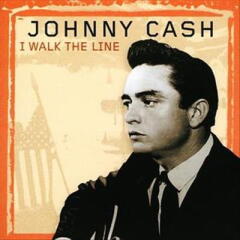
“I Walk the Line” was written by Johnny Cash and appears as the third song on side two of his debut album on Sun Records, Johnny Cash with His Hot and Blue Guitar. Released as a single in May 1956, it went to #1 on the Billboard Hot Country Songs and #17 on the Billboard Hot 100 Singles charts. It remained on the charts for 43 weeks and sold more than 2 million copies, achieving 2x Platinum certification from the Recording Industry Association of America. It was the title song for a 1970 film starring Gregory Peck and the 2005 Johnny Cash biopic starring Joaquin Phoenix. Personnel on the record were: Johnny Cash (lead vocal, acoustic rhythm guitar), Luther Perkins (electric boogie woogie lead guitar), and Marshall Grant (acoustic bass).
Johnny Cash with His Hot and Blue Guitar was recorded between September 1954 and August 1957 at Sun Studios at 706 Union Ave. in Memphis (the building and studio still exist as a museum and tribute to its unique place in the history in American music). Produced by Sam Phillips, it was released as one of the first LPs from Sun Records in October 1957. Four previously released Top 20 singles were included in the album.
Johnny Cash was an American country music singer and songwriter. He was known for his bass/baritone voice, train-rhythm guitars, and his trademark all-black wardrobe, which earned him the nickname “The Man in Black.” He released 67 studio albums, 16 live albums, 105 compilation albums, four soundtrack albums, and 170 singles. He had 14 #1 singles in his career and has sold over 90 million records. He is a member of the Rock and Roll Hall of Fame, Country Music Hall of Fame, Songwriters Hall of Fame, and the Rockabilly Hall of Fame. He received Kennedy Center Honors in 1996 and the National Medal of arts in 2006. Cash appeared in eight films and on several television shows, including his own The Johnny Cash Show, which was filmed in Nashville and ran from 1969-71. He was married to June Carter of the famous country music/gospel group The Carter Family. June Carter-Cash died in May 2003, and Johnny Cash passed away four months later in September 2003 at the age of 71.