Appalachian natural gas producers and marketers are adapting to a new status quo — a world where new pipeline takeaway capacity out of the Northeast is hard to come by and is more or less capped ad infinitum. Without the assurance of pipeline expansions, regional gas producers are no longer drilling with abandon in hopes that the capacity will eventually get built. Instead, producers are practicing restraint by slowing drilling activity, delaying completions and choking back producing wells to manage their inventory during periods of lower demand and prices. In today’s RBN blog, we consider what this new playbook will mean for pricing trends in the supply basin.

The NATGAS Appalachia weekly report provides the data and insights to monitor the northeast natural gas market’s twists and turns and identify the risks and opportunities along the way, including tracking supply-demand trends, outbound capacity and their impact on takeaway pipeline utilization, and regional prices.
Pipeline constraints are nothing new for Appalachian gas producers. Over the past decade, Appalachian natural gas production (blue line in Figure 1) rocketed up to more than 35 Bcf/d, often straining infrastructure and pummeling local price basis — at least until the next tranche of pipeline capacity came online. In recent years, however, Appalachian gas producers have settled into maintenance mode, keeping production relatively flat, even in 2022, despite Russia’s invasion of Ukraine, the resulting energy security crisis, and low storage inventories sending supply basin gas prices rocketing to $9/MMBtu, the highest in over a decade. Among the pressures keeping production flat, producers have battled a number of headwinds since the pandemic, from inflation to shortages of materials and labor, along with hedges entered in late 2020 and 2021 that didn’t allow them to immediately benefit from the lofty gas prices seen last year. However, far and away the biggest constraint for Appalachian producers has been the increasingly grim prospects for new pipeline takeaway capacity.

Figure 1. Northeast Natural Gas Production Receipts vs. Deliveries. Source: Wood Mackenzie flow data
About the song
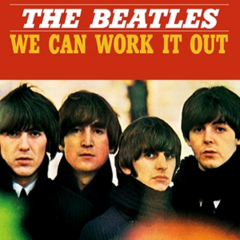
“We Can Work It Out” was written by Paul McCartney and John Lennon. It appeared as a double A-side single backed with “Day Tripper” that was released in December 1965. It went to #1 on the Billboard Hot 100 Singles chart and has been certified Gold by the Recording Industry Association of America. The song was recorded in two takes at EMI studios in London during the sessions for the Rubber Soul album. It was earmarked to be the non-album double A-side single to be released at the same time as the LP. A promotional film of the song with The Beatles was shot at Twickenham Film Studios in London with Joe McGrath directing. Personnel on the record were: Paul McCartney (lead vocal, acoustic guitar), John Lennon (Mamborg harmonium, bass, backing vocals), George Harrison (acoustic guitar, backing vocals), and Ringo Star (drums, percussion).
Rubber Soul was the album The Beatles were working on during the recording of “We Can Work It Out” and “Day Tripper.” Recorded between October-November 1965 at EMI studios in London with George Martin producing, it was The Beatles’ sixth studio album. Released in December 1965, it went to #1 on the Billboard 200 Albums chart and has been certified 6x Platinum by the RIAA.
The Beatles were an English rock band formed in Liverpool in 1960. Consisting of John Lennon, Paul McCartney, George Harrison, and Ringo Starr, they are regarded as the most influential band of all time. They released 17 studio albums, five live albums, 51 compilation albums, 36 EPs, and 63 singles. They have sold over 600 million records worldwide, making them the best-selling music act of all time. They are members of the Order of the British Empire (MBE), the Rock and Roll Hall of Fame, UK Music Hall of Fame, Vocal Group Hall of Fame, and have won one Academy Award, seven Grammy Awards, a Grammy Lifetime Achievement Award, 15 Ivor Novello Awards, one MTV Video Music Award, and three World Music Awards. Paul McCartney was knighted by Queen Elizabeth II in 1997. After the group’s breakup in 1970, all four band members went on to successful solo careers. John Lennon was murdered in December 1980. George Harrison died in November 2001. McCartney and Starr continue to record and tour as solo artists. There is rumor of a new Beatles track being released: a 1978 John Lennon composition called “Now and Then” being recreated by Paul McCartney using artificial intelligence to include all four of The Beatles on it. It is unknown if George Harrison’s “Sue Me, Sue You Blues” will be the flip side.