U.S. Northeast natural gas producers in recent months got a substantial boost in pipeline capacity to receive and move incremental gas production volumes to attractive Gulf Coast markets. TC Energy’s Columbia Gas and Columbia Gulf transmission systems in March completed the Mountaineer Xpress and Gulf Xpress pipeline expansions, respectively, increasing the combined system’s Marcellus/Utica receipt capacity by 2.7 Bcf/d in the producing region, while also bumping up the Marcellus/Utica’s takeaway capacity to the Gulf Coast by nearly 900 MMcf/d. The duo of expansions is among the biggest takeaway capacity additions to be completed out of the Northeast, volume-wise, and among the handful that inextricably connect Marcellus/Utica supply markets to well-sought-after LNG exports markets along the Texas and Louisiana coasts. One of the export terminals these projects are designed to serve is Sempra’s Cameron LNG, where Train 1 began commercial operations in recent weeks. Today, we provide an update on the upstream and downstream implications of the recently installed Northeast-to-Gulf Coast pipeline capacity.
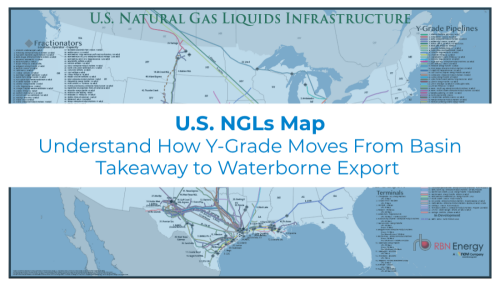
Visualize the infrastructure behind U.S. NGL movement.
The U.S. NGLs Map provides a comprehensive view of the transport, processing, and export networks moving NGLs across the U.S.
Gas pipeline takeaway expansions out of Ohio in recent years have ushered in a new era of interconnectedness between the Northeast and Gulf Coast markets, with implications for prices and flows on both ends of the transportation routes that connect them (see Here I Am, Baby and Look How Far We’ve Come). One of the pipeline systems instrumental to that transformation is TC Energy’s Columbia Pipeline Group, including Columbia Gas Transmission (TCO; gray-green web-like network in Figure 1) and Columbia Gulf Transmission (CGT), which includes the Mainline (orange line) and Onshore system (pink network). TCO/CGT began retooling their transportation capacity in the early years of this decade to allow for southbound flows out of the Northeast. That effort in the last two years has more directly focused on connecting producers/shippers to growing demand along the Gulf Coast from LNG exports. As we detailed in Waiting On the World to Change, TCO and its long-haul sister CGT in late 2017/early 2018 completed a pair of projects: the Leach Xpress (LXP; maroon section of TCO) and Rayne Xpress (RXP; indicated by the purple arrows along the CGT Mainline). LXP allowed TCO to deliver an incremental 1.5 Bcf/d of Marcellus/Utica gas supply to an interconnect with CGT at Leach, KY (maroon dot) by January 2018. For its part, RXP, which was completed just prior to that in November 2017, enabled as much as 1 Bcf/d of that supply to flow further south between Leach and Rayne, LA (orange dot), from where CGT could then shuttle the gas southeast to serve growing power generation demand or into Louisiana for delivery — either directly or indirectly via feeder pipelines — to then-under construction LNG export terminals.
This new capacity was primarily subscribed by Marcellus/Utica producers, with more than 1 Bcf/d of firm transportation contracts in place to move gas south to multiple locations, including CGT’s mainline pool (blue oval), the Rayne compressor station, or CS (again, the orange dot), Perryville Hub near Delhi, LA (red oval) and Henry Hub (purple oval). From these locations, liquefaction capacity holders have contracted to pull supply to the export terminals, including Cheniere Energy’s Sabine Pass LNG (via the Kinder Morgan’s Louisiana Pipeline) and Cameron LNG. [Note that both terminals also receive gas from other pipes. See the LNG Voyager Quarterly for a full list of firm capacity contracts associated with already-operating or soon-to-be-operational liquefaction capacity.]
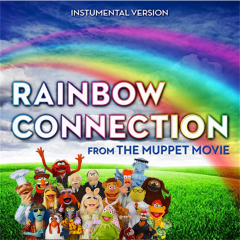
About the song
"Rainbow Connection" was written by Paul Williams and Kenny Ascher and is the first song featured in The Muppet Movie and on the soundtrack for the film. Muppets creator Jim Henson commissioned Williams and Ascher to write the soundtrack for the first feature-length film of the Muppets. Williams, who helped produce the album with Henson, said that "When You Wish Upon a Star," as sung by Jiminy Cricket in Pinocchio, was the blueprint for writing "Rainbow Connection." Williams said he and Ascher wanted the song to reflect that there is "power in your thoughts, and with faith you can do anything."
Jim Henson is the voice of Kermit, the green felt frog that is featured in "Rainbow Connection." Williams said Henson was struggling with the vocals in the studio until he suggested he cut the vocal while puppeteering Kermit, resulting in studio magic and the take you hear on the soundtrack. The song went to #25 on the Billboard Hot 100 chart. "Rainbow Connection" has been covered by many artists since its release in 1979, including Willie Nelson, Judy Collins, Less Than Jake, Jason Mraz, Gwen Stefani, and Me First and the Gimme Gimmes. Personnel on the recording were: Jim Henson (vocals), Art Munson (banjo), Mark Stevens and Alan Estes (percussion) and Kenny Ascher (string arrangements).
The Muppet Movie is a 1979 musical comedy featuring the Muppets, the popular felt puppets created by Jim Henson. The soundtrack was recorded at A&M Studios in Hollywood in 1978, and released in June 1979, the same time as the feature film. The soundtrack album went to #32 on the Billboard Top 200 Albums chart and has been certified Gold by the Recording Industry Association of America. The album won a Grammy Award for Best Children's Album in 1980.
Jim Henson was an American puppeteer, animator, cartoonist, author, filmmaker, and screenwriter who was involved in the creation of the Muppets and Fragile Rock. He made eight feature films and numerous television shows before his death in 1990. Paul Williams is an American composer, singer, songwriter, and actor who remains active to this day. Kenny Ascher is an American jazz pianist, composer, and arranger who is also still doing what he does.