


The Shale Revolution created an unprecedented need for midstream infrastructure of every sort — gathering systems, processing plants, storage hubs, takeaway pipelines, fractionators, export terminals, and more — all with the aim of connecting new hydrocarbon supply to demand. Throughout the 2010s, the scope and urgency of this midstream build-out opened up tremendous opportunities for the master limited partnerships, private-equity-backed developers, and other entities with the management skills, financial wherewithal, and dexterity to make these massive projects happen. Now, much of the Shale Era’s required new infrastructure is in place — and COVID and ESG have slowed new-project development to a crawl — putting many MLPs in a bind and leaving private equity firms to wonder where they should invest their money next. Well, there may be an even better set of new opportunities on the horizon — all related to the coming energy transition — and, as it turns out, midstream developers with hydrocarbon experience are uniquely positioned to lead the way. In today’s RBN blog, we discuss how the project-development model that drove the midstream sector’s growth over the past decade is poised for potentially lucrative re-use in the 2020s and beyond.

The midstream sector in the U.S. oil and gas industry has been evolving continuously since the 1820s and ‘30s, when natural gas was first piped to light streetlamps in Fredonia, NY, and Philadelphia, and the 1850s, when oil produced in western Pennsylvania was shipped to market in wooden barrels on wagons and flatboats. By the 1860s, crude was moving by railcar and pipeline, and by the early 1890s the first long-distance gas pipeline was hauling gas 120 miles from central Indiana to Chicago. Soon thereafter, scientists and other folks started figuring out what to do with NGLs — American Gasol Co., the first commercial marketer of propane, was established in 1912 (though it took another 42 years for the first portable gas barbecue grill with a 20-pound propane cylinder to go on sale!).
The very definition of midstream also has been evolving as the industry becomes more complex and interconnected. Today, the midstream sector involves everything that happens between the wellhead and the point of consumption (see Figure 1): gathering, treating, processing, transportation (trucks, railroads, pipelines), storage, fractionation (for NGLs), liquefaction (to make LNG), exporting, and marketing. Just as important to our discussion today, the types of corporate entities that actually “do midstream” has been changing too, especially over the past three or four decades. And, as we hinted at in our introduction, many of the midstreamers that now dominate the sector have the infrastructure-development experience, financial resources, and entrepreneurial spirit to play major, if not leading, roles in developing the wide variety of projects — renewable fuels, hydrogen, ammonia, carbon capture and sequestration, etc. — that will drive the coming transition to a lower-carbon world.
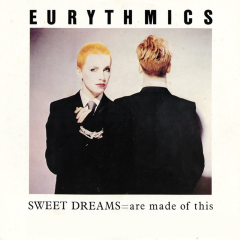
About the song
“Sweet Dreams (Are Made of This)” was written by Annie Lennox and Dave Stewart and appears as the sixth song on The Eurythmics' second studio album of the same name. Released as a single in January 1983, the song went to #1 on the Billboard Hot 100 Singles chart and became The Eurythmics’ breakthrough hit . It has been certified Gold by the Recording Industry Association of America (RIAA). The song has been covered by a few artists, including JX Riders featuring Skylar Stecker, which went to #1 on the Billboard Dance Club Songs chart, as well as Swing featuring Dr. Alban, and Marilyn Manson, whose version went to #26 on the Billboard Alternative Airplay chart. Personnel on The Eurythmics’s record were: Annie Lennox (vocals, synthesizer), and Dave Stewart (synthesizers, drum machine, programming).
The album, Sweet Dreams (Are Made of This), was recorded during 1982 at The Eurythmics’ 8-track home studio and at the Church Studio in North London. Produced by Dave Stewart, the album was released in January 1983, and went to #15 on the Billboard 200 Albums chart. It has been certified Gold by the RIAA. Four singles were released from the LP.
The Eurythmics were a British new wave pop duo formed in Wagga Wagga, Australia, in 1980 by Annie Lennox and Dave Stewart. Both were previously in the band The Tourists, which broke up in 1980. They released their debut album, In the Garden, in October 1981 to very little success. With the #1 hit single, "Sweet Dreams (Are Made of This)" from their second album, the duo went on to produce a string of hit singles and LPs before breaking up in 1990. They released eight albums, one live album, one soundtrack album, two compilation albums, one EP, and 33 singles. The Eurythmics have won four ASCAP Awards, one Brit Award, one Grammy Award, four Ivor Novello Awards, and one MTV Video Music Award and have sold over 75 million records worldwide. The due briefly reunited in 1999, and released the studio album, Peace, Both Lennox and Stewart have gone on to solo careers. Lennox has released six studio albums, one compilation album, and 23 singles. Stewart has released nine studio albums, and nine singles. He is also actively involved in film, television, and soundtrack work.






Comments
Hi,
I work in equity research covering midstream firms for Morningstar. Are we allowed to use the figure 1 exhibit in a presentation that would be distributed to clients, provided we cite RBN Energy appropriately?
Thank you.