On Friday, TransCanada finally secured a Presidential Permit for the U.S. portion of its Keystone XL pipeline, and the company committed to pursuing the state approvals it still needs to build the project. But three hard truths—crude oil prices below $50/bbl, the high cost of producing bitumen and moving it to market, and more attractive energy investments available elsewhere—have thrown a wet blanket on once-ambitious plans to significantly expand production in Western Canada’s oil sands, the primary source of the product that would flow through Keystone XL. Today we begin a series on stagnating production growth in the world’s premier crude bitumen area, the odds for and against a rebound any time soon, and the need (or lack thereof) for more pipelines.
The three oil sands areas in northern Alberta—the giant Athabasca deposits and the smaller Peace River and Cold Lake areas—together cover only ~55,000 square miles (about one-fifth the size of Texas, or of Alberta) but they contain proven reserves equivalent to more than 160 billion barrels of crude oil, according to the International Energy Agency and other sources. As the Shale Era has reminded everyone though, simply having vast hydrocarbon reserves in the ground isn’t enough. Production costs and the cost of delivering product to market need to be competitive if an area is to continue drawing investment—at least over the long-term in the case of areas with higher upfront development costs like the oil sands and the Gulf of Mexico.
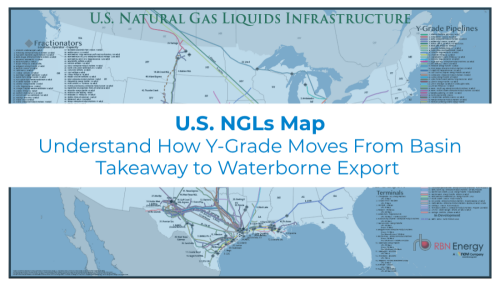
Visualize the infrastructure behind U.S. NGL movement.
The U.S. NGLs Map provides a comprehensive view of the transport, processing, and export networks moving NGLs across the U.S.
As we said in our Over the Hills and Far Away blog series on Western Canadian production, oil sands producers have been especially hard-hit by the collapse in oil prices, for four main reasons: 1) their hydrocarbon-extraction process is more complicated and costly than their shale-play counterparts; 2) the oil sands are farther away from most major refinery centers than most U.S. shale plays; 3) oil sands producers need to either add diluent to their bitumen to allow it to flow through pipelines, or transport high-viscosity bitumen in special, high-cost “coil” rail cars that can be heated before unloading; and 4) existing pipelines out of the oil sands to the U.S. Midwest and Gulf Coast, as well as the existing Trans Mountain Pipeline to British Columbia, had been bumping up against capacity limits, resulting in significant margin-erasing price discounts for Western Canadian Select (WCS, one of the better-known diluted bitumens, or “dilbits” —see Heat It for more on dilbit) versus Louisiana Light Sweet (LLS), at least until incremental pipeline capacity started coming online in early 2015. Figure 1 shows LLS prices (blue line, left axis), WCS prices (brown line, left axis) and the spread between then (yellow line, right axis) since 2013.
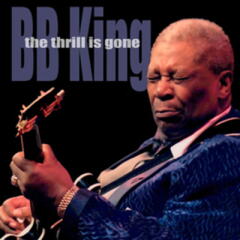
About the song
“The Thrill Is Gone,” a blues classic, was a 1951 hit for Roy Hawkins (who co-wrote the song with Rick Darnell) and an even bigger hit for B.B. King in 1970. King’s recording earned him a Grammy for Best Male R&B Vocal Performance, and in 1998 his version of the song won a place in the Grammy Hall of Fame.