The price discount for Canadian heavy crude benchmark Western Canadian Select (WCS) sold in Hardisty, Alberta versus Gulf Coast equivalent heavy grade Maya has narrowed from $35/Bbl last November to less than $12/Bbl today. The discounts to Maya this year have been less than the cost of rail transportation between Western Canada and the Gulf Coast – reflecting improving crude takeaway capacity. Next month the 600 Mb/d Flanagan South pipeline from Chicago to Cushing and the 450 Mb/d Seaway Twin from Cushing to Houston will open more new capacity for Canadian crude to compete against Maya at the Gulf Coast. The result is likely to be even lower differentials. Today we discuss the likely impact.
WCS is a mix of 19 Canadian heavy conventional and bitumen crudes blended with sweet synthetic crude and condensate diluents. Canadian producer Husky blends WCS in their storage tanks at Hardisty. WCS production at Hardisty is about 250 Mb/d. (see Edmonton and Hardisty Storing Crude Oil in Harmony). WCS is traded and priced at Hardisty but has traditionally also been priced at a differential to WTI at Cushing, OK because that is where much of the Canadian crude is headed from Hardisty – via long haul pipelines to the Midwest. WCS is an important benchmark because the prices of most other heavy Canadian crudes are based on quality differentials to WCS.
Although most heavy Canadian crude heads to the Midwest, refineries in that region are already maxed out on heavy crude processing and surplus supplies are trying to get to the Gulf Coast where there is 1.5 MMb/d of heavy crude processing capacity. As we shall see in a minute, transport constraints have so far restricted the flow of Canadian crude to the Gulf Coast. But once transport capacity opens up to allow more crudes like WCS to reach the Gulf Coast, they will compete in that market against similar heavy crude grades currently imported from Mexico, Venezuela and Columbia. The Gulf Coast import grade that is most often compared to WCS is Mexican Maya – that has similar API gravity and sulfur specifications. Mexican crude is marketed by State owned national oil company PEMEX. The Maya price is set using price formulas that vary depending on the destination market (see Sailing Stormy Waters). The formula for Maya sold to Gulf Coast refiners is based on four reference prices as follows:

Where: WTS = West Texas Sour, #6 Fuel Oil 3% = US Gulf Coast high sulfur fuel oil, LLS = Light Louisiana Sweet, Brent DTD = the Brent North Sea Dated Cargo price, and K = the PEMEX formula adjustment – a “fudge factor” monthly constant that allows PEMEX to adjust their prices to match competitors. Note that all of the reference prices in the formula except WTS are Gulf Coast or international prices – reflecting the fact that Maya is an imported crude.
About the song
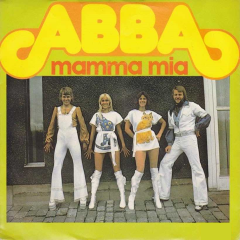
“Mamma Mia” was written by Benny Andersson, Bjorn Ulvaeus, and Stig Anderson and appears as the first song on side one of ABBA's third studio album, ABBA. Released as a single in September 1975, it went to #32 on the Billboard Hot 100 Singles chart. The song was used as the title for the hit Broadway jukebox musical written by British playwright Catherine Johnson. A romantic comedy film version of the play was released in 2008, followed by a sequel, Mama Mia! Here We Go Again, released in 2018. Personnel on the record were: Anni-Frid Lyngstad (lead, backing vocals), Agnetha Faltskog (lead, backing vocals), Bjorn Ulvaeus (rhythm guitar, backing vocals), Benny Andersson (piano, marimba, backing vocals), Janne Schaffer (lead guitar), Mike Watson (bass), and Roger Palm (drums).
The album ABBA was recorded between August 1974 and March 1975 at the Glen, Metronome, and Ljudkopia studios in Stockholm, Sweden. Produced by ABBA members Andersson and Ulvaeus, the album was released in April 1975. It went to #174 on the Billboard 200 Albums chart. Seven singles were released from the LP.
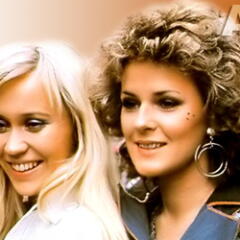
ABBA is a Swedish pop group formed in Stockholm in 1972 by Bjorn Ulvaeus, Benny Andersson, Anni-Frid Lyngstad, and Agnetha Faltskog. The group's name is derived from an acronym of the first letters of their first names, arranged as a palindrome. They got their professional start when they won the Eurovision Song Contest in 1974 with their song, “Waterloo.” ABBA has released nine studio albums, two live albums, seven compilation albums, and 50 singles. Winner of a World Music Award and a member of the Vocal Group Hall of Fame, the group continues to record and released the first studio album in 40 years, Voyage, in November 2021. The group has plans to have a digital concert residency in London beginning in May 2022.