It burns just like propane, smells just like propane, and gets transported just like propane. But instead of being extracted at gas processing plants or refineries, it is produced from renewable feedstocks like used cooking oil or soybean oil, and so it has a low carbon intensity. That means it is eligible for low-carbon fuel credits, like those available in California. Renewable propane has been around for years but has never gotten much traction due to a combination of technical and economic issues. Now that is changing, with a deal announced last week by a major propane retailer and a biorefiner showing the way to a win-win-win for the producer, the marketer, and the environment. In today’s RBN blog, we begin a deep-dive series on where renewable propane comes from, why it has been a challenge to get the market going, and what changes may create significant opportunities across the renewable propane value chain.
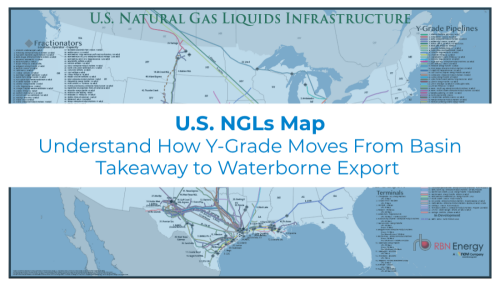
Visualize the infrastructure behind U.S. NGL movement.
The U.S. NGLs Map provides a comprehensive view of the transport, processing, and export networks moving NGLs across the U.S.
Propane, whether it is the traditional hydrocarbon product or the renewable variety, is a byproduct. It is made while producing something else. In the traditional hydrocarbon propane market, about 87% of annual U.S. supply is a byproduct of natural gas production and processing, while 13% is a petroleum refinery byproduct. When processing associated and rich gas, it is necessary to remove the propane (and most of the other NGLs) in order to make the natural gas suitable for delivery into pipelines. Refineries produce propane from crude oil as an integral part of the refining process used to make gasoline, diesel, and other petroleum products. So in both cases, the propane gets produced concurrently with primary products, and thus must be sold and transported to a market.
Similarly, renewable propane is a byproduct of a biorefining process in which the primary product is renewable diesel. Renewable diesel, or RD, has emerged as a super-hot commodity in the past couple of years, as we’ve discussed in a number of blogs, including Playin’ by the Rules. There, we covered some RD basics, including the important facts that renewable diesel is produced from lipids (such as vegetable oil, used cooking oil, animal fats, etc.) and is essentially chemically identical to petroleum-based diesel. That means that it can be used as a direct “drop-in” substitute that is not subject to any blending limits (unlike biodiesel and ethanol). Then, in Green Grow the (Refineries), we zeroed in on HollyFrontier’s plan to shut down its petroleum-based Cheyenne, WY, refinery and convert it into an RD facility. Most recently, in our Come Clean blog series on low-carbon fuel standards, we said that the excitement around RD had continued to grow, and that the amount of operating and planned RD capacity had increased to 7.2 billion gallons per year (gal/yr), or 2.5 times the operating and planned capacity at the start of 2020.
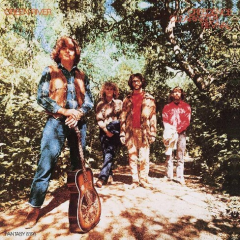
About the song
"Green River" was written by John Fogerty and appears as the first song on side one of Creedence Clearwater Revival's third studio album of the same name. Released in July 1969, the single went to #2 on the Billboard Hot 100 Singles chart. According to John Fogerty, the song's lyrics are about a childhood vacation spot near Winters, CA, called Putah Creek. "Green River" was a soda pop flavor from his childhood days. The Hollies' hit record, "Long Cool Woman in a Black Dress," borrowed heavily from the structure of "Green River," which led to a lawsuit that was settled out of court, with John Fogerty receiving half of the royalties from The Hollies’ song. Personnel on Creedence’s record were: John Fogerty (lead, backing vocals, lead guitar, keyboards), Tom Fogerty (rhythm guitar), Stu Cook (bass), and Doug Clifford (drums).
The album Green River was recorded at Wally Heider Studios in San Francisco between March and June 1969. Produced by John Fogerty, the LP was released in August 1969 and went to #1 on the Billboard 200 Albums chart. It has been certified 3x Platinum by the Recording Industry Association of America. Two singles were released from the LP.
Creedence Clearwater Revival (also known as Creedence and CCR) was an American rock band formed in El Cerrito, CA, by John Fogerty, Tom Fogerty, Stu Cook, and Doug Clifford. These four members had performed together since 1959, when they were named The Blue Velvets — and then The Golliwogs — before changing their name to Creedence Clearwater Revival in 1967. They released seven studio albums, three live albums, 41 compilation albums, and 29 singles before breaking up in 1972. CCR has sold more than 30 million records worldwide and was inducted into the Rock and Roll Hall of Fame in 1993. John Fogerty still records and tours as a solo artist. Tom Fogerty died in September 1990. Stu Cook and Doug Clifford still occasionally perform under the banner of Creedence Clearwater Revisited.