The planned implementation of the International Maritime Organization’s rule slashing allowable sulfur-dioxide emissions from ocean-going ships on January 1, 2020, would create significant demand for 0.5%-sulfur marine fuel — a refined product that few refiners produce today. That could present a big challenge to the global refining sector, which will be called upon to produce marine fuel that complies with “IMO 2020,” as the rule is commonly known. But refiners have stepped up before, and if the IMO 2020 mandate proves to be unachievable and would put global commerce at risk, there could be ways to deal with it — including exemptions or implementation delays. In any case, the move toward much cleaner bunker fuel will be a boon to complex refineries along the U.S. Gulf Coast and elsewhere that can break down bottom-of-the-barrel “residual” fuel oil into feedstocks for gasoline, diesel and other high-value products. Today, we continue our analysis of IMO 2020 and its effects.
As a group, the 50,000-plus tankers, dry bulkers, container ships and other commercial ships that ply international waters are major energy consumers, and for that reason, we’ve blogged about marine fuel often. In Against the Wind, we provided a brief history of efforts by the IMO — a specialized agency of the United Nations — to ratchet down emissions of sulfur dioxide. In January 2012, the IMO’s global cap on sulfur content in bunker fuel was reduced to 3.5% by weight (from the old 4.5%) and in January 2020 — only a year and a half from now — it will be reduced to a much stiffer 0.5%. There are even tougher sulfur standards already in place in the IMO’s Emission Control Areas (ECAs), which include Europe’s Baltic and North Seas and areas within 200 nautical miles of the U.S. and Canadian coasts. In July 2010, the ECA sulfur limit in marine fuel used in those areas was trimmed to 1% (from the old 1.5%), and in January 2015, the limit was reduced again to a very stringent 0.1% — a standard that will remain in force within the ECAs when the 0.5% sulfur cap for the rest of the world becomes effective.
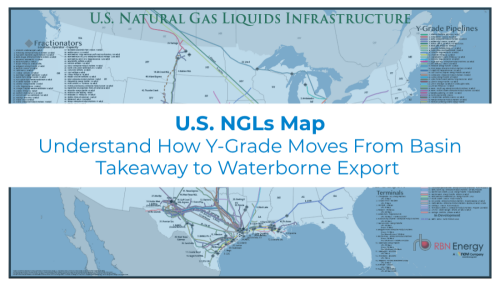
Visualize the infrastructure behind U.S. NGL movement.
The U.S. NGLs Map provides a comprehensive view of the transport, processing, and export networks moving NGLs across the U.S.
As we said in Part 1 of “Bad Moon Rising,” shipowners have been dealing with the 0.1% sulfur cap in ECAs for three and a half years now (primarily by fueling their vessels with 0.1%-sulfur marine gasoil, or MGO, but only when they are within the ECAs), and they’ve known since October 2016 that the 0.5% sulfur cap for bunker in non-ECA parts of the world is scheduled to kick in come January 2020. There are three primary options for shipowners to achieve compliance with the IMO 2020 rule. They could (1) continue burning high-sulfur fuel oil (HSFO; sulfur content up to 3.5%) and install an exhaust gas cleaning system (scrubber) to eliminate most of the sulfur dioxide emissions; (2) switch to marine distillates or low-sulfur fuel oil (LSFO) blends whose sulfur content is 0.5% or less; or (3) use alternative low-sulfur fuels like liquefied natural gas (LNG) or methanol. While maybe 5% of the world’s shipping fleet may be fitted with scrubbers by the time the IMO’s new sulfur cap goes into effect (and a couple of hundred ships may be fueled by LNG), the vast majority of sea-going vessels now consuming HSFO would need to fill up with IMO 2020-compliant marine fuel of some type — MGO, marine diesel oil (MDO) or an LSFO blend (based primarily on middle and heavy distillates with some residual fuel) — before they make their first voyage of 2020. However, there are other ways this may play out. For example, some level of cheating is a distinct possibility, at least in the early part of the implementation period. And it is always possible that certain aspects of the mandate could be relaxed or even delayed if it proves to be unachievable.
About the song
“Bad Moon Rising” was the lead single from Creedence Clearwater Revival’s third album, Green River. Written and produced by John Fogerty, the song was recorded at Wally Heider’s Studio in San Francisco in March 1969. The single reached #2 on the Billboard Hot 100 singles; the Green River LP went to #1 on the Billboard 200 album chart.
John Fogerty has said he wrote “Bad Moon Rising” after watching “The Devil and Daniel Webster,” and was inspired by a scene in the movie involving a hurricane. The last line of the chorus — “There’s a bad moon on the rise” — has often been misheard as "There’s a bathroom on the right," and Fogerty has been known to sing that line sometimes in concert. The song has been used in numerous films and television shows.
Creedence Clearwater Revival, also referred to as CCR, included John Fogerty (lead and backing vocals, lead guitar and piano), Tom Fogerty (rhythm guitar), Stu Cook (bass) and Doug Clifford (drums). The band was formed in the San Francisco Bay area in 1967 and released seven studio albums from 1968 to 1972 — they disbanded in October of that year. John Fogerty went on to have a successful solo career and still tours today. Tom Fogerty (John’s older brother) released several solo albums before passing away in 1990. Stu Cook and Doug Clifford still tour today as Creedence Clearwater Revisited, playing a repertoire of CCR songs. Creedence Clearwater Revival was inducted into the Rock and Roll Hall of Fame in 1993.