By the third quarter of next year, the Enterprise Hydrocarbons Terminal (EHT) on the Houston Ship Channel will have the capacity to export nearly 1.1 MMb/d of LPG — 435 Mb/d more than it can today. Also, Targa Resources and Energy Transfer are each planning 200-Mb/d expansions at their LPG export docks along the Texas Coast, and Phillips 66 and MPLX may very well be announcing projects of their own soon. All this suggests that there will be ample dock space available to propane and butane shippers if, as we expect, LPG volumes continue to ramp up in the 2020s. And, with Enterprise Products Partners’ promise to offer super-competitive rates at EHT, shippers are likely to enjoy low send-out costs. Today, we discuss recent developments on the propane/butane marine-terminal front and what they mean for LPG shippers and exports.
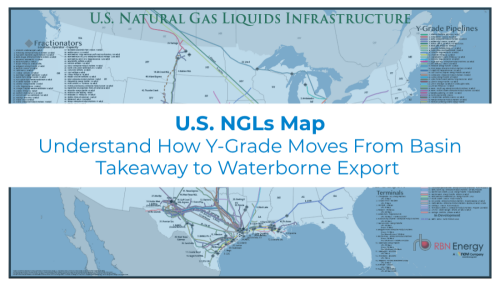
Visualize the infrastructure behind U.S. NGL movement.
The U.S. NGLs Map provides a comprehensive view of the transport, processing, and export networks moving NGLs across the U.S.
Thanks to the Shale Revolution and the burgeoning production of NGLs, the U.S. flipped from being a net LPG importer to a net exporter back in 2012. Since then, waterborne LPG exports have soared, to more than 1.4 MMb/d in both May and June and an average of 1.25 MMb/d in the first six-and-a-half months of 2019, according to RBN weekly NGL Voyager report. As we said in our Between Mont Belvieu and the Deep Blue Sea blog series earlier this year, the vast majority of those export volumes (just under 1.2 MMb/d of the 1.4-MMb/d total in June, for example) are sent out of a foursome of large marine terminals along the Gulf Coast. The biggest of the Big Four is Enterprise’s EHT; the others are Targa Resources’ Galena Park Marine Terminal, also along the Houston Ship Channel; Phillips 66’s Freeport LPG Export Terminal down the coast in Freeport, TX; and Energy Transfer’s export facility over in Nederland, TX (see the Figure 1 map). [Buckeye Partners and EnLink Midstream have much smaller terminals in Corpus Christi, TX, and Geismar, LA, respectively; Trafigura is the Buckeye terminal’s exclusive customer, and EnLink’s terminal is called Riverside.] We noted in that series that the Big Four then had a combined capacity of just under 1.2 MMb/d — Enterprise with 545 Mb/d, Targa with about 230 Mb/d, and Phillips 66 and Energy Transfer with 200 Mb/d each — which would indicate that these facilities have been running at or near their full capacity.
About the song
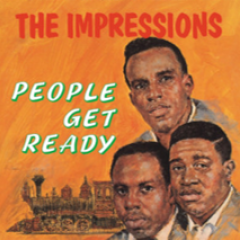
"People Get Ready" was written by Curtis Mayfield and appears as the seventh song on The Impression's fourth studio album of the same name. Released as the second single from the LP in February 1965, the song went to #3 on the Billboard R&B chart and #14 on the Billboard Hot 100 Singles chart. Mayfield wrote the song in 1964, after the March on Washington; the church bombing in Birmingham, AL; and the assassination of President Kennedy. Reverend Martin Luther King Jr. named it the unofficial anthem of the Civil Rights Movement. Many artists have covered the song over the years, including Aretha Franklin, Al Green, the Staple Singers, Bob Dylan, and Bob Marley, who combined the song with his "One Love." Rod Stewart and Jeff Beck released a version in 1985, which went to #5 on the Billboard Mainstream Rock Songs chart and #48 on the Billboard Hot 100 Singles charts. The song was inducted into the Grammy Hall of Fame in 1998. Personnel on the original record were: Curtis Mayfield (lead vocals, guitar), Fred Cash, Sam Gooden (backing vocals), and various Chicago studio musicians assembled by producer Johnny Pate (instrumentation).
The album, People Get Ready, was recorded in 1964 at Universal Recording in Chicago, with Johnny Pate producing. All the songs on the album were written by Curtis Mayfield. Released in February 1965, the album went to #1 on the Billboard R&B Albums chart and #23 on the Billboard 200 Album chart. Three singles were released from the LP.
The Impressions were an American doo-wop, gospel, soul and R&B group formed in Chicago in 1958. R&B singers Jerry Butler and Curtis Mayfield both got their professional starts in the group. Mayfield started singing in a gospel choir in his youth. He met fellow singer Jerry Butler in Chicago when he was 14, and later joined Butler in The Impressions. After Butler's departure from the group in 1962, Mayfield, along with Fred Cash and Sam Gooden — and under the direction of producer Johnny Pate — became the top-selling soul act, known worldwide as The Impressions. Mayfield left the group for a solo career in 1970. The Impressions released 20 studio albums, one soundtrack album,10 compilation albums and 76 singles. They are members of the Rock and Roll Hall of Fame and the Vocal Group Hall of Fame. Twelve members passed through the ranks of The Impressions since their formation. The group's career spanned six decades before officially retiring the name in 2018.
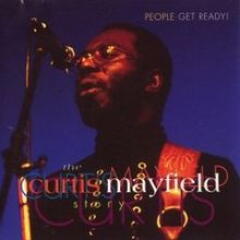
Curtis Mayfield became one of the most influential musicians behind soul music and politically conscious African-American music. The American singer, songwriter, guitarist, and record producer started a successful solo career that yielded sixteen studio albums, six soundtrack albums, four live albums, nine compilation albums, and 34 singles. He has a Grammy Legend Award, Grammy Lifetime Achievement Award, and is a member of the Grammy Hall of Fame. He has been twice-inducted into the Rock and Roll Hall of Fame, once as a member of The Impressions, and as a solo artist. Mayfield was paralyzed from the waist down after lighting equipment fell on him during a performance in New York in August 1990. He continued to record and perform until his death in December 1999.