We are only two months away from the official start of propane heating season in the U.S., and inventories are 3.5 MMbbl lower than last year, or 2.6 MMbbl below the five-year week-on-week low. Volumetrically, it’s a story very much like last summer: Propane exports are running high and while production is up it’s not increasing fast enough to get inventories back to where we would like to see them. But propane prices are not behaving at all like last year. At this point in 2021, the price of propane was moving higher, both in absolute terms and relative to the price of crude oil. This year, prices have been falling for the past four months and are much weaker relative to crude than a year ago. With low inventories and low prices, what are the prospects for the propane market being prepared for the upcoming heating season? And what are the risks if there's a cold-weather surprise? We’ll consider those issues and more in the blog series we begin today, focusing first on how we got here.
Propane Exports, Seasonality and Inventories
The highly seasonal U.S. propane market is traditionally divided into two halves: April through September, when the industry builds inventories, and October through March, when inventories are drawn down to meet winter demand. About this time each year, the industry is laser-focused on the status and pace of inventory increases, and whether it looks like there will be enough supply to meet the expected surge in demand during the impending heating season, particularly if an unusual spell of sustained cold weather hits the market. In recent years this calculus has become increasingly complex as exports have overtaken total domestic demand for propane.
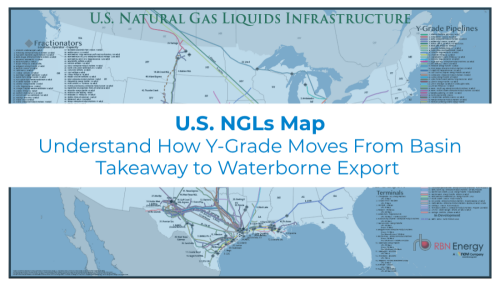
Visualize the infrastructure behind U.S. NGL movement.
The U.S. NGLs Map provides a comprehensive view of the transport, processing, and export networks moving NGLs across the U.S.
As shown in the left graph in Figure 1, total U.S. propane exports (blue bars) have been increasing at a relatively rapid rate, growing about 10% per year in the most recent four-year period. In contrast, the use of propane is down slightly in the U.S. petrochemical sector (yellow bar segments), with ethane the favored feedstock most of the time for steam crackers, and consumer demand (green bar segments — residential, commercial, industrial, agricultural, vehicle, other) has been close to flat for the past five years. The takeaway from this graph is that exports first moved higher than total U.S. demand in 2019 by about 175 Mb/d, and have kept increasing to the point where exports now exceed U.S. demand by a whopping 500 Mb/d.
About the song
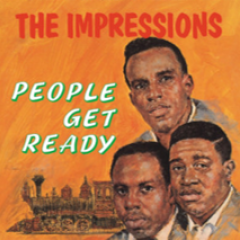
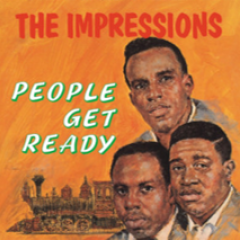
"People Get Ready" was written by Curtis Mayfield and appears as the seventh song on The Impression's fourth studio album of the same name. Released as the second single from the LP in February 1965, the song went to #3 on the Billboard R&B chart and #14 on the Billboard Hot 100 Singles chart. Mayfield wrote the song in 1964, after the March on Washington; the church bombing in Birmingham, AL; and the assassination of President Kennedy. Reverend Martin Luther King Jr. named it the unofficial anthem of the Civil Rights Movement. Many artists have covered the song over the years, including Aretha Franklin, Al Green, the Staple Singers, Bob Dylan, and Bob Marley, who combined the song with his "One Love." Rod Stewart and Jeff Beck released a version in 1985, which went to #5 on the Billboard Mainstream Rock Songs chart and #48 on the Billboard Hot 100 Singles charts. The song was inducted into the Grammy Hall of Fame in 1998. Personnel on the original record were: Curtis Mayfield (lead vocals, guitar), Fred Cash, Sam Gooden (backing vocals), and various Chicago studio musicians assembled by producer Johnny Pate (instrumentation).
The album, People Get Ready, was recorded in 1964 at Universal Recording in Chicago, with Johnny Pate producing. All the songs on the album were written by Curtis Mayfield. Released in February 1965, the album went to #1 on the Billboard R&B Albums chart and #23 on the Billboard 200 Album chart. Three singles were released from the LP.
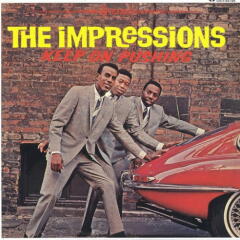
The Impressions were an American doo-wop, gospel, soul and R&B group formed in Chicago in 1958. R&B singers Jerry Butler and Curtis Mayfield both got their professional starts in the group. Mayfield started singing in a gospel choir in his youth. He met fellow singer Jerry Butler in Chicago when he was 14, and later joined Butler in The Impressions. After Butler's departure from the group in 1962, Mayfield, along with Fred Cash and Sam Gooden — and under the direction of producer Johnny Pate — became the top-selling soul act, known worldwide as The Impressions. Mayfield left the group for a solo career in 1970. The Impressions released 20 studio albums, one soundtrack album,10 compilation albums and 76 singles. They are members of the Rock and Roll Hall of Fame and the Vocal Group Hall of Fame. Twelve members passed through the ranks of The Impressions since their formation. The group's career spanned six decades before officially retiring the name in 2018.
Curtis Mayfield became one of the most influential musicians behind soul music and politically conscious African-American music. The American singer, songwriter, guitarist, and record producer started a successful solo career that yielded sixteen studio albums, six soundtrack albums, four live albums, nine compilation albums, and 34 singles. He has a Grammy Legend Award, Grammy Lifetime Achievement Award, and is a member of the Grammy Hall of Fame. He has been twice-inducted into the Rock and Roll Hall of Fame, once as a member of The Impressions, and as a solo artist. Mayfield was paralyzed from the waist down after lighting equipment fell on him during a performance in New York in August 1990. He continued to record and perform until his death in December 1999.