
Plenty of new natural gas shale reserves have been discovered in Western Canada. In British Columbia (BC) there are four basins (Horn River, Montney, Liard and Cordova) with estimated reserves in place exceeding 1,200 Tcf. Drilling in these basins is constrained by low natural gas prices, limited infrastructure and lack of market demand. Before any of these shale plays can be developed fully, producers have to find new markets for their gas that can justify the investment. Today we review West Coast LNG terminals planned to reach new markets in Asia.
Canadian producers need to find new markets because current prices are too low to justify much new development and the market that they have always relied on - exports to the US - is shrinking fast. Prices at the Alberta AECO hub for example are currently trading $0.60/MMbtu below NYMEX Henry Hub. That makes most drilling prospects uneconomic unless there are liquids with the gas. Last week (August 9, 2012) Canada’s second largest producer, Canadian Natural Resources reported shutting in an average of 20 MMcf/d so far this year because of low prices. Canadian National Energy Board (NEB) data shows that natural gas exports to the U.S. were 9.0 Bcf/d in 2005 and fell to 5.7 Bcf/d in 2011 – a 37 percent decline. Canadian market share in the Northeast US is in the process of disappearing by 2016 – pushed out by growing Marcellus production. Canadian gas storage is at record levels and although domestic demand is increasing due to Western Canadian oil sand producer’s energy needs, the likely continued decline in US exports means that Canada must either develop new markets for gas or cut back even more drilling.
The obvious market for Canadian gas is Liquefied Natural Gas (LNG) exports. We previously covered the large number of LNG export projects being contemplated/awaiting approval in the United States (see Export Boom or Import Echo – Do US LNG Export Schemes Make Sense?). You will recall that liquefaction is where natural gas is cooled to -260° Fahrenheit into its liquid state - only 1/600 of its gaseous volume - making it economic to transport between continents in specially-designed double hulled LNG tankers. These projects are very expensive (billions of dollars) and typically take a long time to emerge from the drawing board through the permit and approval process to see the light of day.
Western Canada is well situated geographically to export LNG to the best market - Asia (see map below). The International Energy Agency is projecting that Asian gas demand will surge 50 percent in the next five years, driven by China’s expanding economy. Japan is importing more natural gas after ending their reliance on nuclear energy in the wake of the Fukushima meltdown last year. Asian markets are attractive to Canadian gas producers because LNG contract prices are linked to oil – currently trading at $16/MMbtu versus $2.00/MMbtu in Canada.
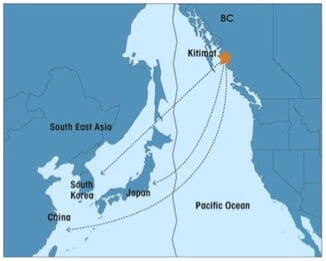
Source: Kitimat LNG website http://www.kitimatlngfacility.com/Markets/marketing.aspx
At least three Canadian LNG export projects are in the advanced stages of planning and permitting. All three plan to build LNG terminals on the West Coast of British Columbia close to Kitimat – a deep-water port.
The first of these projects to be approved is the Kitimat LNG project - a partnership between three of the largest equity owners in the Horn River - Apache Canada, Encana Corporation and EOG Resources. The three partners plan to finance and build a new 287mile, 1.0 Bcf/d “Pacific Trails” pipeline connecting Horn River and Montney production pipelines to a liquefaction facility at Kitimat on the West Coast of BC (see map below). The primary purpose of the partners is to harvest their equity production in Horn River and commit it to the LNG export project. The Pacific Trails Pipeline will connect the Spectra Energy Transmission (West Coast Energy) pipeline at Summit Lake to the proposed Kitimat LNG terminal. The Kitimat liquefaction terminal will have an initial 0.7 Bcf/d capacity expandable to 1.4 Bcf/d and cost $4.5 billion to construct.
The largest BC LNG export project announced so far is LNG Canada, spearheaded by Shell. That LNG terminal is also being planned for Kitimat and will be capable of shipping 2.0 Bcf/d at a cost of $12 billion. Shell ( 40 percent stake ) is partnering with PetroChina, Mitsubishi and KOGAS (Korea) who will each have 20 percent stakes. In June, Shell selected TransCanada to design build and operate the “Coastal GasLink” pipeline. This 430 mile, 1.7 Bcf/d capacity pipeline will connect the Montney gas producing region at Dawson Creek to the Shell Kitimat LNG terminal at a cost of $4.5 Billion.
A third, smaller LNG project has been approved but is not affiliated with gas producers. The BC LNG Export co-op is a smaller barge based liquefaction plant also located at Kitimat, that will process just 0.25 Bcf/d. Plant operators Douglas Channel Energy Partnership plan to utilize excess natural gas pipeline capacity from the Pacific Northern Gas (PNG) Mainline.