Increasing the production of low-carbon-intensity (LCI) hydrogen is viewed by many as a way to help the U.S. reduce its greenhouse gas (GHG) emissions. But so far only minimal amounts of LCI hydrogen are being produced, raising the question of what it would take to significantly ramp up production without breaking the bank. In today’s RBN blog, we conclude a series on a National Petroleum Council (NPC) study on LCI hydrogen with a look at its recommendations for what the U.S. should do next.
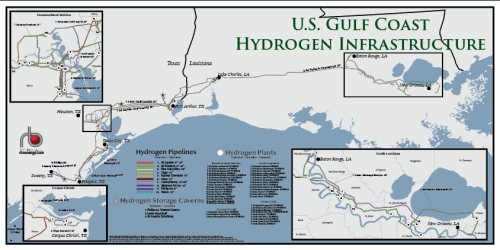
RBN’s U.S. Gulf Coast Hydrogen Infrastructure Map lays out the pipelines and merchant hydrogen plants that make up the gulf coast market, providing an unprecedented snapshot of the region’s hydrogen infrastructure network.
This is the fourth and final installment in a series covering the practical and economic viability of increased utilization of LCI hydrogen to reduce carbon emissions as part of an attempt to meet the net-zero-by-2050 goal enshrined in the 2016 Paris Agreement. In Part 1, we introduced an April 2024 NPC study commissioned by the Department of Energy (DOE) to help define potential pathways leading to LCI hydrogen deployment at scale in the U.S. The blog also highlighted existing domestic hydrogen transmission and storage infrastructure. The existing hydrogen network is small relative to oil and gas systems, but it operates economically, largely to meet the needs of Gulf Coast refiners and chemical companies. Nevertheless, most existing hydrogen production is still “gray,” so-called because it’s derived from natural gas (methane) and carbon dioxide (CO2) is generated by its production. Major investment is required to convert that production to LCI hydrogen; either by capturing and disposing of the CO2 from gray hydrogen production (making it “blue” hydrogen in industry parlance) or by using carbon-free electricity (e.g., from nuclear, wind or solar) to power electrolysis to produce “green” LCI hydrogen from water.
In Part 2, we reviewed modeling undertaken by the Massachusetts Institute of Technology (MIT) for the NPC study to project how much LCI hydrogen would be required — and at what cost— to reduce U.S. carbon emissions under two scenarios. The first, the Stated Policies scenario, projected future carbon emissions from 2025 to 2050 without any new state or federal policies to encourage or subsidize carbon abatement. The second, the Net Zero by 2050 scenario, projected which emissions-reducing technologies would be required to reach the 2050 target in the Paris Agreement and at what cost. The analysis concluded that LCI hydrogen is needed if we are to reduce emissions to net zero in 2050 and would be a cost-effective solution compared to direct air capture (DAC) and other alternatives. A less-palatable conclusion was the large gap between the carbon-reducing trajectories of the two scenarios — we’ll get to that in a moment.
In Part 3, we reviewed the NPC study’s in-depth projection of how expanding LCI hydrogen supply and demand are expected to develop in three phases — activation, expansion, and at-scale — over the next 25 years. Supply will develop along two distinct infrastructure pathways, one industrial (using pipelines and cavern storage) and the other a distributed liquid hydrogen truck delivery network. Production will initially be dominated by blue hydrogen derived from natural gas with carbon capture and sequestration (CCS), followed in later years by green hydrogen produced by using low-carbon electricity to power electrolysis. LCI hydrogen expansion also was expected to vary geographically, with the Gulf Coast accounting for the largest chunk of supply and demand, followed by the West, Great Lakes and Central regions. (To follow the latest LCI project developments, see our weekly Hydrogen Billboard report.)
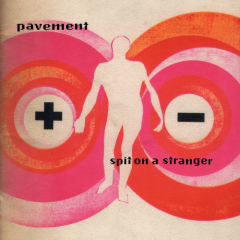
About the song
“Harness Your Hopes” was written by Stephen Malkmus and appears as the second song on Pavement’s ninth EP, Spit on a Stranger, which was released in June 1999. In 2017 the song became Pavement’s most-listened-to song on Spotify. The song also appears on the 2008 expanded edition reissue of Brighten the Corners: Nicene Creedence Edition. Having more than 148 million streams on Spotify, it has been certified Gold by the Recording Industry Association of America. Personnel on the record were: Stephen Malkmus (vocals, guitar), Scott Kannberg (vocals, guitar), Mark Ihold (bass, backing vocals), Bob Nastanovick (keyboards, percussion) and Steve West (drums).
The EP, Spit on a Stranger, was a six-song extended play released on the Matador label in June 1999. The title was the first song on Pavement’s fifth and final studio album, Terror Twilight. The band's final-to-date album was recorded between June and December 1998 at RPM Studios in New York City and RAK Studios in London and produced by Nigel Goodrich. Released in June 1999, it went to #95 on the Billboard 200 Albums chart. Two singles were released from the LP.
Pavement is an American indie rock band formed in Stockton, CA, in 1989. They have released five studio albums, two live albums, seven compilation albums, 10 EPs and 13 singles. The group disbanded in 1999, regrouped again in 2010, and have had several successful tours and concert performances since then. Pavement recently played before a capacity crowd at Sao Paulo’s C6 Festival in May 2024. Seven members have passed through the band since its formation. Original drummer Gary Young died in 2023.