When the Inflation Reduction Act (IRA) was passed into law in August 2022, it earned near-unanimous acclaim from longtime supporters of renewable energy and decarbonization efforts. Industry types also approved of the bill’s focus on incentives to fuel new developments. One of its most ambitious elements was creation of the 45V production tax credit (PTC) for clean hydrogen, a central part of the Biden administration’s efforts to build a clean-energy economy. But while the PTC may have a significant impact on the U.S. energy landscape over the long run, the December 2023 rollout of the proposed rulemaking has generated no small amount of criticism. In today’s RBN blog, we’ll lay out some of the changes that some say should be included in the final rulemaking to help the clean-hydrogen economy make a quick break from the starting gate instead of getting left at the back of the pack.
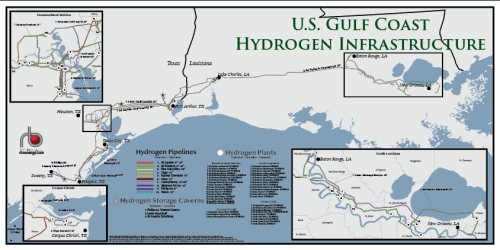
RBN’s U.S. Gulf Coast Hydrogen Infrastructure Map lays out the pipelines and merchant hydrogen plants that make up the gulf coast market, providing an unprecedented snapshot of the region’s hydrogen infrastructure network.
The proposed rules around the 45V tax credit immediately set off a firestorm of criticism from those who viewed them as too restrictive, too likely to stunt the industry’s long-term growth, too far from Congress’s intent, and too focused on incentivizing green hydrogen — which is produced by running water through renewables-powered electrolyzers — at the expense of other methods. Those concerns have not died down, as evidenced by ExxonMobil’s recent statement that its planned blue hydrogen project in Baytown, TX, may no longer be economically viable without revisions to the rule.
As we described in Part 1 of this series, the proposed rulemaking would severely limit how much of the tax credit is available to many hydrogen production facilities. For example, a blue hydrogen project — one in which hydrogen is produced through the auto thermal reforming (ATR) or steam methane reforming (SMR) of natural gas, with the resulting emissions mitigated by carbon capture — can qualify for the credit if it has sufficiently high carbon-capture rates. However, the proposed regulations likely limit it to the less lucrative bottom two tiers of the credit (left two columns in Figure 1 below) due to a “locked” upstream natural gas feedstock emissions factor. By severely reducing the amount of credit available to blue hydrogen, which makes up the vast majority of the announced production we track in our weekly Hydrogen Billboard, it challenges the projects’ economics and likely knocks out a significant chunk of planned new hydrogen production capacity — a potential killer for the idea of a flourishing consumer hydrogen market.

About the song
“A Change Would Do You Good” was written by Sheryl Crow, Jeff Trott, and Brian MacLeod and appears as the second song on Sheryl Crow’s second studio album, Sheryl Crow. The video for the song shows Crow playing the guitar and singing on a New York City street while a second Crow figure is throwing her things, including herself, out a second-story window into the street. Crow catches a cab and leaves at the end of the video. Released as the fourth single from the album in June 1997, it went to #1 on the Billboard Adult Alternative Songs chart and #16 on the Billboard Hot 100 Singles chart. Personnel on the record were: Sheryl Crow (vocals, guitars, keyboards, loops), Wally Ingram (drums), and Ted Wadhams (bass).
The album, Sheryl Crow, was recorded in early 1996 at Kingsway Studios in New Orleans and The Sound Factory and Sunset Sound in Los Angeles, with Sheryl Crow producing. Most of the album was written and recorded while Crow was living in New Orleans for six months. Released in September 1996, it went to #6 on the Billboard 200 Albums chart and has been certified 3x Platinum by the Recording Industry Association of America (RIAA). Five singles were released from the LP.
Sheryl Crow is an American singer, songwriter, musician and record producer. After graduating from the University of Missouri she worked as a teacher and a singer in rock bands on the weekend. She met producer Jay Oliver in St. Louis and began singing on advertising jingles for him. After singing on jingles for McDonald’s and Toyota, she became a full-time musician. Crow toured as a backing singer on Michael Jackson’s Bad Tour (1987-89) and began doing session work as a backup vocalist with major artists in Los Angeles. After an aborted debut album attempt in 1992, Crow released her first LP, Tuesday Music Club, in 1993, scoring four hit singles and being certified 4x Platinum by the RIAA. She has released 11 studio albums, four live albums, six compilation albums, one EP and 48 singles and has sold more than 50 million records worldwide. Crow was inducted into the Rock and Roll Hall of Fame in 2023. She continues to record and tour. After playing the Extra Innings Festival in Tempe, AZ, earlier this month, she begins a European tour in June.