On the surface, it may seem that the LNG market has normalized after the past year’s tumult, and it’s true that many of the day-to-day disruptions that plagued LNG offtakers and operators have subsided. Mass cargo cancellations are a distant memory, and U.S. LNG exports have been flowing at record levels. Global demand has recovered, and buyers are back to worrying more about what they normally worry about: storage refill and securing enough supply for the next winter. However, in other ways, the pandemic and the more decisive shift toward decarbonization measures in many ways have fundamentally changed how deals for future LNG development will get done. Today, we look at what the global initiative to reduce greenhouse gas emissions will mean for LNG project financing.
The LNG industry has been impacted by three major events in the last 18 months, all of which have implications for the future of the industry in the short-, medium-, and long-term. Firstly, the initial wave of U.S. LNG projects, centered on the U.S. Gulf Coast, has now reached full production capacity, running at rates equivalent to about 10.5 Bcf/d (80 Mtpa), or approximately 20% of global LNG demand in 2020, with the first of the early second-wave projects due to begin exporting later this year. The second major event was brought on by the pandemic and the resulting demand destruction. U.S. LNG suffered from cargo cancellations as a result of COVID-19, which limited exports from the Lower 48 last year to an annual average of 6.5 Bcf/d (49 Mtpa). So far in 2021, there is no sign that there will be a repeat of last year’s cargo cancellations as LNG prices in global markets have been robust, notwithstanding the boost in supply. However, 2020’s global LNG market was essentially unchanged from 2019, growing by less than 1%, versus original market expectations of 4-5%. As such, the demand curve for LNG has shifted to the right by at least one and, more likely, two years, before the anticipated growth trajectory resumes. During this period, sponsors of renewable energy projects have maintained much of their momentum, and that growth in renewable energy will serve to reduce the plateau or peak demand for LNG as the world pursues decarbonization strategies — which is the third factor that will impact LNG, and the focus of our discussion today. In particular, the current market environment and push for decarbonization are upending traditional approaches to funding and capacity commitments for new developments.
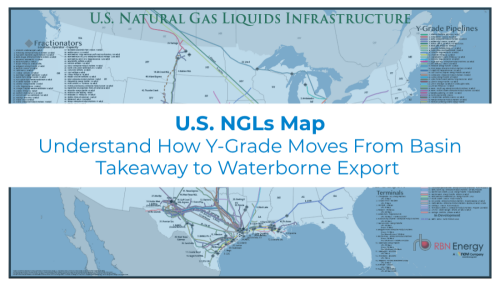
Visualize the infrastructure behind U.S. NGL movement.
The U.S. NGLs Map provides a comprehensive view of the transport, processing, and export networks moving NGLs across the U.S.
Risk Sharing and Finance
The traditional mantra in LNG project design and structuring is that the buyer takes the volume risk under the sales and purchase agreement (SPA), and the seller takes the price risk (refer to Sultans of Swing for a detailed explanation). Essentially, buyers are required to contract for volumes of LNG under take-or-pay provisions that oblige them to pay whether they lift the cargo or not. That is to say, the buyer, often a utility with high credit standing, is providing a secure cash flow to the seller of the LNG, irrespective of its ability to absorb the volumes. On the other side of the deal, the seller, who is typically a project sponsor, takes pricing risk by linking the sale to a commodity price index. Historically, LNG sales were linked to crude oil prices. That’s changed somewhat in more recent years, with some contracts indexed to natural gas benchmarks, such as the U.S.’s Henry Hub or Europe’s Dutch Title Transfer Facility (TTF) or National Balancing Point (NBP). However, oil-linked pricing still prevails among Asian LNG producers, and Brent crude prices have fluctuated between $8/bbl and over $100/bbl over the lifetime of the contracts, which are usually for 20- to 25-year terms. (We covered the most recent gyrations in international pricing recently in Wild Thing.)
About the song
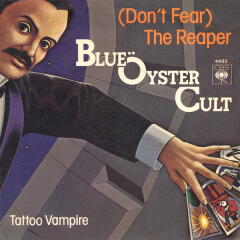
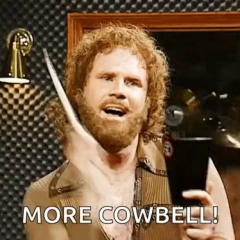
"(Don't Fear) The Reaper" was written by Donald "Buck Dharma" Roeser and appears as the third cut on side one of Blue Oyster Cult's fourth studio album, Agents of Fortune. Released in July 1976, the song went to #11 on the Billboard Hot 100 Singles chart. Personnel on the record were: Donald "Buck Dharma" Roeser (lead vocals, guitar), Eric Bloom (guitar, backing vocals), Allen Lanier (keyboards, guitar), Joe Bouchard (bass), and Albert Bouchard (drums, percussion, cowbell). The song was featured in a hilarious Saturday Night Live sketch in April 2000 entitled, "More Cowbell." Will Ferrell wrote the sketch, where he plays Gene Frenkle, an overweight cowbell player. Christopher Walken plays record producer Bruce Dickinson, who is overseeing the recording of "(Don't Fear) The Reaper." He tells everyone in the studio that "I got a fever, and the only prescription is more cowbell." Stephen King has stated that the song was the inspiration for his novel, The Stand. Live versions of the song have appeared on Blue Oyster Cult's 1978 album, Some Enchanted Evening, 1982's Extraterrestrial Live, 1991's Live 1976, and 2002's A Long Day's Night.
Agents of Fortune was recorded at The Record Plant in New York City in 1975-76, with Murray Krugman, Sandy Pearlman, and David Lucas producing. Released in May 1976, the LP went to #29 on the Billboard Top 200 Albums chart. It has been certified Platinum by the Recording Industry Association of America. Two singles were released from the album.
Blue Oyster Cult was formed in Stony Brook, NY, in 1967 under the name Soft White Underbelly. The group changed its name to Blue Oyster Cult in 1971. They have released 15 studio albums, seven live albums, 21 compilation albums, one soundtrack album, and 32 singles, and have sold more than 25 million records worldwide. Twenty-one members have passed through the band since its formation. Original members Eric Bloom and Donald "Buck Dharma" Roeser still tour as Blue Oyster Cult. Brothers Joe and Albert Bouchard now tour as Blue Coupe, a band that includes Alice Cooper bassist Dennis Dunaway. Albert Bouchard just finished recording the drums for punk rock pioneer The Dictators' upcoming album. Allen Lanier died in 2013. Blue Oyster Cult released their latest album, The Symbol Remains, in October 2020. They start touring again at the end of May 2021.