The implementation date for IMO 2020, the international rule mandating a shift to low-sulfur marine fuel, is less than 12 months away. It’s anyone’s guess what the actual prices of Brent, West Texas Intermediate (WTI) and other benchmark crudes will be on January 1, 2020, or how much it will cost to buy IMO 2020-compliant bunker a year from now. What is predictable, though, is that the rapid ramp-up in demand for 0.5%-sulfur marine fuel is likely to affect the price relationships among various grades of crude oil, and among the wide range of refined products and refinery residues — everything from high-sulfur residual fuel oil (HSFO, or resid) to jet fuel. The refinery sector is in for an extended period of wrenching change, and today we conclude our blog series on the new bunker rule with a look at the structural pricing shifts needed to support the availability of low-sulfur marine fuel.
As we said in Part 1, the International Maritime Organization (IMO) — a specialized agency of the United Nations — for a number of years now has been ratcheting down allowable sulfur-oxide emissions from the engines that power the 50,000-plus tankers, dry bulkers, container ships and other commercial vessels plying international waters. IMO 2020, the agency’s latest rule, calls for the current 3.5% cap on sulfur content in bunker in most of the world to be reduced to a much stiffer 0.5% on January 1, 2020. [There is an even tougher 0.1%-sulfur limit already in place in the IMO’s Emission Control Areas (ECAs), which include Europe’s Baltic and North seas and areas within 200 nautical miles of the U.S. and Canadian coasts.] Baker & O’Brien’s latest analysis of IMO 2020’s impact assumes that current global demand for high-sulfur bunker (HSB; sulfur content of up to 3.5%) is about 3.2 MMb/d, and that by 2020, demand for the new fuel pool consisting of low-sulfur bunker (LSB; 0.5% sulfur or less) and HSB would be 3.4 MMb/d, with the incremental 0.2 MMb/d of demand representing a combination of demand growth and the lower energy density/bbl of the lighter LSB blends. Six primary factors are seen as bringing the bunker market into something approaching balance over the following year or so: (1) some degree of non-compliance with IMO 2020, (2) on-ship “scrubbers” to capture sulfur-oxide emissions, (3) blending of existing low-sulfur fuel oil with distillate to make rule-compliant marine fuel, (4) refinery upgrades (to produce more low-sulfur products), (5) shifts in crude slates and crude oil flows (ditto), and (6) increased global refining throughputs (double ditto). Part 2 and Part 3 discussed those factors in some detail.
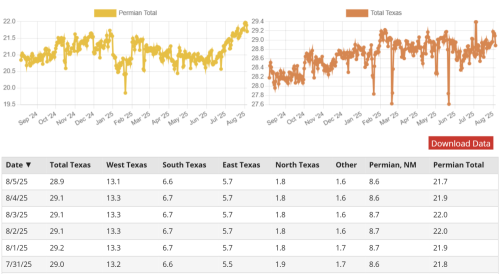
The NATGAS Production Tracker - Texas provides a DAILY update of natural gas production in Texas the New Mexico side of the Permian Basin. Quickly and easily view today’s supplies in the Lone Star state and download the full historical table when you need it.
Two key bottom-line findings are that the global shipping industry will need an incremental 2 MMb/d of 0.5%-sulfur bunker come January 1, 2020, and that the worldwide demand for HSB (and the high-sulfur resid used to make it) will plummet. These big demand shifts will have significant effects on the demand for — and relative prices of — various grades of crude oil, lower-sulfur refined products used to make IMO 2020-compliant bunker, and higher-sulfur refined products and refinery residues.
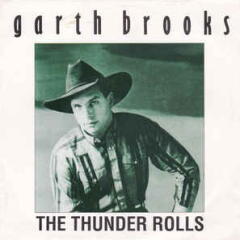
About the song
“The Thunder Rolls” was a #1 hit single for country music star Garth Brooks in 1991. The song, off of Garth’s No Fences album, was co-written by him and Pat Alger. It was originally recorded by Tanya Tucker, but her version was not released until 1995 as part of a self-titled box set. No Fences was released in August 1990 and quickly went to #1 on the Billboard Country Albums chart and #3 on the Billboard Top 200 Albums chart. It remains Garth Brooks’ best-selling album to date, with sales of over 17 million copies. All four singles released from the album went to #1 on the Hot Country Songs chart.
Garth Brooks remains the top-selling solo album artist in the U.S., with domestic sales of more than 148 million records, and worldwide sales of over 170 million. Brooks has released 12 studio albums, two live albums, three compilation albums, three Christmas albums, four box sets, and 77 singles. He has won 22 Country Music Awards, 12 American Music Awards, 17 Billboard Music Awards, five Grammys and one Golden Globe. In June 2018, Brooks released "All Day Long," the first single from his next studio album, which will drop in 2019. He still tours and makes live appearances to this day –– most recently at his “Garth: Live at Notre Dame!” concert on December 2, 2018.