The IMO 2020 rule, which calls for a global shift to low-sulfur marine fuel on January 1, 2020, is likely to require a ramp-up in global refinery runs — that is, refineries not already running flat out will have to step up their game. Why? Because, according to a new analysis, the shipping sector’s need for an incremental 2 MMb/d of 0.5%-sulfur bunker less than 13 months from now cannot be met solely by a combination of fuel-oil blending, crude-slate changes and refinery upgrades. The catch is, most U.S. refineries are already operating at or near 100% of their capacity, so the bulk of the refinery-run increases will need to happen elsewhere. Today, we continue our look into how sharply rising demand for IMO 2020-compliant marine fuel may affect refinery utilization.
This is the third blog in this series, and the latest of the many blogs about the ongoing effort by the International Maritime Organization (IMO) — a specialized agency of the United Nations — to ratchet down allowable sulfur-oxide emissions from the engines that power the 50,000-plus tankers, dry bulkers, container ships and other commercial vessels plying international waters. As we said in Against the Wind, the current 3.5% cap on sulfur content in bunker (marine fuel) in most of the world is set to be reduced to a much stiffer 0.5% on January 1, 2020. [There is an even tougher 0.1%-sulfur limit already in place in the IMO’s Emission Control Areas (ECAs), which include Europe’s Baltic and North seas and areas within 200 nautical miles of the U.S. and Canadian coasts.] There are three primary options shipowners have to achieve compliance with IMO 2020: (1) continue burning high-sulfur bunker (HSB; sulfur content up to 3.5%) and install an exhaust gas cleaning system (scrubber) to eliminate most of the sulfur dioxide emissions; (2) switch to marine distillates or low-sulfur bunker blends whose sulfur content is 0.5% or less; or (3) use alternative low-sulfur fuels like liquefied natural gas (LNG) or methanol (see Bad Moon Rising).
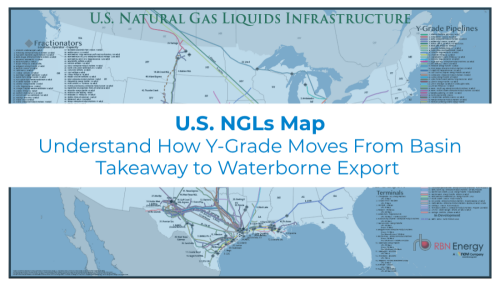
Visualize the infrastructure behind U.S. NGL movement.
The U.S. NGLs Map provides a comprehensive view of the transport, processing, and export networks moving NGLs across the U.S.
In the series we continue today, we’re discussing Baker & O’Brien’s latest analysis of how things may play out under the current plan for IMO 2020 implementation. Part 1 explained the assumption that current global demand for HSB is about 3.2 MMb/d (black bar to far left in Figure 1), and that by 2020, demand for the new fuel pool consisting of low-sulfur bunker (LSB; 0.5% sulfur or less) and HSB would be 3.4 MMb/d (dark green bar to far right) with the incremental 0.2 MMb/d of demand (blue bar) representing a combination of demand growth and the lower energy density/bbl of the lighter LSB blends. We noted six primary factors — in addition to the lower energy density/bbl we just noted — that will combine to bring the bunker market into something approaching balance: (1) non-compliance (red bar), (2) scrubbers (light green bar), (3) blending of existing low-sulfur fuel oil with distillate (purple bar), (4) refinery upgrades (turquoise bar), (5) shifts in crude slates and crude oil flows (orange bar), and (6) increased global refining throughputs (blue-and-white striped bar).
About the song
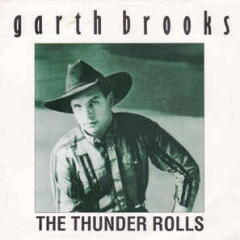
“The Thunder Rolls” was a #1 hit single for country music star Garth Brooks in 1991. The song, off of Garth’s No Fences album, was co-written by him and Pat Alger. It was originally recorded by Tanya Tucker, but her version was not released until 1995 as part of a self-titled box set. No Fences was released in August 1990 and quickly went to #1 on the Billboard Country Albums chart and #3 on the Billboard Top 200 Albums chart. It remains Garth Brooks’ best-selling album to date, with sales of over 17 million copies. All four singles released from the album went to #1 on the Hot Country Songs chart.
Garth Brooks remains the top-selling solo album artist in the U.S., with domestic sales of more than 148 million records, and worldwide sales of over 170 million. Brooks has released 12 studio albums, two live albums, three compilation albums, three Christmas albums, four box sets, and 77 singles. He has won 22 Country Music Awards, 12 American Music Awards, 17 Billboard Music Awards, five Grammys and one Golden Globe. In June 2018, Brooks released "All Day Long," the first single from his next studio album, which will drop in 2019. He still tours and makes live appearances to this day –– most recently at his “Garth: Live at Notre Dame!” concert on December 2, 2018.