It’s been more than three years since the International Maritime Organization (IMO) fully committed to the January 1, 2020, implementation of IMO 2020, a rule that slashes the allowable sulfur content in bunker fuel used in the open seas around most of the world from 3.5% to only 0.5%. There’s been a lot of angst in the interim, most of it regarding the changes in crude slates, refinery operations and fuel blending needed to meet a flip-of-a-switch spike in global demand for low-sulfur bunker. Also, shippers worried that prices for rule-compliant fuel would go through the roof. Well, it turns out that the transition period in the months leading up to the IMO 2020 era has been largely drama-free. Supplies of very low-sulfur fuel oil (VLSFO) and marine gasoil (MGO) — the bunker most ships will now use — have been building in most places, prices are up but moderating, and while there may be a few hiccups as ships shift to new, cleaner fuels, life will go on. Heck, life will likely be even better for most complex U.S. refineries, which can churn out large volumes of low-sulfur refined products and which will have access to price-discounted high-sulfur “resid” as an intermediate feedstock. Today, we take a big-picture look at the global bunker market as IMO 2020’s implementation day approaches.

The Crude Voyager is a weekly analysis of U.S. Gulf Coast loading activity that explains the ebbs and flows of crude loadings, destinations, and geopolitical issues impacting U.S. exports. It outlines the major paths for laden tankers hauling U.S. crude all over the world and reflects the change in tanker departures to the main regions that consume U.S. crude.
As we’ve discussed in a number of blogs, the IMO, a specialized agency of the United Nations, in recent years has been implementing ever-tightening rules to reduce allowable sulfur-oxide emissions from the engines that power the 50,000-plus tankers, dry bulkers, container ships and other commercial vessels plying international waters. In Against the Wind, we explained that in January 2012, the global cap on sulfur content in bunker (marine fuel) was reduced to 3.5% from the old 4.5% (orange bar with dashed green oval in Figure 1) and that on January 1, 2020 — next Wednesday — it is set to be reduced to a much stiffer 0.5% (orange bar with dashed red oval). There are even tougher standards for sulfur already in place in the IMO’s Emission Control Areas (ECAs), which include Europe’s Baltic and North seas and areas within 200 nautical miles of the U.S. and Canadian coasts. In July 2010, the ECA sulfur limit in marine fuel was reduced to 1%, from the old 1.5% (teal bar with dashed purple oval), and in January 2015, the limit was ratcheted down again to a very stringent 0.1% (teal bar with dashed yellow circle) — a standard that will remain in force within the ECAs when the 0.5% sulfur cap for the rest of the world becomes effective on New Year’s Day.
About the song
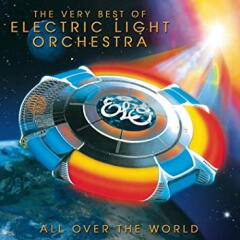
"All Over the World" was written by Jeff Lynne and was featured in the 1980 film “Xanadu.” Lynne's band, the Electric Light Orchestra (ELO), contributed one half of the soundtrack album for the movie. "All Over the World" was recorded by ELO at Musicland Studio in Munich, Germany, with Jeff Lynne producing. It was released as a single in July 1980, and went to #13 on the Billboard Hot 100 chart. Personnel on the record were: Jeff Lynne (lead vocals, backing vocals, electric and acoustic guitars, synthesizer), Bev Bevan (drums, percussion, tympani), Richard Tandy (piano, keyboards, synthesizer), Kelly Groucutt (bass, backing vocals) and Louis Clark (strings).
The “Xanadu” soundtrack album was released in conjunction with the release of the feature film of the same name starring Olivia Newton-John. Newton-John was featured on side one, and the Electric Light Orchestra on side two. The album went to #4 on the Billboard Top 200 Albums chart, and was certified 2x Platinum by the Recording Industry Association of America.
Electric Light Orchestra is an English rock band formed in Birmingham, England, in 1970 by Roy Wood, Jeff Lynne and Bev Bevan. All three were past members of the popular British rock band, The Move. Roy Wood wanted to add strings and horns to a rock band, giving it a more classical music feel, so ELO was formed. An astounding number of 34 members have passed through the band's ranks since its inception. The band has sold more than 50 million records worldwide to date. ELO has released 14 studio albums, seven live albums, 40 compilation albums, one soundtrack album, one EP and 50 singles. ELO was inducted into the Rock and Roll Hall of Fame in 2017. Lynne disbanded ELO in 1986, but re-formed the group in 2014 as "Jeff Lynne's ELO." The newly branded version of ELO features Lynne and original keyboardist Richard Tandy, as well as various touring musicians. In November, this iteration of the band released a new full-length album titled “From Out of Nowhere.”