


There hasn’t been a major new refinery built in the lower 48 since 1976. Now, no less than 5 projects to build new oil refineries are on the drawing boards in North Dakota. These projects are really “micro” refineries since they all have 20 Mb/d capacity compared to the 128 Mb/d national average of operating US refineries (source: Energy Information Administration - EIA). The projects all aim to take advantage of a shortage of refined products in North Dakota – especially diesel – as well as abundant supplies of crude from the Bakken shale. Today we review their progress.
North Dakota is producing a heck of a lot of crude oil these days, only a fraction of which is consumed in State. The latest production data from the North Dakota Pipeline Authority (NDPA) released this week indicates crude output in April 2014 just crept past the 1 MMb/d mark - up a whopping 292% from 343 Mb/d in Jan 2011. Yet the Tesoro Mandan refinery is still the only facility processing crude in the State and although it was upgraded in 2012 from 58 Mb/d capacity it now has a maximum 71 Mb/d of crude, just over 6% of current production. As we have described in previous posts and Drill Down reports (see I’ve Been Working on the Railroad), the rest of North Dakota’s production leaves the State for other refineries by rail (63% of April production) and pipeline (30%).
The Mandan refinery does not meet local refined product demand – most noticeably only producing about 20 Mb/d of middle distillate diesel range material compared to local demand that reached a peak of 63 Mb/d last August (2013). The chart in Figure #1 below shows EIA demand data for diesel fuel (mostly ultra low sulfur diesel – ULSD - for road and rail use) from 2009 when it averaged just 28 Mb/d through March 2014 when monthly consumption was 52 Mb/d. Most of the difference between Mandan diesel supply (red line on the chart) and North Dakota demand is met by trucking or railing in fuel from Montana and Wyoming refineries. Surging diesel demand in North Dakota reflects the big increase in the State’s oil drilling and transportation activities. A blog series posted by our friends at Turner Mason in December 2013 provides a great analysis of where that increased demand for ULSD comes from. They estimated that new drilling activity in North Dakota is consuming 15.5 Mb/d of diesel with another 3.8 Mb/d needed to power trucks picking up oil from wells not attached to pipelines yet and 1.5 Mb/d to power crude by rail locomotives shipping crude out of North Dakota. Demand for gasoline has also increased in North Dakota from the State’s increasing oil boom population, although not as dramatically as diesel.
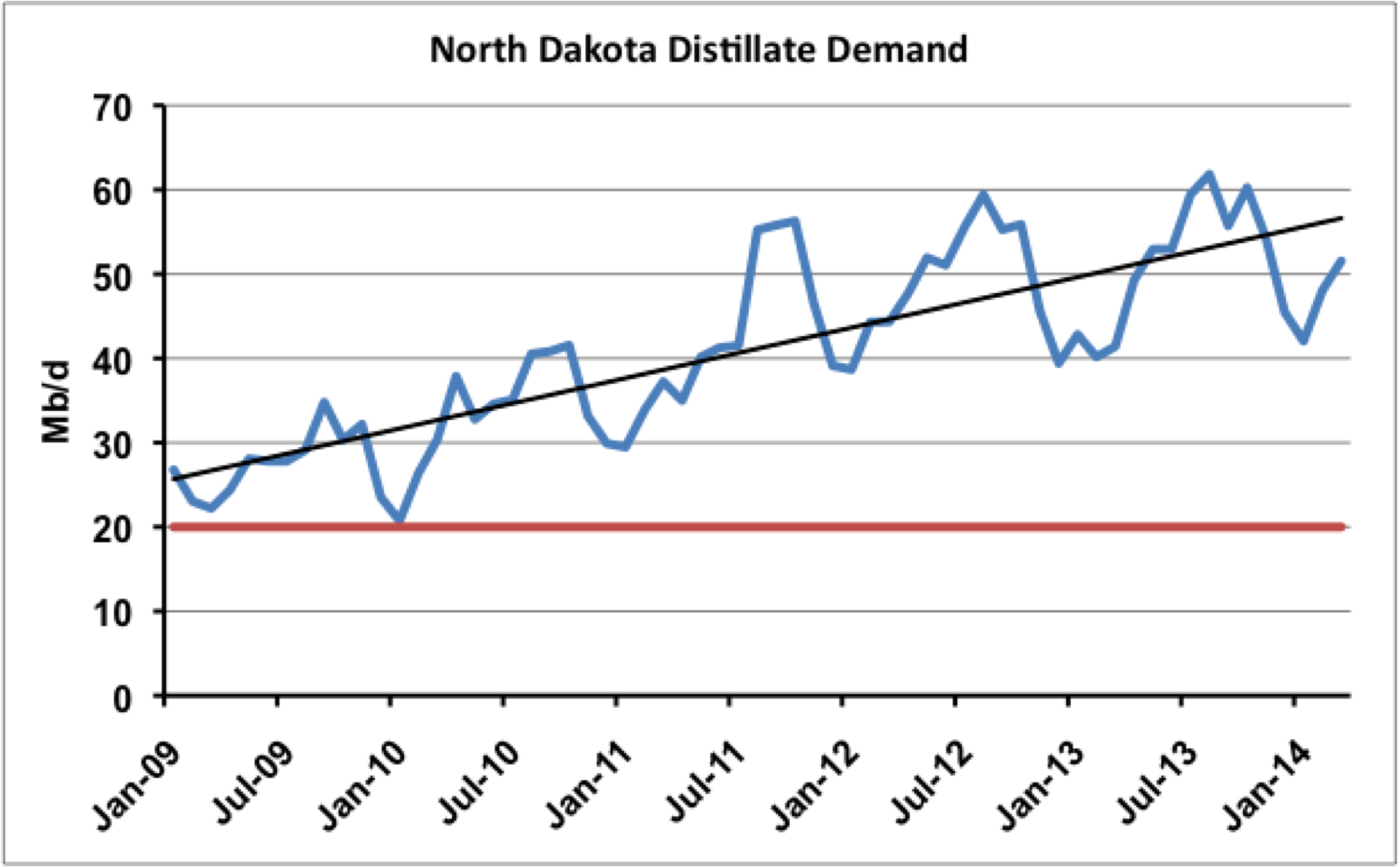
Figure #1

About the song
If You've Got The Money I've Got The Time was written by Left Frizzell and Jim Beck in 1950 and was a #1 COuntry Hit for Lefty. Willie Nelson took his version to #1 in the Country chart in 1976






Comments
I asked this on an older stale post, so may not have not been seen by many people.
If Canadian oil diluted with American condensate can’t be exported from an American port due to the export ban on US petroleum exports. Can this same condensate in Canadian oil be exported from from a Canadian port, or will they need to strip the condensate before exporting to China?
Anyone have any ideas?
There are a numer of Maxim type skidded refineries in Bakken. These only extract the diesel fraction in the oilfield for offroad uses. The balance of the product stream is returned to the crude stream.
The problem is that there is not enough local market for other refined products in the immediate area.
Also, Bakken is very high in light ends, thus downstream units to convert the gases from the crude unit are needed.