Every day, midstream companies in North America transport massive volumes of crude oil, natural gas, NGLs, and refined products to market. Without their pipelines, economic activity would rapidly grind to a halt. Still, environmental critics and ESG-conscious investors and lenders are quick to point out that the commodities that midstreamers pipe are among the leading sources of greenhouse gas emissions, and that, at the very least, pipeline companies should be reducing or even offsetting the carbon dioxide (CO2) and other GHGs associated with operating their networks. That’s now happening in a big way — and in a variety of ways — as we discuss in today’s blog.
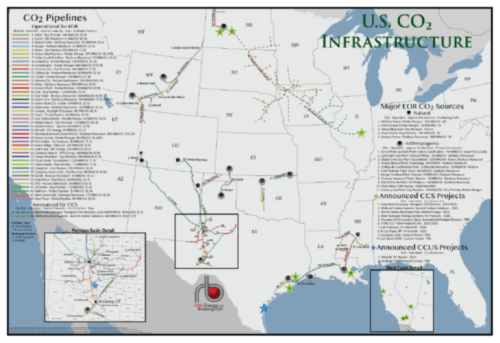
RBN Energy’s US CO₂ Infrastructure map brings together legacy Enhanced Oil Recovery (EOR) assets, as well as announced large-scale Carbon Capture and Sequestration (CCS) and Carbon Capture, Utilization and Sequestration (CCUS) projects, all in our signature concise, accurate, and intelligible style.
It’s official: “ESG” is now the #1 search term on Google in the Houston area. (Not really, but it sounds plausible, doesn’t it?) As we said in Part 1 of this blog series, the oil and gas industry has been responding to the growing interest in Environmental, Social, and Governance issues by examining how it can become “greener,” especially on the GHG emissions front. In the LNG sector, a number of market players have been seeking to differentiate their LNG from that supplied by their competitors by offering buyers the option of contracting for “carbon-neutral” LNG, where every metric ton (MT) of CO2 emitted during natural gas production, liquefaction, shipping, and end-use consumption is matched one-for-one with an MT of independently verified, “nature-based” carbon offsets.
In Part 2, we discussed the 15-plus shipments of carbon-neutral LNG that have been made since Shell sent out its inaugural cargo more than two years ago. We also took a detailed look at a couple of those deals to see where this “guilt-free” LNG was ending up and what was driving the buyers’ decisions to voluntarily pay more for LNG if its Scope 1, Scope 2, and Scope 3 GHG emissions are offset by the retirement of carbon credits. Finally, we noted that while LNG has emerged as the primary testing ground for carbon-neutral cargoes, there also have been at least a few cargoes of carbon-neutral crude oil, LPG, and ethylene, with more likely to follow.
About the song
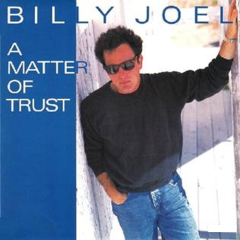
“A Matter of Trust” was written by Billy Joel and appears as the third song on side one of his 10th studio album, The Bridge. Released as the second single from the album in July 1986, "A Matter of Trust" went to #10 on the Billboard Hot 100 Singles chart. Personnel on the record were: Billy Joel (lead, backing vocals, guitar, acoustic piano, synthesizer); David Brown and Russell Javors (guitar); Doug Stegmeyer (bass), Liberty DeVito (drums), and Jeff Bova (synthesizer).
The Bridge was recorded in 1985-86 at The Power Station, Chelsea Sound, and RCA Studios in New York City and Evergreen Studios in Burbank, CA. Produced by Phil Ramone, the album was released in July 1986. It went to #7 on the Billboard Top 200 Albums chart, and has been certified 2X Platinum by the Recording Industry Association of America. Four singles were released from the LP.
Billy Joel is an American singer, songwriter, and musician from New York who has sold over 150 million records worldwide. He started his career as a member of The Hassles, who made two albums for United Artists in 1967 and 1969. Joel then formed the keyboard and drum duo, Attila, who released one album for Epic in 1970. Stephen Thomas Erlewine of All Music wrote: "Attila undoubtedly is the worst album released in the history of rock and roll." Joel himself has called the album "psychedelic B.S." He started his solo career in 1971, with the release of his debut album, Cold Spring Harbor. Billy Joel has released 13 studio albums, six live albums, 16 compilation albums, and 61 singles. He has won five Grammy Awards, is a member of the Rock and Roll Hall of Fame, and has been awarded a Gershwin Prize for Popular Song from the Library of Congress and a Kennedy Center Honor. He continues to write music and occasionally perform live.