Will hold-by-production (HBP) drilling by producers acting to preserve their leases for the longer term end up sending U.S. oil and gas production volumes higher when energy fundamentals and prices suggest production should slow down? This has happened before, with one of the highest profile instances in the Haynesville Shale between 2009-13, leading to even lower natural gas prices. Could it happen again in the Marcellus this year? Today we continue our look at HBP lease provisions with a focus on the Marcellus.
In Part 1 we looked at the HBP provision that is a standard component of oil and gas land lease agreements between producers and mineral rights owners in the U.S. Producers can pay bonuses of thousands of dollars per acre for rights to conduct exploration and production activities on parcels of private land. However lease agreements typically dictate that drilling rights expire after an initial term, (that varies by negotiation but is typically 3-5 years) unless the lease operator produces minimum commercial quantities of oil or gas from the acreage to hold the lease by production. Once HBP’d the lease begins a second term that lasts as long as minimum production continues. We discussed how HBP clauses sometimes lead to “forced drilling” by producers to preserve drilling rights beyond the primary term. In the Haynesville, LA dry gas play there was a leasing frenzy in 2008-09 as producers rushed in to sign up landowners – typically with a 3-year initial term. Just as they began developing the shale in earnest, gas prices tumbled below breakeven levels ($4/MMBtu at the time in the Haynesville). But despite the poor economics, producers continued drilling because of the need to secure their leases by production. After the 3-year terms expired around 2011-12, new drilling and production declined. For reference, Figure 1 is the graph from Part 1 that shows the Haynesville lease timeline, production volumes, gas prices, and breakeven.
Only 2 Days Left to Save $450 on School of Energy Calgary!Early Bird Rate Ends FridayRegister now to receive discounted rate for RBN’s next School of Energy scheduled for March 30 – April 1, 2015. |
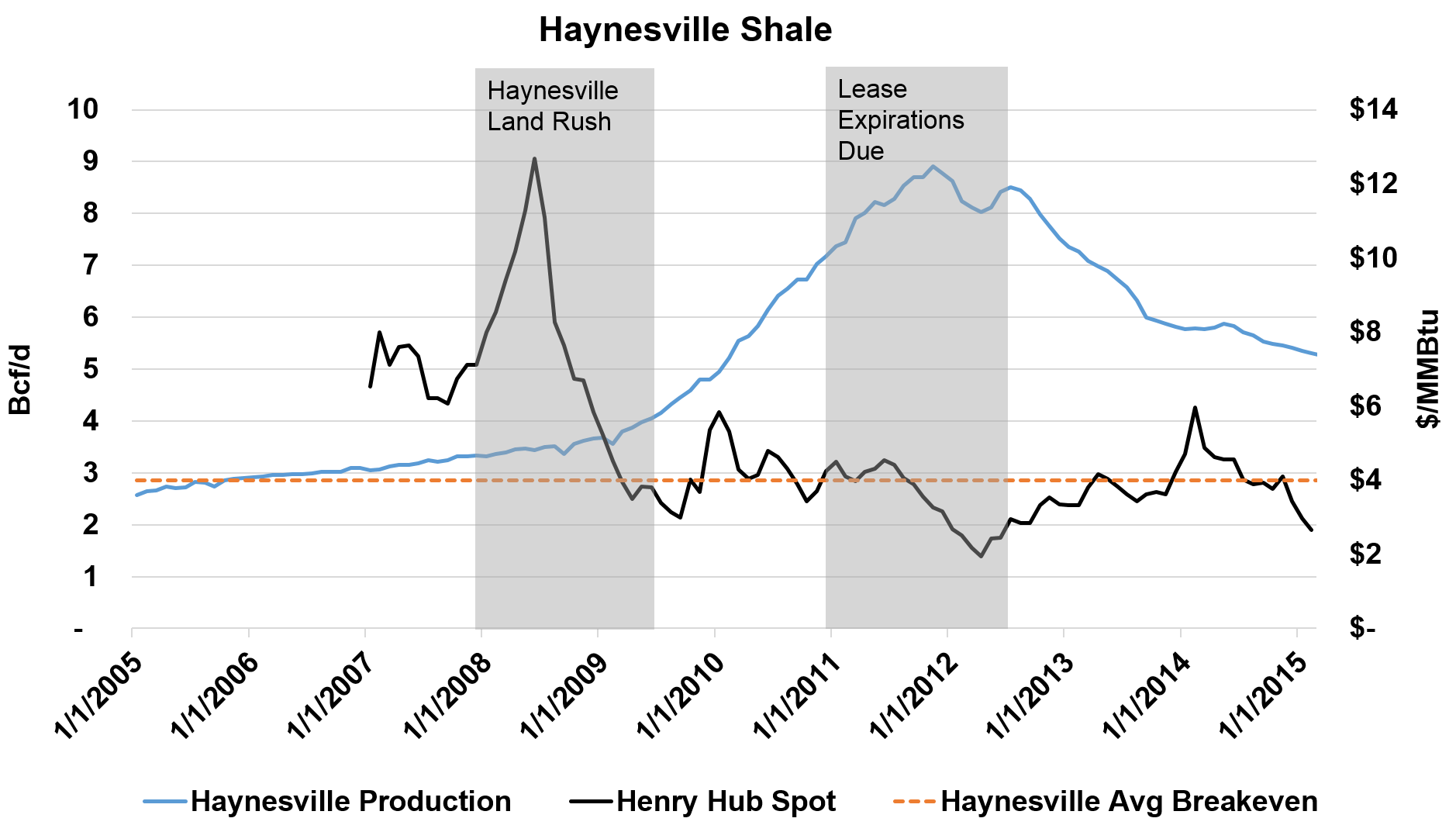
Figure 1
Source: Bentek, RBN Energy, NGI (Click to Enlarge)
Today we are once again in a price environment where new drilling for oil and gas has become uneconomic in many shale plays except for more prolific “sweet spots” (see It Don’t Come Easy). Although as we pointed out yesterday in “All About That Base” rapid reductions in drilling and completion costs may well change those economics – especially if prices recover somewhat. But in the short term we wondered if the kind of forced drilling that happened in the Haynesville because of HBP provisions might be repeated in the Marcellus/Utica shale, which has been the biggest contributor to ongoing natural gas production growth (see 50 Ways To Leave The Marcellus).

About the song
"Hold on Tight” by Electric Light Orchestra (ELO) hit number two on the US Billboard Top Rock Tracks chart in 1981 and helped launch the roots rock revival of the 1980s.