The frac spread—the difference between the value of a typical basket of NGLs and the price of natural gas, in $/MMBtu—has averaged a paltry $2.28 for the past two years, by far the longest period of depressed NGL values since the start of the Shale Revolution. That’s bad news for natural gas processing economics, which are most favorable when NGL prices are strong and natural gas prices are weak. But things are about to get a lot better. Today we consider the currently low frac spread, what it means for natural gas producers and processors, and why a big turnaround may be in the offing.
The frac spread (short for “fractionation spread”) and its kissing cousin, the NGL-to-crude ratio, have been frequent topics in the RBN blogosphere, and for good reason. From the beginning, an underlying principal of RBN’s analysis of drill bit hydrocarbons (gas and liquids produced at the wellhead) has been our belief that the relationships between crude oil, natural gas and natural gas liquids (NGLs) have become far more important in the Shale Era than they were a generation ago. Now, what happens in oil markets impacts gas and NGL markets, and vice versa. (See “The Domino Effect” for a thorough review of how this interconnectedness has played out.) As we said in Do It Again, the NGL-to-crude ratio is a weighted average of OPIS/Mont Belvieu NGL prices divided by CME/NYMEX front month crude oil futures. The NGL mix that we use to calculate the ratio is 42% ethane, 28% propane, 11% normal butane, 6% isobutane, and 13% natural gasoline. (We track both the NGL-to-crude ratio and the frac spread every day on our website in RBN Spotcheck, which is available to RBN Backstage Pass subscribers.) For many years the NGL-to-crude ratio averaged about 60%, staying within a 50%-to-70% range most of the time, and rising to a frothy 76% in September 2011. This was The Golden Age of Natural Gas Processors, as we said in a blog series of the same name. But, as we’ve discussed often, rapidly growing natural gas production and increasingly oversupplied market conditions depressed natural gas prices in the early days of the Shale Revolution, which gave producers the incentive to shift their attention and resources toward “wet” gas shale areas that produced significant volumes of NGLs. The resulting NGL supply growth crushed NGL prices, which pushed the NGL-to-crude ratio down to a new plateau: since 2012 the ratio has averaged just over 40%, and even the collapse in oil prices since mid-2014 hasn’t changed the ratio much. (As of November 30, 2016, with NGL prices up in sympathy with the new OPEC deal, it stood at just 45.4%.)
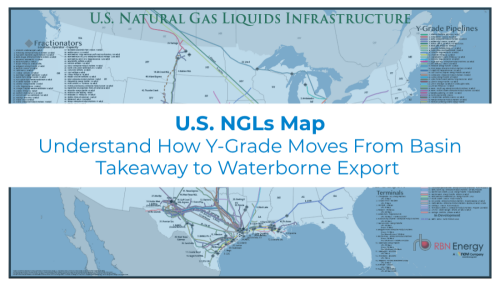
Visualize the infrastructure behind U.S. NGL movement.
The U.S. NGLs Map provides a comprehensive view of the transport, processing, and export networks moving NGLs across the U.S.
Today we look at the frac spread, which, as we said, is the difference between the value of natural gas and the same weighted-average value of the same NGL mix used to calculate the NGL-to-crude ratio. It’s important to note here that the frac spread is not a measure of natural gas processing margins—making that mistake is all too common. For one thing, the margin for any particular processing plant depends on the liquids content of the raw gas being fed into it, and as you know some gas is a lot “wetter” than others. For another, even if two identical processing plants were fed gas with a liquids content of, say, 3 gallons of NGLs per 1,000 cubic feet of gas processed (a metric called GPM, or gallons per Mcf), the mix of NGLs within those 3 gallons may well be very different: one might have only 35% ethane—the NGL “purity product” with the lowest price—and a lot of heavier, higher-priced purity products like butanes and natural gasoline, while the other may have 65% ethane and far less of the more valuable stuff. What the frac spread does offer, though, is a yardstick measure of the general financial health of the gas processing sector as a whole.

About the song
"Help!" was written by John Lennon, with some assistance from Paul McCartney, and was credited to Lennon/McCartney. The song appeared as the first song on side one of the soundtrack album of the 1965 film of the same name. Help! was the second film released to feature The Beatles. John Lennon has stated that "Help!" was one of his favorite Beatles songs that he wrote. Released as a single in July 1965, the song went to #1 on the Billboard Hot 100 Singles chart. It has been certified Gold by the Recording Industry Association of America (RIAA). Personnel on the record were: John Lennon (lead vocals, acoustic guitar), Paul McCartney (bass, backing vocals), George Harrison (lead guitar, backing vocals), and Ringo Starr (drums, tambourine).
Help! was the fifth studio album from The Beatles, and it was the soundtrack to their second feature film. Recorded between February and June 1965 at EMI (Abbey Road) Studios in London, the record was produced by George Martin. Released in August 1965, the UK version contained 14 songs, while the U.S. version contained seven songs, with the rest of the album being comprised of instrumental music from the film. It went to #1 on the Billboard Top 200 Albums chart and has been certified 3x Platinum by the RIAA. Two singles were released from the LP.
The Beatles were an English rock band formed in Liverpool in 1960. The core group of John Lennon, Paul McCartney, George Harrison, and Ringo Starr went on to change the culture of popular music and become the most influential band of all time. They have sold more than 600 million records worldwide. The Beatles have released 23 studio albums, five live albums, 54 compilation albums, 22 EPs, and 63 singles. They have won one Academy Award, one Billboard Award, four Brit Awards, nine Grammy Awards, one Grammy Lifetime Achievement Award, one Grammy Trustees Award, 14 Ivor Novello Awards, one MTV Video Music Award, and three World Music Awards, and have 15 songs in the Grammy Hall of Fame. The Beatles are members of the Rock and Roll Hall of Fame, UK Music Hall of Fame, and the Vocal Group Hall of Fame. In 1997, Paul McCartney was knighted by Queen Elizabeth II; Ringo Starr received the same honor from Prince William in 2018. John Lennon died in 1980 and George Harrison in 2001. Paul McCartney and Ringo Starr continue to record and tour as solo artists.