In the upstream oil and gas world, “reserve life” — calculated via the Reserve Life Index (RLI) — is one of the simplest and most widely cited metrics. The calculation is straightforward: divide a company’s proved reserves by its current annual production and you get an estimate of how long those reserves will last. But behind that neat little ratio lies a web of technical, financial and strategic forces that can make RLI a surprisingly nuanced measure of an E&P’s long-term outlook. In today’s RBN blog, we analyze the reserve-life trends of the 39 E&P companies we cover.
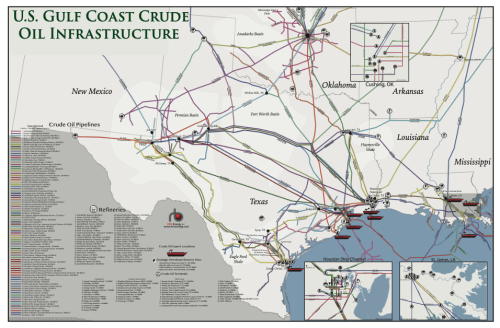
RBN’s US Gulf Coast Crude Oil Infrastructure Map - is up-to-date and provides a clear and comprehensive view into North America’s most dynamic and important crude oil market landscape.
At its core, reserve life starts with the size and quality of the rock. Reservoirs with strong porosity, permeability and pressure profiles generate higher recoveries, while effective secondary and tertiary recovery techniques can stretch reserves for decades. Deep offshore basins, like the Gulf of Mexico (GOM), are notorious for short RLIs because the reservoirs have very high decline rates. That is the primary reason most E&Ps left the Gulf decades ago, although production there is on the rise (see Back in the Saddle). Shale reservoirs also have much higher decline rates than conventional resources. A short RLI creates a reinvestment treadmill that makes it very difficult to manage the capital demands on the company. The recent emphasis on shale production means that 90% of capital investment since 2019 has gone to offsetting declines rather than adding to supply. Conversely, a longer RLI makes the pace of reinvestment more manageable.
But geology is not the only factor. The weighting of total proved reserves between proved developed and undeveloped makes a huge difference. (Proved reserves are the estimated quantities of oil and natural gas that geological and engineering data demonstrate — with reasonable certainty — can be economically produced from known reservoirs under existing economic conditions, operating methods, and government regulations as of a specific evaluation date. Proved undeveloped reserves require significant future capital before they can be produced. Companies with vast undeveloped reserves generally have a longer RLI than companies with far fewer undeveloped reserves.) In addition, the pace at which a company develops its acreage is equally important: An aggressive drilling program that drives reserve additions higher will push RLI higher, as reserves are added at a faster clip than production. Conversely, a cash-return model (where E&Ps prioritize generating free cash flow and returning cash to shareholders over production growth) can reduce reserve life as reserves are reduced at a faster rate than production drops. This is illustrated in Figure 1 below, which plots the reinvestment rate and reserve life between 2014-24 for our universe of companies. The RLI (blue bars and left axis) averaged 12.8 years in 2014-15 before gradually falling to 9.9 years in 2024 as the reinvestment rate (orange line and right axis) was reduced from 104% of cash flow in 2014-15 to only 50% in 2024.
About the song
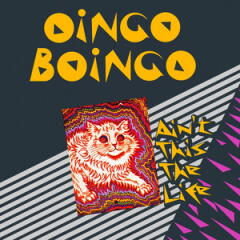
“Ain’t This The Life” was written by Danny Elfman and appears as the first song on side two of Oingo Boingo’s self-titled debut 10-inch EP. The song is a parody of living in high society with no financial concerns. The EP was originally recorded as a promotional record to give to record companies, known as the Demo EP. “Ain’t This the Life” and “Only a Lad” from this EP got heavy airplay on cutting-edge KROQ radio in Los Angeles in 1980. “Only a Lad” ended up on the band’s debut album of the same name. Recorded at Sound Arts in Los Angeles and Indigo Ranch in Malibu, the record was produced by Michael Boshears and Jo Julian. Artist Louis Wain did the cover artwork. The EP was released in September 1980. No singles were released from it. Personnel on the record were: Danny Elfman (lead vocals, rhythm guitar), Steve Bartek (lead guitar), Richard Gibbs (keyboards), Kerry Hutch (bass), Johnny “Vatos” Hernandez (drums), Leon Schneiderman (baritone, alto saxophone), Sam “Sluggo” Phipps (tenor saxophone) and Dale Turner (trumpet).
Oingo Boingo was an American rock band formed in Los Angeles in 1979 by Danny Elfman. Elfman had previously led and written music for the surrealist music theater group, The Mystic Knights of the Oingo Boingo, whose roots go back to 1972. In 1976, the group appeared on the television talent show The Gong Show and won. They signed with I.R.S. Records in 1979 and released their debut album, Only a Lad, in June 1981. They released eight studio albums, two live albums, a soundtrack album, five compilation albums, an EP and 19 singles. Forty-three members passed through the group from its formation until its dissolution in 1995.
Danny Elfman is an American film composer, singer, songwriter and musician. His first film score was for Forbidden Love, released in 1982. He has scored 103 motion pictures. He has won 24 BMI Film & Television Awards, three Emmy Awards, a Grammy Award, a Richard Kirk Award, a Disney Legend Award, a Max Steiner Film Music Achievement Award, and a Society of Composers and Lyricists Lifetime Achievement Award. He continues to write and score motion picture soundtracks.
"About the Song" -- written by Mickey McMahan , RBN Director of Musicology