Passage of the Inflation Reduction Act (IRA) in August 2022 was intended to unleash a wave of clean-energy initiatives, from hydrogen and renewable fuels to electric vehicles and large-scale carbon-capture projects, all part of the Biden administration’s plans to reduce carbon dioxide (CO2) emissions and move the U.S. closer to a net-zero economy. But while billions in federal financing and tax credits have helped move many projects forward, they can only advance as fast as permitting, regulations and economic reality will allow. In today’s RBN blog, we look at the surge in proposed carbon-capture projects since passage of the IRA, where they are in the review process, and how the pace of permitting at the federal level compares with the states that have primacy over their own sequestration wells.
The replay of our Fall 2026 School of Energy (September 9 & 10, Houston) is now available online!
Learn from RBN experts, participate in hands-on Excel modeling, connect with industry peers, and gain a stronger understanding of today's interconnected energy markets.
Let’s start with a quick refresher on carbon capture. When CO2 is captured and stored, and that’s all, the process is called carbon capture and sequestration (CCS) and requires a Class VI injection well (right side of Figure 1) for long-term storage in deep geologic formations. If the CO2 is used for some other process before it’s stored, it is called carbon capture, use and sequestration (CCUS) and requires a Class II injection well (left side of Figure 1) — the most common example being enhanced oil recovery, or EOR. Permitting for Class VI wells is typically handled by the Environmental Protection Agency (EPA), although a few states have control over that process, something referred to as primacy (more on that in a bit).
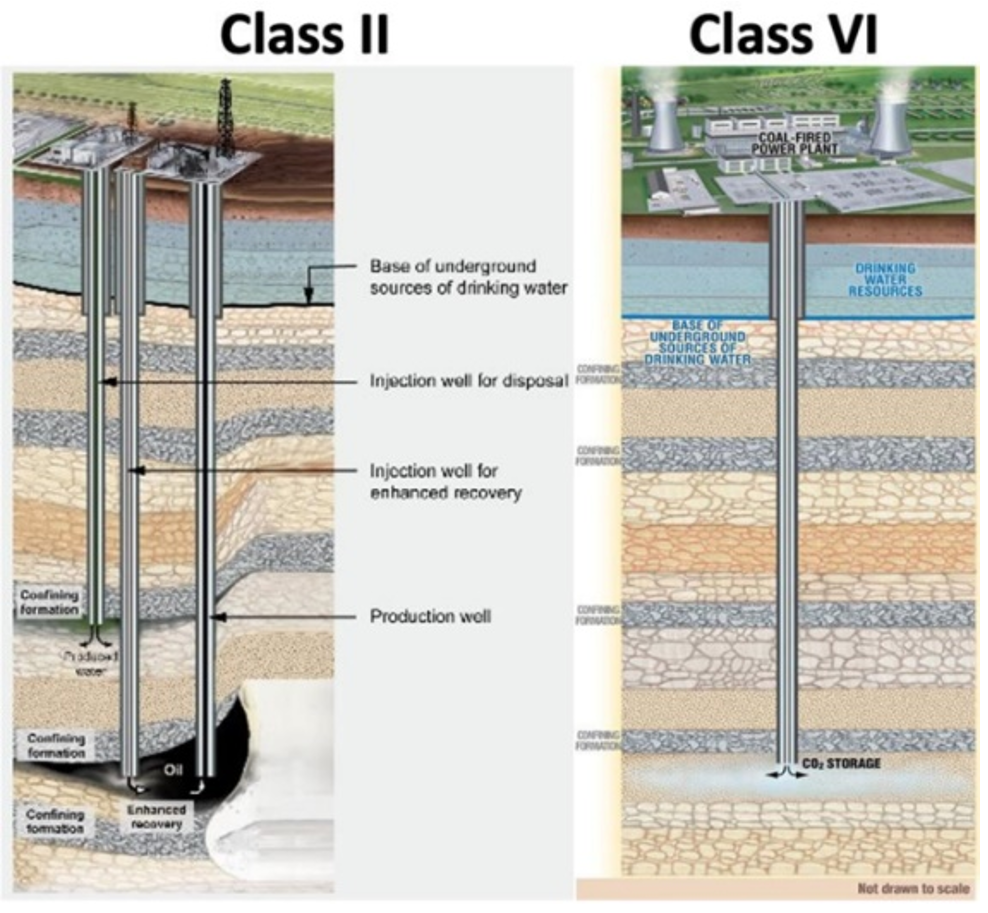
Figure 1. Class II and Class VI Injection Wells. Source: EPA
Even though regulations around Class VI wells have been around since 2010, few applications have been approved by the EPA in that time. Just two projects with four total wells have reached active status:
- Archer Daniels Midland (ADM) operates the Illinois Industrial Carbon Capture and Storage Project in central Illinois. It captures CO2 emissions from an accompanying ADM ethanol facility in nearby Decatur. It has one operating well and one that is in its post-injection phase. Ethanol plants are an obvious choice for carbon capture, given that the CO2 resulting from ethanol fermentation is highly concentrated, which makes capturing it more efficient (and less expensive) compared to many other industrial processes.
- Wabash Carbon Services (WCS) plans to sequester the CO2 that would be generated by an ammonia fertilizer plant it plans to construct in Terre Haute in west-central Indiana. The wells, which received final permitting in January, are in their pre-operation phase. WCS says the plant will serve as a model for producing fertilizer with zero carbon emissions.
About the song
“The Waiting” was written by Tom Petty and appears as the first song on side one of Top Petty and The Heartbreakers’ fourth studio album, Hard Promises. Petty says the song’s title was inspired by a Janis Joplin quote about touring: “I love being onstage and everything else is just waiting.” It was released as a single in April 1981 and went to #1 on the Billboard Top Tracks and #19 on the Billboard Hot 100 Singles charts. Personnel on the record were: Tom Petty (lead vocals, rhythm guitar), Mike Campbell (lead guitar, bass), Benmont Tench (keyboards, backing vocals), Stan Lynch (drums, backing vocals), and Phil Jones (percussion).
Hard Promises was recorded in 1980-81 at Sound City in Van Nuys, CA, and Cherokee and Goodnight in Hollywood. Produced by Jimmy Iovine and Tom Petty, the album was released in May 1981. It went to #5 on the Billboard 200 Albums chart and has been certified Platinum by the Recording Industry Association of America. The album’s release was initially delayed by Petty voicing his objections to his label raising the retail price on his album by $1 over the usual list price. Petty won the battle and the LP was released under its usual list price. The album cover was shot by Joel Bernstein and features Petty in Aaron’s Record Store in Hollywood. During the recording of the album, John Lennon was murdered in New York City. The run-out groove on the early U.S. and Canadian pressings has “We Love You J.L.” etched in the vinyl. Three singles were released from the LP.
Tom Petty and The Heartbreakers were an American rock band formed in Gainesville, FL, in 1976. Heartbreakers Petty, Mike Campbell and Benmont Tench were in the Gainesville band Mudcrutch, who released one single for Shelter Records in 1975. The three enlisted Gainesville bassist Ron Blair and Los Angeles drummer Stan Lynch to form the original version of The Heartbreakers in 1976. They released 13 studio albums and 68 singles. They have sold more than 80 million records worldwide and were inducted into the Rock and Roll Hall of Fame in 2002. The band broke up after the death of Tom Petty in October 2017 at the age of 66. All of The Heartbreakers have remained active after Petty’s death. Mike Campbell has been the most visible, touring as lead guitarist for Fleetwood Mac and releasing three studio albums with his band, The Dirty Knobs. They begin a U.S. tour to promote their latest LP, Vagabonds, Virgins & Misfits, on June 21.