An influx of natural gas supply in northern Louisiana — from Marcellus/Utica inflows and the rebound in Haynesville Shale production — is not only reversing long-held flow patterns but is also starting to fill up existing pipeline capacity on routes to the Southeast U.S. and the Louisiana Gulf Coast, where demand is growing. As more LNG export capacity comes online in the Bayou State, more gas will be needed at the coast, and, with existing routes to the coast filling up, more pipeline capacity will be needed as well. These factors are expected to transform the Louisiana gas market over the next several years, with impacts to prices, transportation values and basis, and with repercussions for both the U.S. gas market and global LNG trade. Today, we discuss highlights from our new Drill Down Report on the fast-changing Louisiana gas flow patterns and the need for more pipeline capacity.

As we discussed a few weeks ago in our blog Ship Ahoy!, the emergence of LNG exports as a new, stable source of natural gas demand in the U.S. is reshaping domestic and international gas markets, and nowhere is that more evident than in Louisiana, the epicenter of the transformation. Lower-48 LNG exports — which were non-existent just three years ago — have climbed to an average of about 3 Bcf/d in 2018 to date, with the bulk of that leaving the U.S. from Cheniere Energy’s Sabine Pass LNG facility in Cameron Parish, LA. Over the next three years, LNG export capacity will surpass the 10 Bcf/d mark, with much of that built along the Louisiana coastline — in the backyard of Henry Hub, the U.S.’s gas benchmark price. That means that additional gas supplies will be needed in southern Louisiana.
That incremental gas supply is unlikely to come from the nearest producing region — the offshore Gulf of Mexico, where production has been in decline. Rather, the supply growth is happening primarily in northern Louisiana, both due to a rebound in local Haynesville Shale gas supply, as well as the influx of gas supplies from the Northeast. Production volumes from the Greater Haynesville in Louisiana have ramped up by 3 Bcf/d over the past 18 months to about 7 Bcf/d, and that’s expected to climb by another 2 Bcf/d between 2018 and 2023. In terms of inflows, the Louisiana coast has become a premier destination for Appalachian gas producers, and pipeline reversal projects are allowing more Marcellus/Utica gas to move south into the Gulf Coast region. Northeast gas supply, which has climbed nearly 4 Bcf/d in the past year to 27 Bcf/d, is expected to soar to nearly 40 Bcf/d by 2023, and more takeaway projects are under way, with more than 5 Bcf/d of that incremental capacity targeting southbound flows, including deliveries into northern Louisiana.
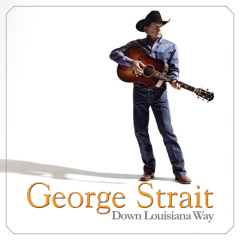
About the song
"Down Louisiana Way," written by Aaron Barker, Donny Kees, and Sanger D. Shafer, appears as the fifth track on George Strait's 15th studio album, Lead On. The album was recorded in Nashville at the Emerald and Sound Stage studios in April 1994, with Tony Brown and George Strait producing. Lead On, which was released on November 8, 1994, produced four Top 10 singles, and has sold over a million copies to date. The personnel on the album are: George Strait (lead vocals), Eddie Bowers (drums), Stuart Duncan (fiddle and mandolin), Buddy Emmons and Paul Franklin (steel guitar), Brent Mason and Steve Gibson (electric and acoustic guitar), Glenn Worf (bass), Matt Rollings (piano), and Steve Nathan (organ). Lead On went to #1 on the U.S. Billboard Top Country Albums chart, and #26 on the U.S. Billboard Top 200 Albums chart.
George Strait is an American country music singer, songwriter, actor and music producer from Texas. Also known as "King George," and “the King of Country," Strait has released 29 albums so far in his career, all on MCA Records. He has had 61 #1 songs on the country music charts, more than any other artist in any genre. He has had 13 multi-platinum, 33 platinum and 38 gold albums, with more than 68 million records sold in the U.S. alone. He is in third place, after Elvis and The Beatles, among recording artists with the most gold and platinum albums in the history of music. Strait also holds the record for the most Country Music Association (CMA) and Academy of Country Music (ACM) awards. He is still recording and touring to this date.