
The natural gas market dynamics that were expected to turn gas flow patterns and price relationships in the Eastern U.S. on their heads and, in turn, transform supply-demand dynamics in Louisiana — including around the U.S. price benchmark Henry Hub — have come to fruition. LNG exports have surged as new liquefaction and export terminals have come online, injecting a new demand source along the Louisiana coastline. Producers have lined up to serve that demand. And midstreamers have worked to get the gas there, reversing and expanding existing northbound pipelines to move gas south into and through the Bayou State. Now, Louisiana’s gas market is nearing a critical juncture: the pipelines that connect the supply gateways in northern Louisiana to the demand centers along the Gulf Coast are nearing saturation. Today, we begin a series providing an update on Louisiana’s gas pipeline constraints and the projects lining up to alleviate them.
We first discussed the Louisiana’s emerging bottlenecks two years ago in the Born on the Bayou series. At the time, the next phase of the great gas pipeline flow reversal was just coming into view. Gas production in the offshore Gulf of Mexico was steadily declining even as the need for gas supplies for LNG exports along the coast was ramping up. Historical flow patterns moving gas from offshore Louisiana north and east to Northeast and Midwest markets had flipped. A deluge of supply from the Marcellus/Utica was headed south on reversed and new pipelines, much of it bound for northern Louisiana, and production from northeastern Louisiana’s Haynesville Shale was in full growth mode after an extended plateau through the mid-2010s. With the supply influx and demand growth both bearing down on Louisiana and Henry Hub, the questions were, how would all that affect the Bayou State’s supply-demand dynamics, and could the pipeline infrastructure withstand it?

Visualize the infrastructure behind U.S. NGL movement.
The U.S. NGLs Map provides a comprehensive view of the transport, processing, and export networks moving NGLs across the U.S.
A rigorous analysis of pipeline flows and upcoming pipeline and LNG export projects at the time revealed an impending tectonic shift in the Louisiana gas market that would involve severe bottlenecks appearing by this year (2020) if additional pipeline capacity wasn’t built to move gas south from northern Louisiana. As we concluded in Part 6 of the Born on the Bayou series, gas flows into northern Louisiana would continue rising as Marcellus/Utica production climbed and more Gulf-bound pipeline capacity was completed; Haynesville production would keep increasing as well, and the combination of inflows and in-state production would bring a lot more supply to northern Louisiana. But only a limited amount of that would be able to move to Southeast/Gulf demand centers, given that eastbound routes out of the Perryville Hub in northern Louisiana would fill up quickly. Gas also was unlikely to move west, given the unrelenting competition from growing Permian supplies. Thus, much of that incremental supply would get funneled south via existing pipelines through central Louisiana. But that route too had limited capacity, much less than the projections for supply inflows into the state. The implication, then, was that as more gas was needed at the coast and pipeline capacity to get it there was limited, transportation capacity constraints were not far off, and that as those developed, the price spread between northern and southern Louisiana would widen such that midstreamers would jump in to build out additional capacity.
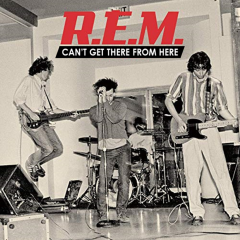
About the song
"Can't Get There from Here" was written by Bill Berry, Peter Buck, Mike Mills and Michael Stipe, and appears as the first cut on side two of R.E.M.'s third studio album, Fables of the Reconstruction. Released as the first single from the album in June 1985, the record went to #14 on the Billboard Top Rock Track Singles chart. It was the first R.E.M. song to feature a horn section. Personnel on the record were: Bill Berry (drums, backing vocals), Peter Buck (guitar, banjo, harmonica), Mike Mills (bass, piano, backing vocals), Michael Stipe (lead vocals), David Bitelli (tenor, baritone sax), Jim Dvorak (trumpet) and Pete Thomas (tenor sax).
Fables of the Reconstruction was recorded at Livingston Studios in London between February-March 1985, with Joe Boyd producing. Lyrically, the album explores the mythology of the American South in the same manner that many of the songs on Tom Petty and the Heartbreakers March 1985 release, Southern Accents, did. Both bands have roots in the Deep South. Released in June 1985, the album went to #28 on the Billboard 200 Album chart, and has been certified Gold by the Recording Industry Association of America.
R.E.M. was an American rock band formed in Athens, GA, in 1980 by Michael Stipe, Peter Buck, Mike Mills and Bill Berry. The band released 15 studio albums, four live albums, 16 compilation albums, one soundtrack album, six EPs and 63 singles. They have sold more than 85 million records worldwide. R.E.M. has won two Billboard Music Awards, three Grammy Awards, 12 MTV Music Video Awards, and are members of the Rock and Roll Hall of Fame. The band disbanded amicably in September 2011. The former members have continued on with various solo musical projects.