The growing number of energy-intensive data centers coming online across the U.S. is spurring utilities to ramp up their plans for adding new sources of power generation — including a slew of gas-fired plants — and also complicating their efforts to rely more on renewable resources and decarbonize the power grid. The push to quickly develop new energy infrastructure is also running into well-documented issues with permitting such projects. In today’s RBN blog, we discuss the proliferation of massive data centers — many of them catering to the surge in interest in artificial intelligence (AI) — and what that means for utilities and power-related demand for natural gas.

The replay of our Fall 2026 School of Energy (September 9 & 10, Houston) is now available online!
Learn from RBN experts, participate in hands-on Excel modeling, connect with industry peers, and gain a stronger understanding of today's interconnected energy markets.
U.S. electricity consumption totaled 4.07 trillion kilowatt-hours (kWh) in 2022, the highest on record and 14 times greater than in 1950, according to the Energy Information Administration (EIA). As shown in Figure 1 below, electricity use increased in all but 11 years between 1950 and 2022, although the recent trends tell a more complex story — eight of those year-over-year decreases have occurred since 2007 thanks to efforts to improve energy efficiency and reduce power usage. But things are changing, and quickly.
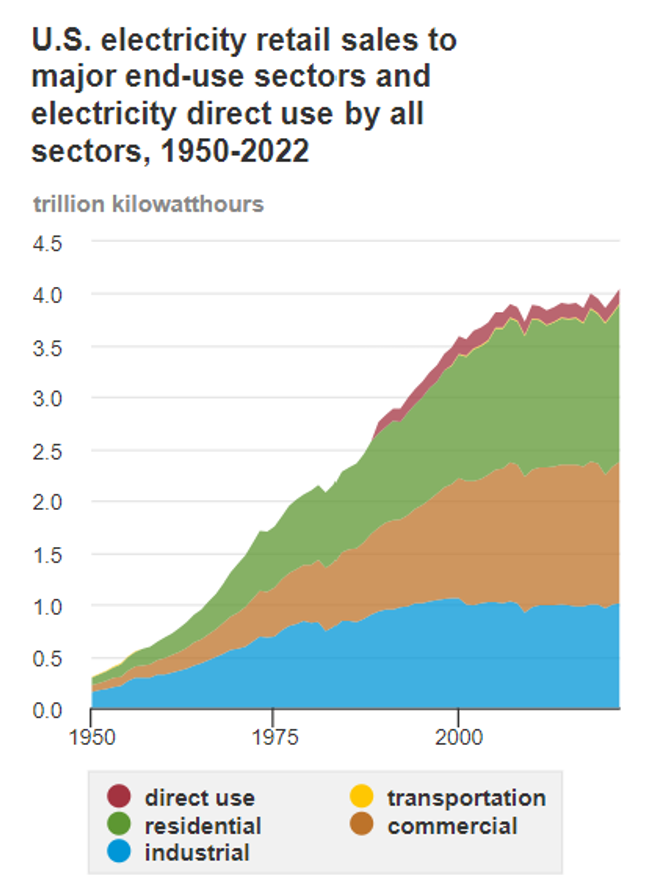
Figure 1. U.S. Electricity Retail Sales to End-Use Sectors, 1950-2022. Source: EIA
The EIA expects the U.S. to set new power-demand records in 2024 and 2025, and fast-rising demand from AI-focused data centers, electric vehicles (EVs) and the “electrification of everything” strongly suggest that we’re in for an extended period of power-generation development. The EIA sees U.S. energy consumption steadily increasing through 2050, with electricity playing an increasingly large role. As shown in Figure 2 below, total energy consumption, including electricity use, increases by as much as 15% from 2022 to 2050 across the reference and side cases in the EIA’s Annual Energy Outlook 2023 (AEO2023). The largest increases, in percentage terms, are in the industrial sector (blue-gray line), where energy consumption increases as much as 32%, and in the transportation sector (red line), where energy consumption increases as much as 8%. Changes in energy consumption in the residential (orange line) and commercial (black line) sectors are smaller and the least sensitive to change.
About the song
“Storm Front” was written by Billy Joel and appears as the first song on side two of Billy Joel’s 11th studio album of the same name. Joel said he was influenced by Peter Gabriel’s 1986 hit “Sledgehammer” for the driving rhythm section in “Storm Front.” Personnel on the record were: Billy Joel (lead vocals, Hammond B-3 organ, Clavinet), Jeff Jacobs (synthesizers, horn arrangement), Mick Jones (guitar), David Brown (guitar solos), Schuyler Deale (bass), Liberty DeVitto (drums), Crystal Taliefero, Frank Lloyd, Richard Marx (backing vocals), Lenny Pickett, Andrew Love (saxophones), and Wayne Jackson (trumpet, trombone).
The album, Storm Front, was recorded in 1988-89 at the Hit Factory, Right Track, and Power Station in New York City, and The Warehouse in Vancouver, BC. Produced by Billy Joel and Mick Jones, it was released in October 1989. It went to #1 on the Billboard 200 Albums chart and has been certified 4x Platinum by the Recording Industry Association of America. Joel changed up his backing band for this album and added additional musicians for the recording. Seven singles were released from the LP.
Billy Joel is an American singer, songwriter and pianist. Nicknamed the “Piano Man” after his 1973 hit song of the same name, he has been a successful solo artist since the seventies. Joel began his music career in 1965, playing on sessions for Kama Sutra Records and in rock cover bands. He was a member of The Hassles, which released two LPs, and Attila, a heavy metal duo that released one album. Joel released his first solo studio album in 1971. He has released 13 studio albums, seven live albums, 18 compilation albums and 82 singles and has sold more than 150 million records worldwide. He has won five Grammy Awards and is a member of the Rock and Roll Hall of Fame. Joel is the recipient of Kennedy Center Honors, a Gershwin Prize from the Library of Congress, and has a star on the Hollywood Walk of Fame. In April 2024, Joel was featured in a broadcast on CBS Television of his 100th performance at Madison Square Garden. He continues to record and perform.