


The pace of data center development accelerated in 2024, raising questions about how to power these energy-hungry behemoths. Natural-gas-fired plants are a go-to approach to helping local utilities provide the reliable, around-the-clock electricity that large-scale data centers need. Now, two giant oil and gas companies, ExxonMobil and Chevron, want to do something they’ve never done before: build gas-fired plants and sell power exclusively to data centers. And some utilities are partnering with big-tech companies on power plants of their own. In today’s RBN blog, we’ll discuss data center power needs and the unusual notion of building big gas plants to serve those customers.

The Natural Gas Master Class is a one-day online event focusing on understanding flow analysis, interpreting pipeline data and forecasting future flows. This course is designed to equip you with the knowledge and skills to effectively analyze the complexities of natural gas markets, flow analysis, and pipeline modeling. Join us online
October 21 | Online
What’s a Data Center?
Let’s start with the basics. As we discussed in Storm Front, a data center is the home for hundreds or even thousands of networked computers that process, store and share data. Data centers — many of them owned and operated by tech giants like Amazon, Google, Meta and Microsoft (see photo below) — are among the most energy-intensive building types, consuming up to 50 times the energy per square foot of a typical commercial office building, with electrical demand at larger facilities ranging from 100 megawatts (MW) to 2,000 MW. [For perspective, we noted in Just Can’t Get Enough that a city the size of Lubbock, TX, (population 267,000) requires about 700 MW.] Demand for data centers has grown exponentially with the expansion of artificial intelligence (AI) tools like ChatGPT and Perplexity, which demand far more computational power — and energy — than conventional Google searches.
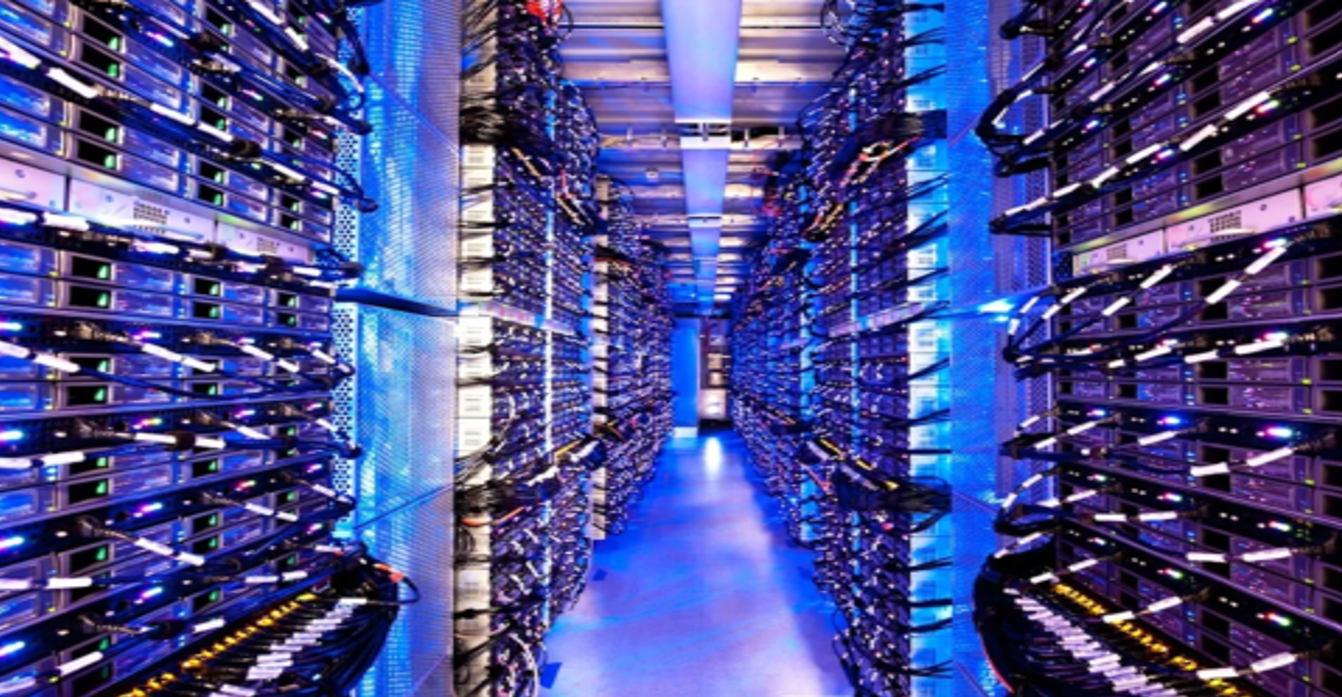
The Interior of a Microsoft Data Center. Source: Microsoft
Now, we’ll dive into the news. Chevron and ExxonMobil announced separately in December that they are each exploring ways to jump into the electricity-supply business by using natural gas (with carbon capture and sequestration, or CCS) to power data centers. Each said they do not intend to put the electricity from these new plants on the overall power grid; instead, the plants’ output would be dedicated to the data center customer.

About the song
“Dive In” was written by Dave Matthews and Carter Beuford and appears as the sixth song on Dave Matthews Band’s seventh studio album, Big Whiskey and the GrooGrux King. Dave Matthews has said, “It’s a really dark song. It’s really about the possible end of everything. I tried to disguise it as an ‘everything’s going to be fine’ kind of song.” Personnel on the record were: Dave Matthews (vocals, lead guitar), Stefan Lessard (bass), LeRoi Moore (saxophone), Boyd Tinsley (violin), Carter Beauford (drums, percussion), Rob Cavallo (keyboards), and Joel Derouin (strings arranger and conductor).
Big Whiskey and the GrooGrux King was recorded between November 2007 and February 2009 at Haunted Hollow in Charlottesville, VA; Studio Litho and Studio X in Seattle; Piety Studio in New Orleans; Electric Lady Studios in New York City; Capitol Studios in Hollywood; and Lightening Sound Studios in Hidden Hills, CA. Produced by Rob Cavallo, the album was released in June 2009 and went to #1 on the Billboard 200 Albums chart. It has been certified Platinum by the Recording Industry Association of America (RIAA). The album’s title refers to the band’s saxophonist, LeRoi Moore, who died in 2008 from an ATV accident after the album was completed. Three singles were released from the LP.
Dave Matthews Band is an American rock band formed in Charlottesville, VA, in 1991 by Dave Matthews, Stefan Lessard, Carter Beauford, Boyd Tinsley and LeRoi Moore. Matthews, Beauford and Moore started making song demos together in 1991. After putting a full band together and gaining popularity in Charlottesville clubs, they released their first LP on their Bama Rags label in 1993 (it was later re-released by RCA in 1997 and achieved RIAA Platinum status). The band has released 10 studio albums, 85 live albums, three compilation albums, two EPs and 36 singles and have sold more than 38 million records worldwide. They have won a Grammy Award and were inducted into the Rock and Roll Hall of Fame in 2024. Eleven members have passed through the band since its formation. Original members Matthews, Lessard and Beauford are still in the group. They continue to record and perform live.







Comments
I don't agree with the comment in your blog on powering data centres to the effect that the strategy of direct energy use is an "unusual notion of building big gas plants to serve individual customers". Lots of US facilities like refineries incorporate on site generation. The EIA in its annual electricity table (see link below estimates that about 3% of US electricity is generated for direct use. This is likely about 10% or so of electricity used by industry. If I understand the EIA's methodology correctly, this only counts the electricity generated by the user, so these numbers don't capture the onsite generation from plants owned by third-party lessors on industrial sites. It may not be mainstream, but it doesn't really fit into the category of "unusual".
https://www.eia.gov/electricity/annual/table.php?t=epa_02_02.html
Hey, Thanks so much for your comment. We really appreciate it. We did tweak the blog to indicate that our reference of "unusual" was not just about serving individual customers, but specifically data centers. Thanks again and we always love seeing more stats!
Appreciate the "dive in" to this topic. Look forward to updates on actual data center power demand.