The growing number of energy-intensive data centers coming online across the U.S. is spurring utilities to ramp up plans to add new sources of power generation but also complicating efforts to decarbonize. One of the hottest topics in energy today is how plans to restart shuttered nuclear plants and build new small modular reactors (SMRs) could help accomplish both goals. In today’s RBN blog, we’ll look at why data centers and nuclear power seem like a natural fit, examine which shuttered plants might be brought back to life, and outline plans by a pair of U.S. economic titans to bring new advanced reactors online.

The Natural Gas Master Class is a one-day online event focusing on understanding flow analysis, interpreting pipeline data and forecasting future flows. This course is designed to equip you with the knowledge and skills to effectively analyze the complexities of natural gas markets, flow analysis, and pipeline modeling. Join us online
October 21 | Online
As we discussed in Uranium Fever, the U.S. generates more nuclear power than any other country even though very little has been built over the last 30 years. Large nuclear power plants can produce more than 1,000 megawatts (MW) of uninterruptible power and deliver up to 24 million kilowatt-hours (kWh) per day while generating no greenhouse gas (GHG) emissions. That has led to efforts to bring shuttered reactors back to life, including the 800-MW Palisades nuclear plant in Michigan, which we detailed in Coming Back to Life. The plant on the shores of Lake Michigan was closed in May 2022, then sold to Holtec International the following month. A Holtec subsidiary began the decommissioning process for the Palisades site but soon decided it would be more beneficial to restart it instead. Thanks in part to a $1.52 billion loan guarantee from the U.S. Department of Energy (DOE), Holtec hopes to re-energize the plant by October 2025. (There is no established regulatory framework to restart a power plant where the decommissioning processes had already begun, and there is plenty of work that needs to be done at the site, so it’s difficult to say how long the restart process might actually take. That timeline could be further challenged by widespread stress cracking recently found in the tubes of the plant’s two steam generators.)
Restarting nuclear reactors like Palisades is one solution to meet the expected energy demand of large-scale data centers popping up across the U.S. As we wrote in Storm Front, the surge in data centers is a major reason for the expected spike in electricity consumption. According to the Energy Information Administration (EIA), U.S. electricity consumption totaled 4.07 trillion kWh in 2022, the highest on record and 14 times greater than in 1950. Data centers are pushing power demand higher primarily because artificial intelligence (AI) services like ChatGPT require far more energy than a simple web search. For instance, a Google search requires about 0.0003 kWh; a ChatGPT query is estimated to need as much as 0.01 kWh — or 30X a simple search. The demand issue is rampant across the U.S., with some utilities warning about the potential long-term impact on their residential and industrial customers.
Data centers and nuclear power are increasingly seen as a compelling combination for two main reasons:
Quantity and Quality: Many data center operators would prefer to rely on uninterrupted, carbon-free power, but that’s a tricky combination since wind and solar power are intermittent and baseload power provided by gas or coal plants comes with greenhouse gas (GHG) emissions. Nuclear provides the opportunity to meet both goals. For decades, nuclear power has been the largest source of clean energy in the U.S., accounting for 19% of total energy produced in 2023. (Nuclear power plants also typically generate power at relatively low operating costs when compared to other power sources, according to the EIA.)
Potential at Existing Infrastructure: A dozen nuclear reactors, totaling 9,436 MW of generating capacity, closed in the U.S. from 2013-21, primarily for economic reasons, and could be considered for restart to meet future demand needs. The DOE evaluated 54 operating and 11 recently retired nuclear power plant sites, identifying 41 suitable for hosting new reactors. According to the report, these sites could deliver 60,000 MW (60 GW) or more of electric power using large light-water reactor technology, or up to 95,000 MW (95 GW) with smaller modular reactors (SMRs; more on those in a bit).
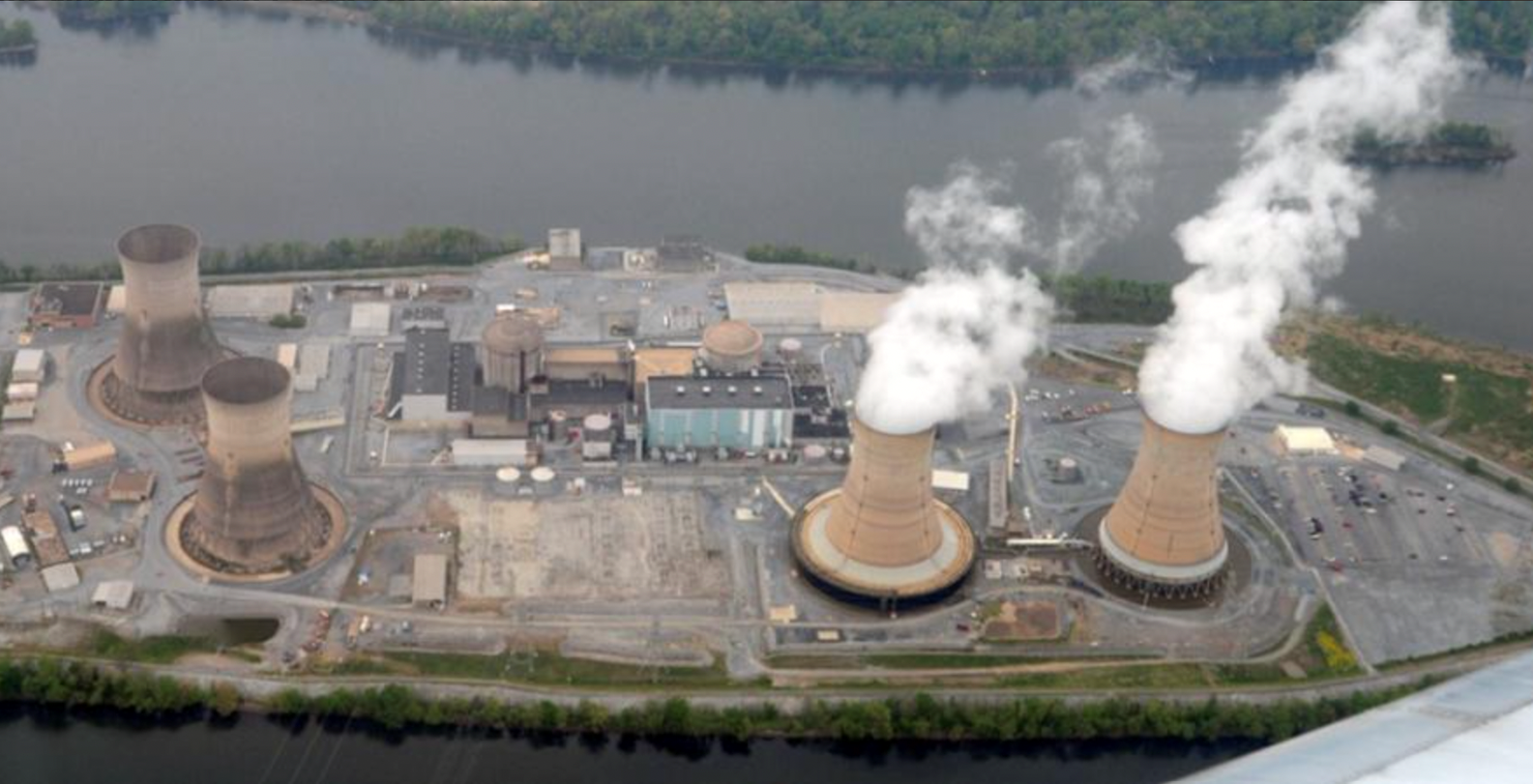
The Three Mile Island Nuclear Station. Source: Constellation Energy
About the song
“We’ll Be Together” was written by Sting and appears as the first song on side three of Sting’s second solo studio album, the double-LP Nothing Like the Sun. Sting originally wrote the song as a beer commercial for the Kirin Brewery Company. Released as a single in October 1987, it went to #7 on the Billboard Hot 100 Singles chart. Personnel on the record were: Sting (lead vocals, bass), Eric Clapton (guitar), Manu Katche (drums), Kenny Kirkland (keyboards), Branford Marsalis (saxophone), Mino Cinela, Andy Newmark (percussion), and Renee Geyer, Vesta Williams, Dolette McDonald, Janice Pendarvis, Annie Lennox (backing vocals).
Nothing Like the Sun is Sting’s second solo studio album recorded in March-to-August 1987 at Air Studios in Montserrat and produced by Sting, Hugh Padgham, Bryan Loren and Neil Dorfsman. Released in October 1987, it went to #9 on the Billboard 200 Albums chart and has been certified 2x Platinum by the Recording Industry Association of America. The album features guest guitarists such as Andy Summers, Eric Clapton, Mark Knopfler and Hiram Bullock. Five singles were released from the LP.
Sting (Gordon Matthew Thomas Sumner) is an English singer, musician, songwriter and actor. He was the frontman and main songwriter for the new-wave band The Police from 1977 until their breakup in 1986. He launched his solo career in 1985. With The Police, he released five studio albums, three live albums, seven compilation albums, four soundtrack albums, one EP and 26 singles. As a solo artist, he has released 15 studio albums, six live albums, seven compilation albums, seven soundtrack albums, five EPs and 51 singles. Sting has appeared in 17 motion pictures, several television shows, and three Broadway shows. He has won 25 American Music Awards, 17 Grammy Awards, two MTV Video Music Awards, and seven Ivor Novello Awards, He has a CBE, a Polar Music Prize and a Kennedy Center Hono and is a member of the Songwriters Hal of Fame. In 2003 The Police were inducted into the Rock and Roll Hall of Fame. Sting continues to act, record and tour, and will be doing select dates with his Sting 3.0 band in addition to more concerts with Billy Joel in 2025.