


Since the ban on exports of U.S. crude oil was lifted in December 2015, export volumes have soared, and for the week ending October 27, 2017, they surpassed 2 million barrels/day (MMb/d) for the first time ever, according to Energy Information Administration (EIA) statistics. And while exports slowed last week, it is clear that there’s more to come. But the pace of export growth depends on many things, including the ability of Gulf Coast infrastructure to receive and store increasing volumes of West Texas Intermediate (WTI), SCOOP/STACK, Bakken and other crudes and load it onto ships — the bigger the ship the better. Fortunately, coastal Texas and Louisiana already had extensive crude-related infrastructure in place when the export ban ended just under two years ago, and elements of that have been repurposed to handle exports. Will it be enough? Today, we begin a new blog series on existing and planned storage facilities and marine terminals targeted to support rising U.S. crude oil exports.
In response to the 1973-74 oil crisis, the U.S. government in 1975 implemented a ban on the export of most U.S.-sourced crude oil — the only exceptions being oil from Alaska, oil exported to Canada, heavy oil from California and very limited trades with Mexico. Crude exports already had been minimal (only a few thousand barrels/day, on average) when the ban was put in place — in fact, exports actually rose in the late 1970s as Alaska North Slope (ANS) production kicked in (exports peaked, for the time, at 287 Mb/d in 1980). By the early 2000s, though, ANS was on the decline and crude exports amounted to a drop in the bucket, averaging less than 30 Mb/d. With the Shale Revolution, U.S. production of crude oil (including condensate — the ultra-light crude produced in a number of tight-oil plays) started rising, and by 2014, U.S. producers provided most of U.S. refiners’ need for lighter grades of oil, reducing the need for imported light crude in the process. (The increasing availability of heavy western Canadian crude to U.S. refiners also trimmed the need for overseas imports of heavier crude.) As U.S. production continued to rise, stockpiles of lighter crudes built up and the spread between West Texas Intermediate (WTI; the key benchmark for U.S. light crudes) and international benchmark Brent widened. Some relief for U.S. producers came in June 2014, when the U.S. Commerce Department broadened its definition of refined products (whose export was never banned) to include condensate that was minimally processed (run through a stabilizer or other unit so it could be called “processed condensate”). Exports of processed condensate took off, peaking in December 2015 (the month the crude export ban was lifted) at more than 150 Mb/d. But processed condensate couldn’t be counted as crude exports — after all, it was processed.
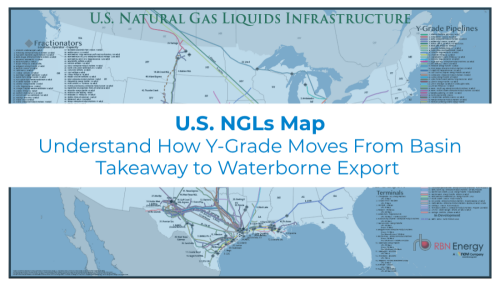
Visualize the infrastructure behind U.S. NGL movement.
The U.S. NGLs Map provides a comprehensive view of the transport, processing, and export networks moving NGLs across the U.S.
Before the crude export ban was lifted, small volumes of crude were being exported — an average of about 350 Mb/d in 2014 and 465 Mb/d in 2015 (red horizontal line in Figure 1), mostly to Canada (pink bar segments). Back then there were tiny amounts of crude exports to countries other than Canada under export ban waivers issued by the Department of Commerce. When the export ban became history in December 2015 (vertical green dashed line), exports to countries other than Canada started to ramp up (blue bar segments), pushing crude exports to an average of 600 Mb/d in 2016, with about 60% of the exported crude going to Canada and the other 40% going elsewhere. Crude exports really took off in 2017, averaging about 950 Mb/d through September. In October, exports spiked to average almost 2 MMb/d — in part because of aberrations related to Hurricane Harvey (which hit the Texas coast at the end of August) and a wide spread between WTI and Brent prices (making exported barrels particularly attractive). Crude exports hit an all-time record of 2.13 MMb/d in EIA’s weekly statistics for the week ended October 27, 2017. The incremental exports in 2017 have mostly moved to overseas markets; exports to Canada have held relatively steady.
About the song
“Rockin’ in the Free World” was a track on Neil Young’s 1989 album, Freedom, and was also included on his Greatest Hits album in 2004. The idea for the song came from Young’s longtime collaborator, guitarist “Poncho” Sampedro, who remarked to Neil after seeing American flags burned during the funeral procession of Iranian leader Ayatollah Khomeini that they should stay out of the Middle East for a while and “keep on rockin’ in the free world” where it was safer. The song soon became an anthem for the collapse of communism, symbolized by the fall of the Berlin Wall.
Neil Young played in a few Toronto bands, including a stint with the Minah Birds, which included Rick James, before gassing up his 1953 Pontiac hearse and moving to Los Angeles in 1966. Once there, he teamed up with old pal Stephen Stills and formed Buffalo Springfield, whose first hit was "For What It's Worth," a song about the riots on Sunset Strip that hit a chord with disenfranchised youth in America at that time.
Neil has often been referred to as the Godfather of Grunge, due to his gritty, distorted guitar work. He has released 53 solo albums, three Buffalo Springfield albums and 19 releases with various forms of Crosby, Stills, Nash & Young in his career.
Below are pictures of Neil: one with first hearse, a 1948 Buick Roadmaster; and one with his LincVolt:






Comments
Thanks Housley, good piece. While you rightly point out that several USGC ports can export crude, to me draft restrictions remain a critical problem for export econs from the region. Placing Afras & Suezs full of of Permian crude into Asian markets probably looks quite difficult when competing with Very Large Crude Carries (VLCCs) of similar light, sweet grades from West Africa. To my understanding, reverse-lightering onto these larger vessels adds a lot of cost to the export and makes it less competitive. This is why the LOOP reversal would be so huge -- the only VLCC port on the USGC to my understanding.
In reply to Draft Restrictions by Philippe Casey
https://www.bizjournals.com/sanantonio/madness/supertankers-tested-at-port-corpus-christi.html
Corpus will be able to load a VLCC two-thirds of the way by late 2018. The dock can hold it fine.
Good article, but two comments:
1. It's not the WTI/Brent spread that is driving export. Very common misconception. It is the Gulf Coast price to Brent driving export. (LLS to Brent or WTI-Houston to Brent). EIA discussed this properly on pages 4 and 5 of the most recent Short Term Energy Outlook. Most of the WTI/Brent differential is actually piping constraints between Cushing and the Gulf. Exports don't relieve that.
2. It's curious to me to learn how few ultra-deep draft ports we have. I know that aircraft carriers and submarines are deep-draft and need 50+ feet channels. And we have all kinds of Navy bases for them. I guess the VLCCs are even deeper. Also, as far as the cost of lightering, how much incoming crude does not go through LOOP and has to pay that on the IMPORT side? Seems like an opportunity for improvement.