Even as many countries and companies around the world continue to ramp up their use of wind and solar power and explore the potential for a variety of renewable, low-carbon and no-carbon fuels, there’s a growing acknowledgment that natural gas — imperfect as it may be from a climate perspective — will remain a significant part of the global energy mix for decades to come. So why not make natural gas as clean as it can be by reducing emissions of methane — gas’s primary component and a particularly potent greenhouse gas? That’s the driver behind the certified gas movement, the focus of a new Drill Down Report that we discuss in today’s RBN blog.
First, a definition: Certified natural gas is gas that an independent third party has verified as being produced, gathered, processed, transported and/or distributed in a way that meets higher environmental standards or, more specifically, has a demonstrably lower methane intensity, or MI. For the most part, the certified gas movement has focused on the upstream end, namely where gas is produced, either in gas-focused plays like the Marcellus/Utica and the Haynesville or crude-oil-focused plays like the Permian and the Bakken, where large volumes of associated gas (a mix of methane, NGLs and various impurities) emerge from wells with crude oil.
The global push to slash methane emissions from upstream operations (and, to a lesser extent so far, from midstream and downstream operations) and certify gas as having significantly lower MI has been accelerating and broadening. It now seems possible that within a couple of years the majority of gas produced in the U.S. will be certified as being low-MI, and that increasing numbers of gas buyers — power generators, industrials, LNG exporters and local distribution companies (LDCs) among them — will be insisting on certified gas, or at least moving toward doing so. Further, a certified gas market is developing (a handful of trading platforms have already been launched), as are tracking systems to ensure that gas sold as certified is fully accounted for and legit, with no double-counting or fuzziness.
Let’s acknowledge three things up front. First, for either certified or plain-old natural gas, the volumes of methane, carbon dioxide (CO2), and other greenhouse gases (GHGs) generated from the production wellhead to the point where the gas is to be burned pale in comparison with the massive volumes of GHGs released by the combustion of that gas by end-users. For that reason, many environmental activists openly question the real value of certified gas. (Some also question the efficacy of various methane-detection devices.) Second, there’s the physical reality that while a producer, a pipeline company, and an LNG producer or LDC may reach a deal to supply, deliver, and receive X amount of certified gas per day, that lower-MI gas is blended in the pipeline with “non-certified” gas from other sources and the end-user in fact receives a mix of certified and non-certified gas molecules. Third, while the International Energy Agency (IEA) says the U.S. oil and gas industry emits more methane into the atmosphere than its counterparts in any other country (blue bars and left axis in Figure 1 below), that’s largely because the U.S. is far and away the largest producer. Yet, the MI of its operations (gold dots and right axis) are among the lowest, in part because of concerted efforts by U.S. producers to detect and repair leaks and thereby maximize the amount of gas that can be sold.
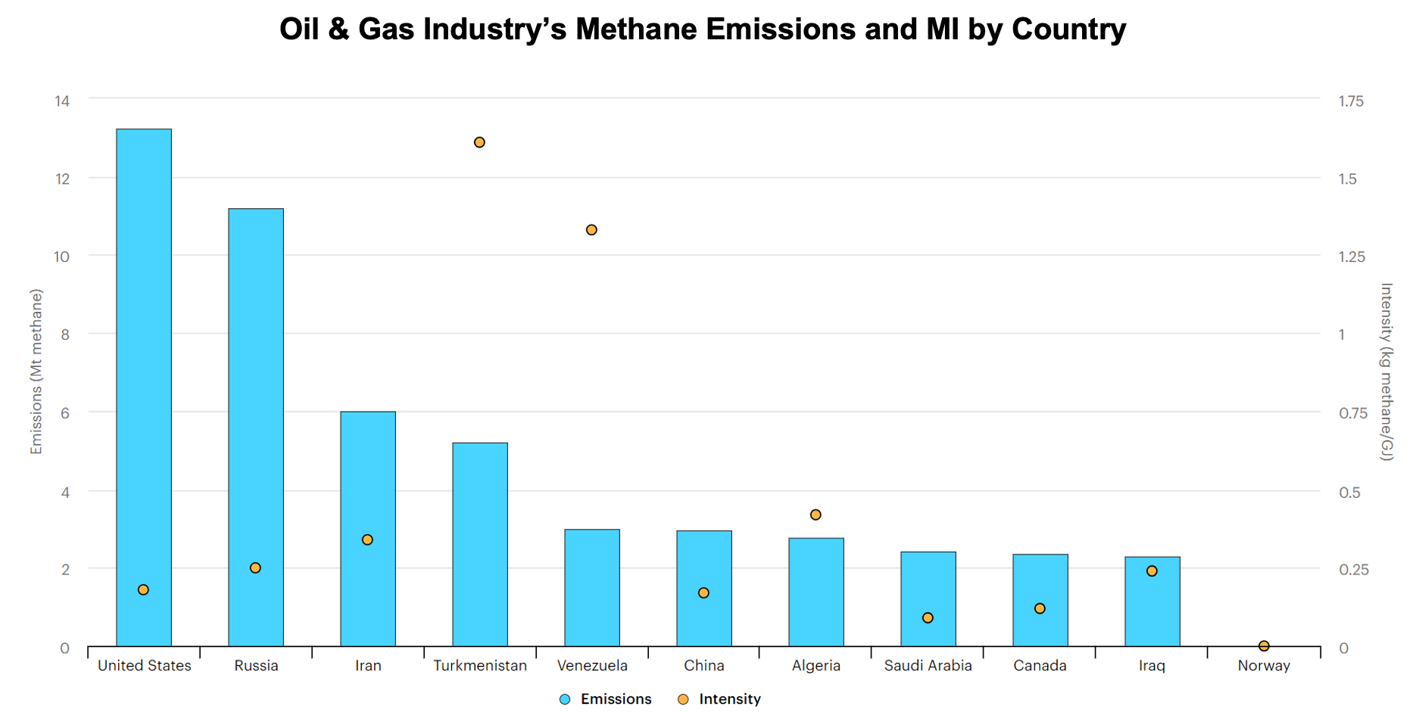
Figure 1. Oil & Gas Industry’s Methane Emissions and MI by Country. Source: IEA
About the song
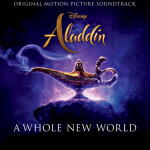
“A Whole New World,” with music by Alan Menken and lyrics by Tim Rice, appears as the ninth song on the Aladdin: Original Motion Picture Soundtrack album. Brad Kane and Lea Salonga, in their respective roles as Aladdin and Jasmine in the movie, sing the duet together in the film, with the song serving as the film’s theme song. It won Grammy Awards for Song of the Year and Best Song Written Specifically for a Motion Picture at the 30th Annual Grammy Awards. It also won an Academy Award and a Golden Globe Award. Peabo Bryson and Regina Bette released a pop single of the song in November 1992. It went to #1 on the Billboard Hot 100 Singles chart and has been certified Gold by the Recording Industry Association of America (RIAA). It was the first song from a Disney animated film to top the Hot 100 Singles chart. Their single won the Grammy Award for Best Pop Performance by a Duo or Group with Vocals at the 30th Annual Grammy Awards.
The album, Aladdin: Original Motion Picture Soundtrack, was recorded between 1988 and 1992 and produced by Alan Menken, Tim Rice and Walter Afanasieff. It won composers Menken and Rice two Academy Awards, two Golden Globe Awards and a Grammy Award. The soundtrack featured vocal performances by Bruce Adler, Brad Kane, Lea Salonga, Robin Williams, Jonathan Freeman, Peabo Bryson and Regina Belle. Released in October 1992, it went to #6 on the Billboard 200 Albums chart and has been certified 3x Platinum by the RIAA. “A Whole New World” was the only single released from the LP.
Aladdin is a 1992 American animated musical fantasy comedy film produced and released by Walt Disney Pictures. Based on the Arabic folk tale “Aladdin” from “One Thousand and One Nights,” the film was produced by John Musker and Ron Clements. Released in November 1992, the motion picture grossed $504.1 million at the box office.