As demand for data centers accelerates, developers continue to search for locations that offer the best combination of several factors, starting with the availability of uninterrupted (and affordable) power. Those variables have led to a data-center buildout in several parts of the U.S., such as Northern Virginia, Texas and California’s Silicon Valley, but Canada has its own set of positives to lure developers. In today’s RBN blog, we look at the state of data-center development in Canada, how the factors that affect site selection differ from the U.S., and how Canada is working to become a bigger player in the global market.

Demand for data centers (see Storm Front), which are home to thousands or even tens of thousands of networked computers that process, store and share data, has grown significantly with the expansion of artificial intelligence (AI) tools like ChatGPT and Perplexity, which demand far more computational power (and energy) than conventional Google searches. The prospect of a massive buildout of data centers has utilities just about everywhere preparing for a surge in power demand (see Where You Lead I Will Follow). And while access to uninterrupted power is a critical factor for companies deciding where to build a data center, it’s not the only variable — power prices, access to fiber-optic networks and climate also play a major role, and there are some significant differences between the Canadian and U.S. markets.
North America is the global leader in data center development, with about a 40% market share, with virtually all of that in the U.S., which has nearly 4,000 sites in operation, according to DataCenterMap.com. Canada has 283 data centers in operation, and while that’s less than 1% of the U.S. total, it still makes Canada a Top 10 market globally. The majority of Canadian data centers are located in major population centers near the country’s U.S. border (see Figure 1 below), including Toronto (86), Montreal (58) and Vancouver (29), although some are located in more remote areas, and Alberta has big plans to ramp up investment there (more on that in a bit).
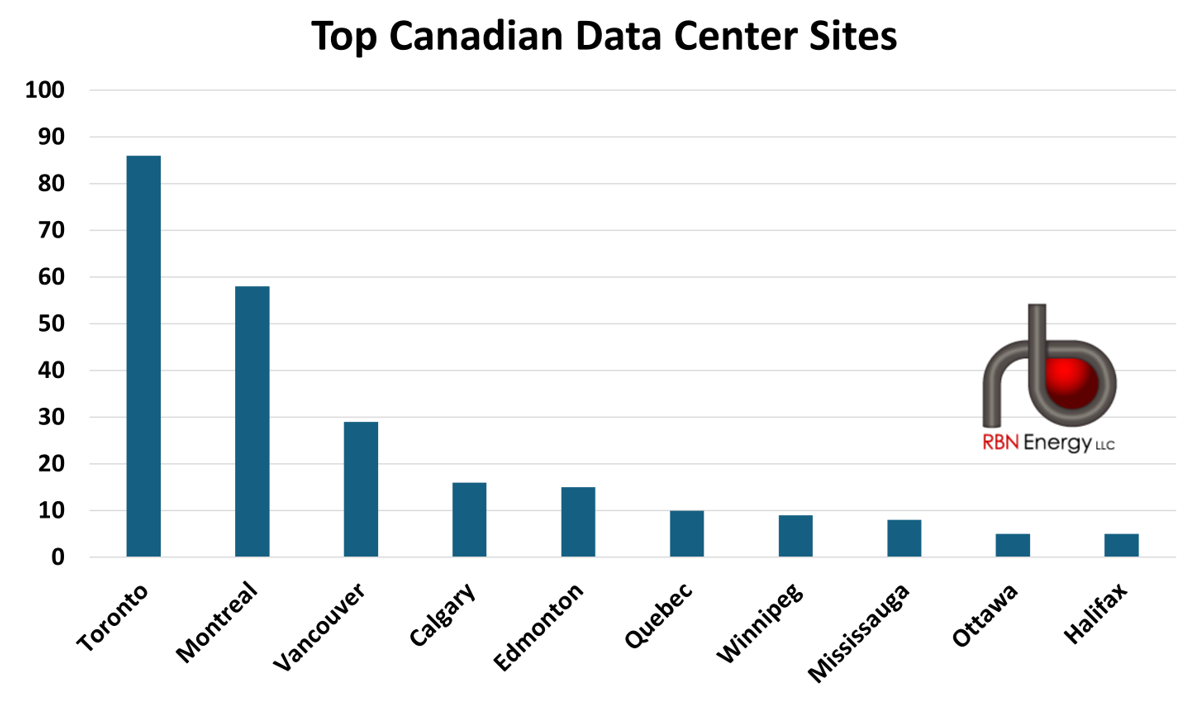
Figure 1. Data Center Locations in Canada. Source: DataCenterMap.com
About the song
“Finding My Way” was written by Geddy Lee and Alex Lifeson and appears as the first song on side one of Rush’s eponymous debut album. Rush drummer John Rutsey performed on the album but left after its release to be replaced by Neal Peart. The song was released as a single on Mercury Records in August 1974 but failed to chart. Personnel on the record were: Geddy Lee (lead vocals, bass), Alex Lifeson (guitar, backing vocals) and John Rutsey (drums, percussion, backing vocals).
The album, Rush, was recorded at Eastern Sound and Toronto Sound in Toronto in the summer and fall of 1973. Both studios were eight-track facilities. Its hard-rock sound reflected the band’s influences of Led Zeppelin, Cream and Yes. Produced by Rush, it was first released on the band's indie label, Moon Records, with 3,500 copies pressed. Radio station WMMS in Cleveland began playing the cut “Working Man” in heavy rotation, which led to the band being signed by Mercury Records. They re-released the album in March 1974 and it went to #105 on the Billboard 200 Albums chart. It has been certified Gold by the Recording Industry Association of America. Two singles were released from the LP.
Rush was a Canadian progressive rock band formed in Toronto in 1968. The band’s primary lineup featured Geddy Lee on lead vocals, bass, keyboards and synth pedals; Alex Lifeson on guitar and backing vocals; and Neal Peart on drums, percussion and backing vocals. They released 19 studio albums, 11 live albums, 12 compilation albums, two EPs and 38 singles. They have sold more than 40 million records worldwide. They are members of the Rock and Roll Hall of Fame, are Officers of the Order of Canada, and have a star on the Hollywood Walk of Fame. Nine members have passed through the group since its inception. The band officially disbanded in 2021, one year after the death of Neal Peart in January 2020 at 67.