The rapid development of the Permian’s vast hydrocarbon resources that we expect will continue through the 2020s and beyond can’t happen if there’s insufficient gathering-pipeline infrastructure in place to transport crude from well sites to takeaway pipelines. Similarly, the favorable pricing that Permian producers hope to receive for their crude oil is possible only if their gathering systems are interconnected to two or more long-haul, big-bore pipelines that offer them some serious destination optionality. The need for new gathering pipes with multiple links to Gulf Coast- and Cushing-bound takeaway pipes is the driving force behind the Beta Crude Connector, a planned 100-mile-plus pipeline network in the heart of the Permian’s Midland Basin that was unveiled on Monday (April 15) by a joint venture of Concho Resources and gathering specialist Frontier Energy Services. Today, we kick off a new blog series on crude-gathering projects in the Permian with a look at the Concho/Frontier plan.
Gathering pipelines play a critically important — but often overlooked — role in the midstream sector. These hydra-like systems, with a number of small-diameter-pipe “tentacles” feeding larger-bore pipes downstream, provide the most cost-effective means of transporting crude oil from the lease to storage and to takeaway pipelines. The rapid development of new, high-intensity production areas like the Permian’s Delaware and Midland basins depends on well-planned gathering systems; relying only on trucks to haul crude to long-haul pipelines would slow development of these areas to a crawl. As we said in our Hot Legs blog series a couple of years ago, there’s been a fierce battle on to build new gathering pipelines in the Permian, and midstream companies better bring their A game. Why? Because successfully developing these systems requires a keen understanding of three key factors: lining up producer commitments, providing takeaway optionality, and minimizing the total cost of moving crude from the lease to the Gulf Coast, Cushing or other destinations. Takeaway optionality is particularly important. Producers want to get the highest possible price per barrel, and the best way to do that is to have access to the destination that offers the best price at a given moment. (See our recent Hard Hat and a Hammer for more on Midland-Cushing differentials.)
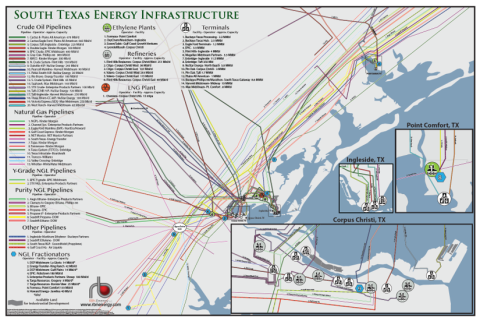
RBN Energy’s South Texas Energy Infrastructure Map brings together all the pieces of the critical and complex puzzle of the greater Corpus Christi region. Spanning from Point Comfort, TX to Corpus Christ, TX and south of the Agua Dulce natural gas hub, the map details the processing, transportation and export facilities in RBN Energy’s classic clear, concise and easy to comprehend style.
The Midland Basin gathering system that we discuss in our blog series opener today has a whiff of déjà vu about it. Back in 2017, we blogged about a huge gathering system that a joint venture of Concho and Frontier Energy Services developed in the Delaware Basin and then sold to Plains All American. That system — the Alpha Crude Connector, or ACC — includes more than 500 miles of gathering and shuttle pipes in the northern Delaware in southeastern New Mexico and West Texas. In laying out ACC, Frontier developed beneficial optionality for its customers by connecting the pipeline system to three major downstream pipelines that run to Midland, where these pipes connect to takeaway pipes to Cushing, Houston and Nederland, TX, among other destinations.

About the song
"Have It All" was written by Jason Mraz and members of his live backup band Raining Jane: David Hodges, Jacob Kasher Hindlin, Mona Tavakoli, Chaska Lela Potter, Mai Sunshine Bloomfield and Rebecca Emily Gebhardt. It was the lead single from his 6th studio album Know, and went to #10 on the Billboard Adult Top 40 chart. Mraz says the song's inspiration came from a spiritual encounter the singer had while traveling in Southeast Asia. Know was produced by Mraz and Andrew Wells, and released in August 2018. It went to #9 on the Billboard Top 200 Albums chart.
Jason Mraz is an American singer-songwriter. His use of nylon-stringed guitars and Brazilian rhythms help to make his song stylings unique. He has released six studio albums, five live albums and 17 singles, and has sold more than 7 million albums and 11 million downloaded singles. Mraz has won two Grammy Awards and two ASCAP Awards. He still records and tours to this date.