Canada has been exporting propane from marine terminals in British Columbia (BC) to Asian markets since May 2019 and, despite modest propane production volumes, it has become an integral part of the global market — Japan, for example, depends on Canada for one-ninth of its LPG. Now, the companies that co-own the larger of BC’s two LPG export terminals are planning yet another facility next door that would enable Canadian propane exports to Asia to double over the next few years. In today’s RBN blog, we discuss the AltaGas/Royal Vopak plan and its implications for Canadian producers and LPG consumers in Canada, the U.S. and Asia.
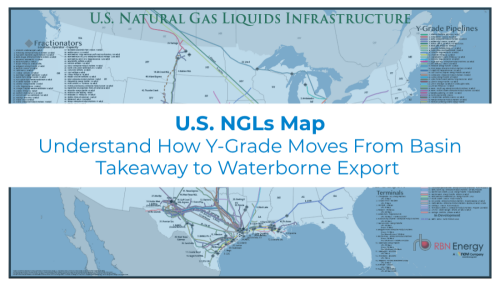
Visualize the infrastructure behind U.S. NGL movement.
The U.S. NGLs Map provides a comprehensive view of the transport, processing, and export networks moving NGLs across the U.S.
You’d think that exporting hydrocarbons from Western Canada to Asia would be a no-brainer. After all, Western Canada offers enormous crude oil, natural gas and NGL resources and Asia — a straight shot across the Pacific Ocean — has seemingly unquenchable demand. But efforts to export energy products from Canada’s West Coast to Asian markets were thwarted time and again — at least until May 2019, when propane was first exported from AltaGas and Royal Vopak’s jointly owned (70/30) Ridley Island Propane Export Terminal (RIPET; green pentagon in Figure 1), which is located south of Prince Rupert, BC. Starting with an initial nameplate export capacity of 40 Mb/d, which has since been expanded to 80 Mb/d, the terminal has been in steady operation since, relying on propane supplies railed in from the producing areas of northeastern BC and Western Alberta (CN Rail shown by the red dotted line). RIPET was joined two years later in 2021 by Pembina Pipelines’ new, 25-Mb/d Prince Rupert Export Terminal (PRET; blue pentagon), which is located a short distance from RIPET on Watson Island. PRET’s supplies also are railed in from the same production areas. (By the way, you can track propane exports from these two terminals in our NGL Voyager Report.)

About the song
“Big in Japan” was written by Marian Gold, Bernhard Lloyd, and Frank Mertens. It appears as the third song on side one of Alphaville’s debut album, Forever Young. Released as a single in January 1984, it went to #1 on the Billboard Hot Dance Club Play and #66 on the Billboard Hot 100 Singles charts. Lyricist Marian Gold said the song is about two lovers in Berlin fantasizing about being free from their addictions. Personnel on the record were: Marian Gold (lead, backing vocals), Bernhard Lloyd (keyboards, programming, electric guitar, drum machine), Frank Mertens (keyboards), Ken Taylor (bass), Curt Cress (drums, percussion), and Wolfgang Loos (keyboards, gong).
Forever Young was recorded between January-August 1984 at Studio 54 in Berlin. Produced by Colin Pearson, Wolfgang Loos, and Andreas Budde, the album was released in September 1984. It went to #180 on the Billboard 200 Albums chart. Four singles were released from the LP.
Alphaville is a German synth-pop band formed in Munster in 1982 by Marian Gold, Bernhard Lloyd, and Frank Mertens. Thirteen members have passed through the group since its formation, with Gold being the only original member still in the group. They have released eight studio albums, one live album, 10 compilation albums, and 25 singles. The band still occasionally tours and records. They released an album in September 2022, Eternally Yours, that featured symphonic versions of 16 Alphaville songs, including “Big in Japan.”