Thanks to expanding heavy crude oil production in Western Canada’s oil sands in recent years and increased pipeline access from the region to the U.S. Gulf Coast, re-exports of Canadian heavy crude from Gulf Coast terminals set a record in 2023. With additional production gains on tap in the oil sands, it might seem natural to think that another re-export record is in the works for 2024. However, assuming the much-delayed Trans Mountain Expansion Project (TMX) does indeed start up this year — offering a vastly expanded West Coast outlet for oil sands production — last year’s re-export high might end up being a peak, at least for the number of years it takes for growth in Western Canadian heavy crude production to exceed the capacity of the TMX expansion. In today’s RBN blog, we take a closer look at TMX’s likely impact on Gulf Coast re-exports.

The RBN Crude Oil Analytic Suite gives you access to four weekly reports covering crude oil markets, including: Crude Billboard, Crude Permian, Crude TradeView, and Crude Voyager.
Western Canada’s heavy crude oil production, primarily from the oil sands of Alberta, has long sought — and in recent years found — access to tidewater in much larger volumes for shipment to countries other than the U.S. These re-exports — moved from Canada to the U.S., then exported again to other nations — have become an integral part of the Canadian crude oil export picture.
It’s not that Canada has never been able to directly export crude oil from its own shores, as this has been the case for Canada’s East Coast offshore production (see I Am a Rock) since the 1990s in the form of medium and light crude oil to Europe, and modest amounts of light and heavy crude oil from its West Coast for several decades, utilizing the existing (but soon to be greatly expanded) Trans Mountain Pipeline. The problem was that with Alberta’s oil sands-related heavy crude oil production steadily increasing in recent years and no ready incremental access to export capacity from the West Coast, that heavy crude oil had to go somewhere.
With refineries in the Midwest effectively saturated with Canadian heavy barrels, more crude has found its way to the Gulf Coast over the past few years for use by refineries in the region and, eventually, for rising exports from the Gulf Coast. This came about from a combination of increased pipeline connections from Alberta to the U.S. Midwest (see We’re Here for a Good Time) and more connections from the Midwest to the Gulf Coast and within the Gulf Coast region (see Carefree Highway and Oil From the North Country for more details).
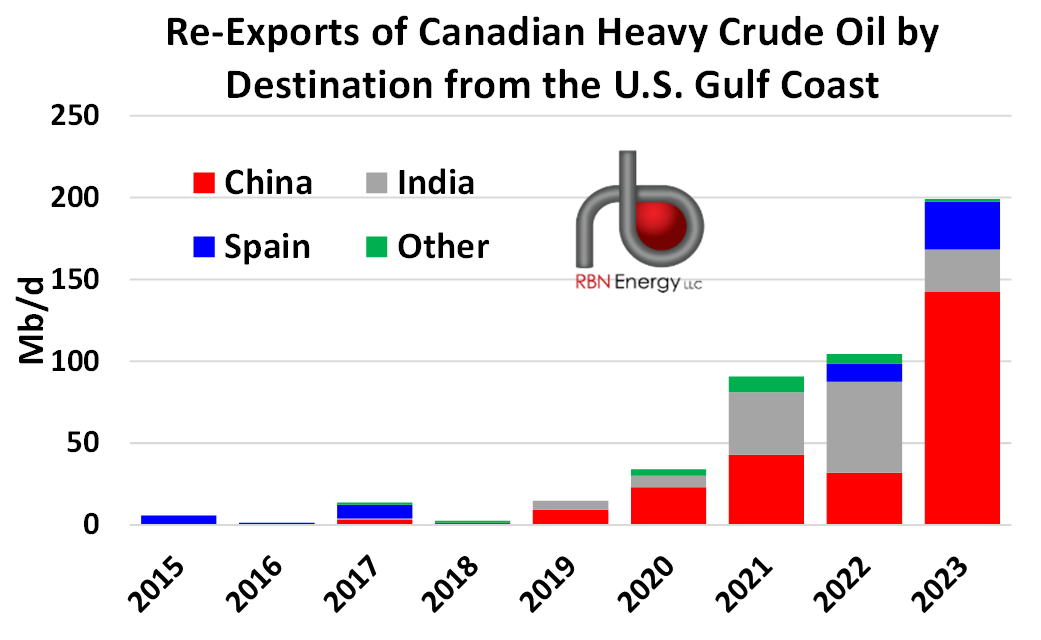
Figure 1: Re-Exports of Canadian Heavy Crude Oil by Destination from the U.S. Gulf Coast. Source: U.S. Census Bureau
About the song
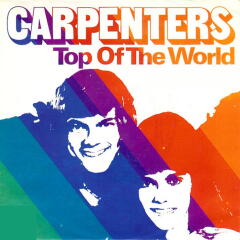
“Top of the World” was written by Richard Carpenter and John Bettis and appears as the second song on side one of the Carpenters’ fourth studio album, A Song for You. After country singer Lynn Anderson’s success with her version of the song going to #2 on the country singles charts, the Carpenters decided to re-record Karen’s vocals on their version and release it as a single in September 1973. The single went to #1 on the Billboard Hot 100 Singles chart and has been certified gold by the Recording Industry Association of America. Personnel on the record were: Karen Carpenter (lead, backing vocals), Richard Carpenter (Wurlitzer electric piano, backing vocals, orchestrations), Joe Osborn (bass), Hal Blaine (drums, percussion), Tony Peluso (electric guitar), and Buddy Emmons (pedal steel guitar).
A Song for You was recorded in early 1972 at A&M Studios in Hollywood with Jack Daugherty producing. Released in June 1972, the album went to #4 on the Billboard 200 Albums chart and has been certified 3x platinum by the RIAA. The album was conceived as a concept LP, with the Leon Russell-composed title song book ending selections comprising other love songs. Six charting singles were released from the LP. Ironically Leon Russell’s “A Song for You” was not one of them.
The Carpenters were an American pop music duo consisting of siblings Karen and Richard Carpenter. With Richard on piano and backing vocals, and Karen on drums and lead vocals, they began performing in Southern California as the Richard Carpenter Trio, then as the more pop-oriented Spectrum. Signing with A&M Records in 1969, they achieved success the following year with the two hit singles, “(They Long to Be) Close to You” and “We’ve Only Just Begun.” They released 14 studio albums, two live albums, 16 compilation albums, three soundtrack albums, and 49 singles. They have won three Grammy Awards and have a star on the Hollywood Walk of Fame. After Karen’s death in February 1983, Richard has continued as a solo artist. He has released three solo albums and four singles. He continues to record and tour and will begin a European tour in September 2024. Carpenter is an avid Mopar collector and still owns the 1970 Plymouth Barracuda with a 440 six-pack that he purchased new.