


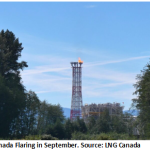
On October 18, LNG Canada posted a community notification that increased flaring at its site would begin on October 20 and run intermittently for a period of 14 to 18 days. The company stated that refrigerants from the recently docked LPG tanker (see our Analyst Insight of August 1) will be introduced into the plant’s equipment to start the cooling process. As part of this process, flaring and additional testing will take place, and we suspect that this will involve additional gas flow from the Coastal GasLink pipeline into the plant and the production of small test amounts of LNG. Although there is no way to correspond the height of the site’s flare stack to the amount of gas being taken into the plant, LNG Canada states that the flare height could reach as high as 30 meters (~100 feet). Given past testing and flaring that has taken place, we would hazard a guess that this would involve gas intake up to 50 MMcf/d for the 14 to 18 days of testing. An earlier notification of gas flaring was posted on September 20 (see our Analyst Insight of September 23) in which the company stated that it would be conducting its first test of the site’s gas turbines that run on natural gas as fuel and are used to cool other incoming natural gas into a liquid form (LNG).
Featured Articles
- Analyst Insight
LNG Canada Increasing Gas Intake as Testing Proceeds
LNG Canada is increasing its intake of natural gas as part of its extensive testing procedures. RBN expects gas intake approaching 500 MMcf/d by November and first commissioning LNG cargoes being exported before the end of this year.


- Blog
Thinking Out Loud - What Might Be the Timing and Scope of the Ramp Up of Gas into LNG Canada?
LNG Canada, under construction for nearly six years on Canada’s West Coast, is rapidly approaching the time when first gas will be entering the plant for testing and calibration of equipment, marking an important transformation for the Western Canadian natural gas market. This will kick off what will likely be about a yearlong testing process before officially entering commercial service in mid-2025. In today’s RBN blog, we consider daily gas flow data from the startup of similar-sized LNG plants on the U.S. Gulf Coast and develop a conjectural timeline for LNG Canada to help assess how much gas will flow to the site — and how soon — and when LNG exports might begin.
- Analyst Insight
Increased Flaring Once Again at LNG Canada – Is a Commissioning Export Cargo Just Around the Corner?
Increased flaring at LNG Canada once again and, presumably, much greater gas intake. Is LNG production finally taking place with the potential for a commissioning export cargo by year end or early January? Maybe.
