


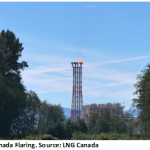
On September 20, LNG Canada reported that it will be increasing flaring at its Kitimat, BC, site as part of the process of testing natural gas intake to the plant’s gas turbines. The turbines use natural gas as a fuel to run compression and liquefaction equipment that is used to produce LNG. The company states that it will be intermittently running one gas turbine at approximately 15% of capacity for a period of up to 10 days which places the end of this particular testing phase as being on or about September 30. We estimate that total gas fuel intake to the site at full capacity would be approximately 200 MMcf/d which points to a capacity test at 15% utilizing approximately 30 MMcf/d of gas as turbine fuel. The company goes on to state that additional testing of the site’s other three turbines and compressors will be taking place in the future. As an aside, the company notes that this first test will be utilizing nitrogen as the gas to undergo liquefaction, and which becomes a liquid at temperatures (-196oC, -321oF) even colder than those required to liquefy natural gas (-162oC, -260oF).
Featured Articles
LNG Canada Notifies of Increased Flaring – Greater Volumes of Gas into the Plant?


Thinking Out Loud - What Might Be the Timing and Scope of the Ramp Up of Gas into LNG Canada?
LNG Canada, under construction for nearly six years on Canada’s West Coast, is rapidly approaching the time when first gas will be entering the plant for testing and calibration of equipment, marking an important transformation for the Western Canadian natural gas market. This will kick off what will likely be about a yearlong testing process before officially entering commercial service in mid-2025. In today’s RBN blog, we consider daily gas flow data from the startup of similar-sized LNG plants on the U.S. Gulf Coast and develop a conjectural timeline for LNG Canada to help assess how much gas will flow to the site — and how soon — and when LNG exports might begin.


Hear My Train A Comin' - The Liquefaction Train Ramp-Up Process and Timelines
The year-on-year gain in U.S. LNG feedgas demand has been the single biggest factor behind the soaring natural gas prices and storage shortfall this year. And there is more of that demand on the horizon. Cheniere Energy’s Sabine Pass Train 6 and Venture Global’s new Calcasieu Pass facility are due to start service in the first half of 2022. However, feedgas volume is likely to ramp up ahead of the new year as both projects progress through the commissioning phase and aim to export their first commissioning cargoes before the end of the year. How soon could that incremental feedgas demand show up? Getting a handle on the timing requires an understanding of how a liquefaction plant works and the various steps of the commissioning process. Today, we start a short series on what’s involved when bringing a liquefaction plant online and what that can tell us about the timing of incremental feedgas flows this fall/winter.
