


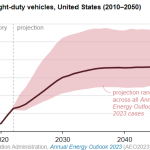
The rate of electric vehicle (EV) adoption in the U.S. will vary greatly through 2050, driven by a variety of factors including state and federal policies, government incentives and declining manufacturing costs, but will remain well short of the Biden administration’s goal to have at least half of new U.S. vehicles be electric by 2030.
Featured Articles


- Blog
(The EPA) Drives Me Crazy - New U.S. Rule on Tailpipe Emissions Conflicts With Energy Reality
The Biden administration recently announced a very ambitious — to say the least — rule on tailpipe emissions. But while the rule’s legal and political standing might be a bit uncertain — it’s seen by many as a de facto ban on conventionally fueled cars and trucks and is likely to face several court challenges — doubts also remain about whether it matches up with the realities of today’s energy world. In today’s RBN blog, we look at the new rule, what it would mean for U.S. consumers and automakers, and how it conflicts with the views of RBN’s Refined Fuels Analytics (RFA) practice on the future of global oil and refined products demand and the rate of electric vehicle (EV) adoption.


- Blog
One Shining Moment, Part 2 - Price Trends Could Pave the Way to Greater EV Adoption, or Obstruct It
Electric vehicles (EVs) in the U.S. may be at a turning point, with high gasoline prices prompting would-be car buyers to give them a second look — or a first look, in many cases. EV adoption has been slow to pick up speed in the U.S. for a variety of reasons, including the lack of a nationwide charging network and concerns about “range anxiety.” But a major factor has always been that gasoline-fueled cars have been cheaper to purchase and operate than EVs. The recent run-up in gasoline prices, amplified by Russia’s invasion of Ukraine, has changed the math in those comparisons, at least in the short-term. Is the pace of EV adoption about to accelerate, or will trends in gasoline and electric power prices put the transition into cruise control, or even neutral? In today’s RBN blog, we look at how forecasts for power and gasoline prices might shape the conversations around EVs through 2030.
- Analyst Insight
EVs, Hybrids Make up 16% of U.S. Light-Duty Vehicle Sales in Q2 2023, Driven by Surge in Luxury Market
Sales of electric vehicles, hybrids, and plug-in hybrids accounted for 16% of U.S. light-duty vehicle sales in Q2 2023, driven by gains in the luxury vehicle market as automakers also increased the number of EV models available to consumers.
