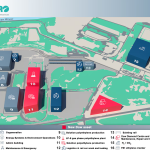
Dow said this week the previously announced delay of its Path2Zero project (see schematic below), a major expansion of its ethane cracker in Fort Saskatchewan, will last up to two years, citing an uncertain market environment.
Dow announced in late April that it was indefinitely delaying additional construction of Path2Zero. The April decision came as a surprise to Alberta’s petrochemical and energy industry and came after Dow had already spent more than US$1 billion on the project in 2024.
“The plan was to bring it up in ’27. In this market environment, that doesn’t feel like the right timing,” CEO Jim Fitterling said, according to a news report by H2 View. “We’ve announced a one-year delay. I think a one- to two-year delay timeframe is what we’re looking at.”
The company said during its Q1 earnings release in April that delaying the project would reduce its capital spending by US$1 billion this year. Dow, which announced the project in November 2023, said this week that work would continue.
“Dow is evaluating and adjusting the pace and spending of key portions of the Fort Saskatchewan Path2Zero project until market conditions improve,” Dow said in an email to RBN. “While Dow continues to finetune its plans, we are completing engineering and construction as planned on certain aspects that are already underway. We will provide an update by year-end.”
Dubbed the Path2Zero project because of its focus on creating net-zero Scope 1 and Scope 2 emissions in the production of polyethylene, the C$8.9 billion (US$6.5 billion) expansion was also seen as a major step forward in terms of creating a much larger demand outlet for ethane.
The site’s emissions reduction would be achieved in part by converting some off-gas emissions from the ethane crackers to hydrogen to power the site’s furnaces. Other carbon-based emissions would be tied into a larger carbon-capture project that is already partly operating in Alberta (see Forever and for Always). The emissions-related infrastructure is expected to cost C$2 billion to C$3 billion, bringing the all-in cost of the project to north of C$11 billion (US$8.1 billion).