


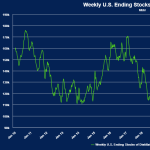
According to the EIA’s Weekly Petroleum Status Report (WPSR) released this morning, distillate inventories fell for a fourth consecutive week, dropping to just above 103 MMbbl (far right of green line in chart below), their lowest weekly level since the first week of June. Distillate stocks are on track for their lowest end-of-month level since April 2005, and this week marks the lowest inventories have been in the month of August since 1951. The latest draw was concentrated on the East Coast, where stocks have dropped to their lowest level since 2022. As discussed in the Crude Oil Billboard, refinery utilization remains near 98%, its highest level for this time of year since 1998. Refinery input was essentially flat with the prior week at 17.4 MMb/d, the highest level for this time of year since 2019. As mentioned in 'Running on Fumes', refiners are already responding aggressively to exceptionally strong margins, but elevated production has yet to translate into meaningful inventory rebuilding. That disconnect is helping keep the diesel crack near record territory. The benchmark crack climbed above $97/bbl last week, more than triple year-ago levels and within striking distance of $100/bbl. Strong exports are adding another layer of pressure, pulling incremental barrels into an already tight global distillate market rather than allowing U.S. stocks to recover.
Featured Articles
- Analyst Insight
Refinery Utilization Hits an Eight-Year High as Product Cracks Remain Strong
As discussed in this week’s Crude Billboard, the EIA’s latest Weekly Petroleum Status Report (WPSR) shows how strong refinery demand and exports can quickly tighten U.S. crude balances, even as imports rise.
- Analyst Insight
Running on Fumes: Diesel Crack Flirts With $100/bbl Milestone
The diesel crack has become a key focal point for the market. After surging more than 11% last week to $92.75/bbl, 264% above year-ago levels, it pushed to a record $99.125/bbl yesterday, bringing the $100/bbl mark within striking distance.


- Blog
Basket Case – With U.S. Refiners Already Running Hard, Relief on Diesel Remains Elusive
Today, we look at why high crack spreads don’t necessarily increase a refinery’s output, how market disruptions elsewhere can drain U.S. inventories, and the indicators that will help tell us whether the diesel squeeze is easing (or worsening).
