


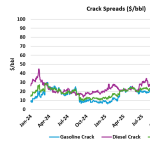
Renewed conflict in the Middle East dominated the week ended July 17, 2026, sending crude prices sharply higher as Gulf Coast crack spreads soared to record levels (yellow oval in graph below). The benchmark 3-2-1 crack spread skyrocketed above $62/bbl after reaching a record high earlier in the week, driven primarily by exceptionally strong middle distillate margins. Diesel cracks and gasoline cracks soared to their strongest level in four years, highlighting robust product demand despite the sharp increase in crude prices. Rather than eroding refining economics, higher crude prices were more than offset by stronger product values, allowing refiners to preserve historically attractive margins.
Featured Articles
- Analyst Insight
Refinery Utilization Holds Above 96% as Strong Diesel Margins Drive Throughput
The EIA’s Weekly Petroleum Status Report (WPSR) for the week ended July 17 shows that U.S. refinery crude runs eased by 58 Mb/d to just over 17 MMb/d. Utilization remained exceptionally high at 96.1%, underscoring refiners' willingness to maximize throughput as refiners sought to capitalize on historically attractive processing economics.


- Blog
Cracking the Code – What 2026’s Record Crack Spreads Tell Us About Refining Economics
Crude oil may get the headlines, but the fuels made from it have delivered some of the market’s biggest surprises of 2026. With supply disruptions, strained trade flows and compliance costs all shaping this year’s numbers, let’s look at what goes into a crack spread and what we can learn from it.


- Blog
Basket Case – The $100/bbl Diesel Crack, or How 2026 Exposed the Fragility of Global Refining
For many, 2026 will be remembered as the year that diesel cracks topped the century mark ($100/bbl) for the first time, surpassing even the post-COVID boom year of 2022. Today, we examine the various factors driving this run-up and what they reveal about the broader physical refined products market.
