


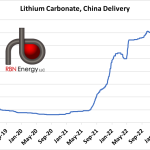
It seems that commodity markets learn the same lessons over and over again, one of which is - "The best cure for high prices is high prices" - i.e. high prices depress demand and incetivize production, eventually "fixing" the market. That dynamic is playing out in the lithium markets right now. Lithium is a key component of current battery technology, and "everyone" thought that demand would continue to rise inexorably, supporting prices. As recently as last summer, prices were nearly 400% higher than today, and 18 months ago, they were 500% higher than today. Prices for Lithium Carbonate, a key intermediate product in the manufacture of Lithium Ion batteries, are currently $15,150 per metric ton (mt), down from a high of over $70,000 per mt. (see graph below).
Featured Articles


One Shining Moment, Part 3 - As Interest in EVs Spikes, Revised Tax Credit Boosts Plans for U.S. Production
By all appearances, the momentum behind electric vehicles (EVs) has done nothing but increase over the last year, boosted by higher gasoline prices and federal legislation intended to speed the pace of EV adoption. But the transportation sector's transition to electric power and away from the internal-combustion engine (ICE) won't be easy, and may take a lot longer than many expect or hope, due in part to the significant challenges in finding the hard-to-come-by metals and other materials needed for EV production. In today’s RBN blog, we look at the continuing focus on EVs, China’s current dominance in the global market, and how the newly passed Inflation Reduction Act (IRA) is boosting plans to make EV batteries in the U.S.


Brine of the Century - Alberta Ramping Up Efforts to Produce Lithium from Oil and Gas Well Brine
Lithium is in high demand worldwide for the production of rechargeable batteries used in the rapidly expanding electric vehicle (EV) and utility-scale energy storage markets, as well as a plethora of everyday mobile devices. The problem is, there are relatively few places on the planet that offer rock formations or naturally occurring underground brine reservoirs conducive to the economic production of lithium — and even there the concentrations of lithium in the rock and brine are measured in parts per million. Now, a handful of companies in Alberta and elsewhere are exploring the potential for “direct lithium extraction” from oil and gas well brine, an alternative technique that some view as a potential breakthrough. In today’s RBN blog, we discuss the promise — and potential pitfalls — of lithium production from oil and gas brine.


Tell It Like It Is, Part 2 - Unseen Costs of the Energy Transition: Minerals and Metals
On March 24, 2022, in the wake of the still-unfolding crisis in Ukraine, “energy and climate ministers” from 40 countries convened in Paris for an International Energy Agency summit to send a “strong message of unity” regarding energy security and to issue a consensus on accelerating “clean energy transitions worldwide.” But there are already strong signals that accelerating the construction of solar and wind power systems, battery storage and electric vehicles (EVs) won’t be easy and won’t be cheap. One of the greatest challenges ahead is this: The minerals and metals that will be needed to build it all may not be available in the massive, almost unthinkable volumes that will be required. And the materials that will be available may cost a lot more — maybe even enough to force a scale-back of energy transition goals. There was already evidence of impending shortages and higher prices well before Ukraine was invaded by Russia. And the price inflation has worsened considerably since then, in part because Russia is a major supplier of many key commodities. In today’s RBN blog, we discuss the major cost challenges of pursuing the energy transition.
