
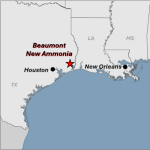
Woodside Energy has placed its Beaumont New Ammonia facility (see map below) under strategic review and is evaluating its options for the site, the company said during its H1 2026 earnings presentation on August 25.

As detailed in this week’s Hydrogen Billboard, CEO Liz Westcott said the company’s assets “must all compete for capital equally,” and that new energy opportunities must be supported by clear customer demands and commercial markets and compete for capital with other investment opportunities. 

“Beaumont New Ammonia is a high-quality asset, and it is now in operation, and it is approaching important milestones over the course of 2026. The asset, though, was acquired in a different global environment to the one we are in today,” she said. “It is important, I think, to reflect the changes that we have had in the last 12 months, and that is why we have announced the strategic review of the asset. We are going to look at all options to determine the best value option for Woodside. There is no determined pathway today.” 

Woodside acquired the project from OCI Global in August 2024 for $2.35 billion, citing expectations that global ammonia demand would double by 2050, with lower-carbon ammonia making up about two-thirds of total demand. The site was available and operating normally 92.2% of the time during Q2, following Woodside’s assumption of operational control from OCI Global at the end of Q1 2026, the company said during its quarterly earnings call in July. The site is only producing conventional (gray) ammonia currently. The start of lower-carbon ammonia production remains targeted for 2027, subject to the commissioning of Linde’s low-carbon hydrogen facilities and startup of ExxonMobil’s carbon capture and sequestration (CCS) infrastructure, including approval of the relevant CCS permitting process.

Westcott said a disciplined approach to sustainability would support Woodside’s long-term resilience and value, which includes balanced and achievable climate targets that align with the pace of the global energy transition. She said the company’s Scope 1 and 2 greenhouse gas (GHG) emissions-reduction targets remain unchanged, but that it has retired its Scope 3 targets. 

“These targets were established in a different market context and based on a different expected pace of the energy transition,” she said. “The reality is that markets for emerging lower carbon opportunities, including hydrogen, ammonia and carbon capture and storage, have developed more slowly than anticipated.”