A long-duration energy storage (LDES) project being developed in Alaska was awarded $5.5 million in federal funding this month, allowing work to begin on the project’s Phase 1. The Pumped Thermal Energy Storage in Alaska Railbelt project — referred to as POLAR — would be the largest installation of its kind in the U.S. once complete, with 1.2 GWh of storage, allowing it to discharge 50 MW continuously over 24 hours. Phase 1 of the project includes planning activities related to budgeting, permitting, procurement and early development activities.
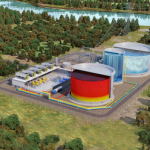
As we noted in You Light Up My Life, the estimated $330 million project moved closer to reality in the fall of 2023 when the Department of Energy offered a grant for as much as $50 million to start construction. Westinghouse intends to build the facility in Healy, AK, south of Fairbanks, at the site of a coal-fired power plant unit that will be retired. The facility would rely on heated concrete blocks (colored sections in rendering below) to store releasable energy. It would use a heat pump to draw electricity from the power grid and convert the electricity into heat stored in the concrete blocks.
The stored energy would then be converted back into electricity using a heat engine, providing a source of dispatchable backup power when demand is high or when supply is low. The project could power about 2,000 homes for a month and would pair with a wind-power development in the state's Railbelt region, as the Golden Valley Electric Association in Fairbanks is looking to add 150 MW or wind power to its system. The site would also serve as a test of how well that type of storage system would work in winter conditions. A first phase of the storage system could be built by 2028.
In September 2023, the DOE’s Office of Clean Energy Demonstrations announced up to $286 million in funding for nine projects. The projects will develop LDES systems in 17 states.